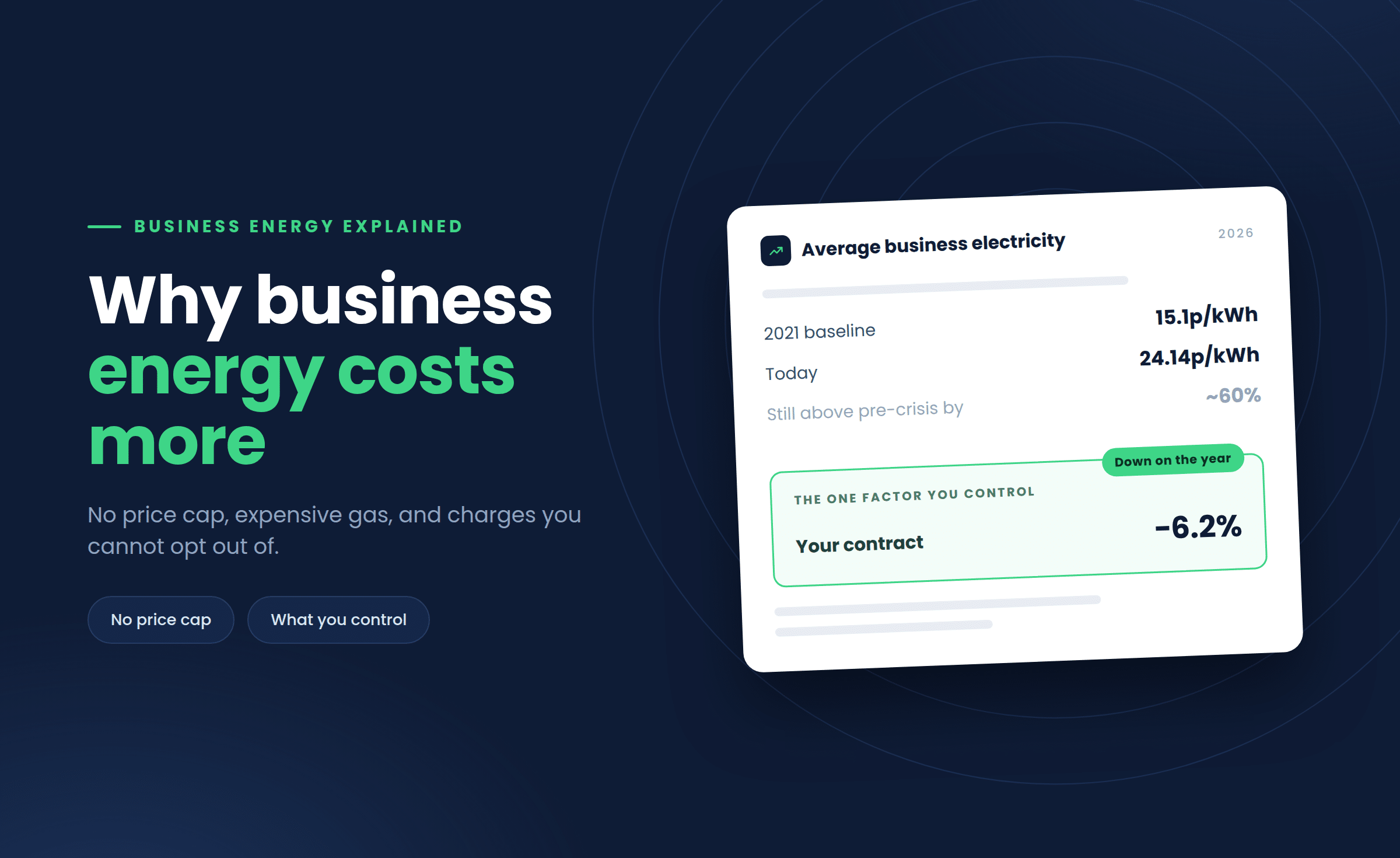

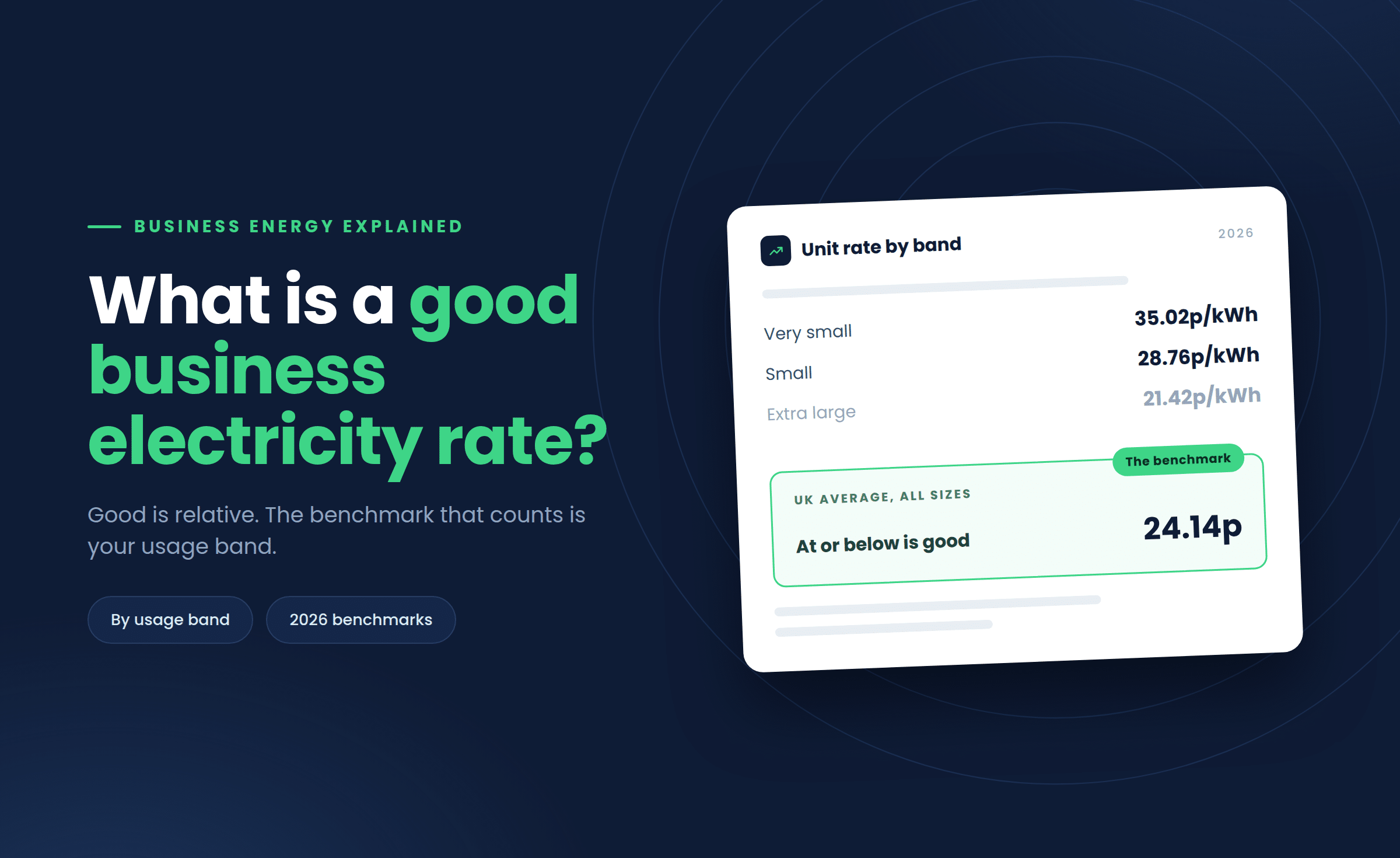
A good business electricity rate in 2026 sits close to or below the UK average of 24.14p/kWh, though what counts as competitive depends heavily on your usage band, meter type and contract length.
Ask ten brokers what counts as a good rate and you will get ten slightly different answers. That is because good is relative: a micro business on a tiny meter pays a very different baseline to a warehouse running three-phase supply around the clock.
Suppliers price by usage band, region, contract length and how your demand looks across the day. This guide sets out what good actually means by size, using the published DESNZ averages so you have a proper benchmark, and it pairs with our guide to the average business energy bill if you want the annual-cost picture too.
How do you know if your electricity rate is competitive?
Compare your pence per kWh unit rate against the average for your usage band, not the national average alone, since a small site and a large factory sit on entirely different pricing tiers.
The UK average across all business sizes is 24.14p/kWh, but that figure blends a corner shop with a distribution centre.
If your quoted rate is close to or under the average for your band, you are in reasonable shape, and if it is above by 3p or more it is worth comparing business electricity prices before you renew.
Our guide to how much business energy costs puts those unit rates in annual terms.
The standing charge trap
A low unit rate paired with an inflated standing charge can still leave you worse off. Always look at the total annual cost, not just the headline pence figure.
What rate should different business sizes expect?
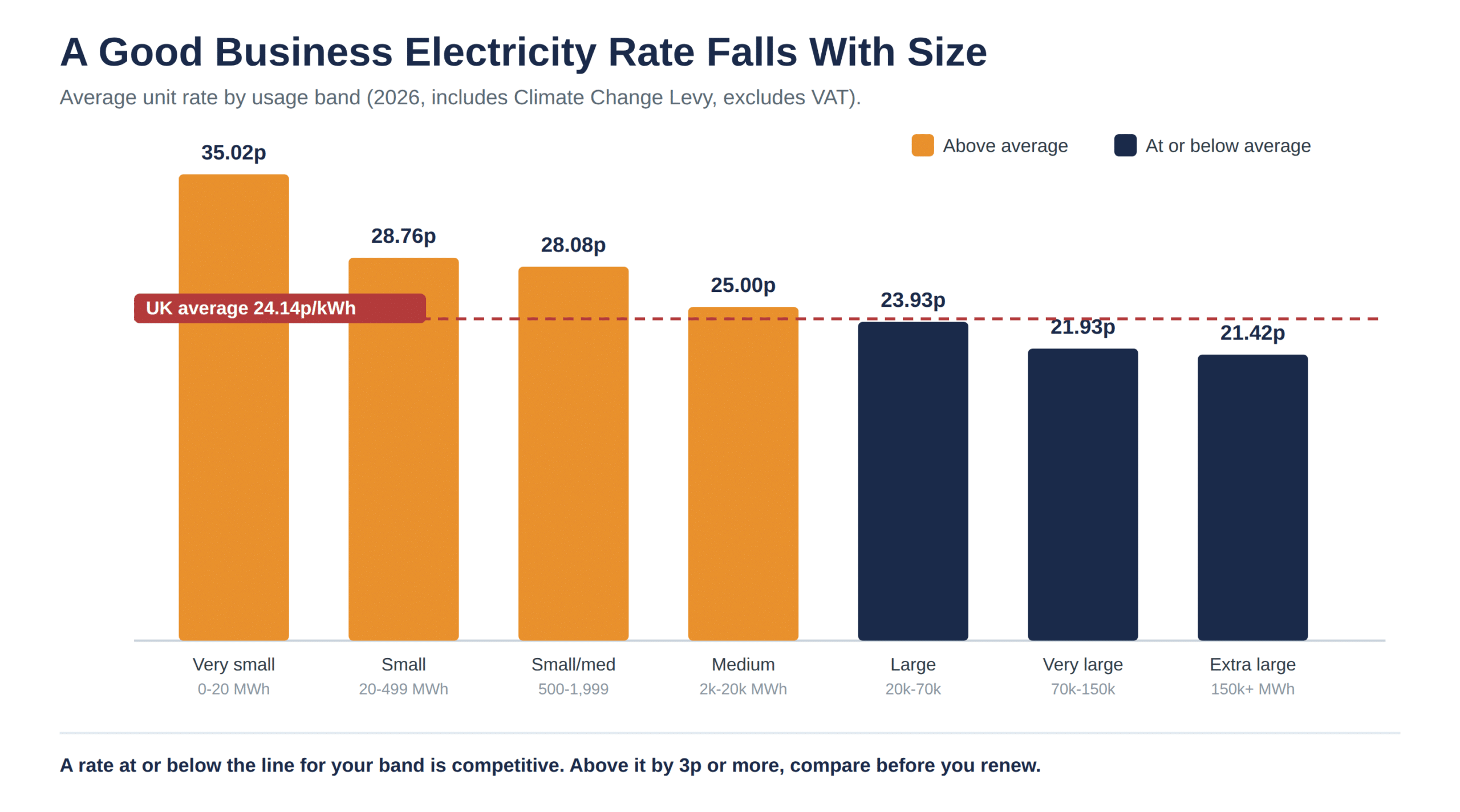
Rates fall as usage rises: a very small business should expect around 35.02p/kWh, while a large site can expect closer to 23.93p/kWh, on current averages to Q1 2026.
Average unit rate by usage band
The table below breaks it down by band. These are UK averages including the Climate Change Levy and excluding VAT, drawn from DESNZ price data, so treat them as a benchmark rather than a guaranteed quote.
| Business size | Annual usage | Average rate (p/kWh) |
|---|---|---|
| Very small | 0 to 20 MWh | 35.02p |
| Small | 20 to 499 MWh | 28.76p |
| Small / medium | 500 to 1,999 MWh | 28.08p |
| Medium | 2,000 to 19,999 MWh | 25.00p |
| Large | 20,000 to 69,999 MWh | 23.93p |
| Very large | 70,000 to 150,000 MWh | 21.93p |
| Extra large | Over 150,000 MWh | 21.42p |
Larger sites benefit from economies of scale and often move onto half-hourly settlement, which gives suppliers a clearer risk picture and usually a sharper price. Smaller sites pay more per unit because fixed costs are spread across less consumption.
Where the best available rates sit today
The sharpest 2026 fixed deals we have seen start from around 26p/kWh on a two-year fix, though your own figure depends on region, standing charge and when you lock in.
- A two-year fix tends to offer the most competitive headline rate.
- Region matters because distribution network charges differ by area.
- Meter type (standard, half-hourly or smart) also shapes what suppliers quote.
What pushes your unit rate up or down?
Your rate is driven mainly by usage volume, region, contract length, meter type and how close you are to contract end, with businesses that let deals lapse typically paying the most.
The main levers on your rate
- Usage volume: higher consumption usually earns a lower unit rate.
- Region: network charges set by Ofgem’s price controls vary by distribution area.
- Contract length: longer fixes lock in a rate but can miss a fall in wholesale prices.
- Meter type: half-hourly meters give suppliers better data and sometimes sharper pricing.
- Timing: out-of-contract deemed rates run 40% to 80% higher than a negotiated deal.
Wider market conditions matter too. UK business electricity is down a little year on year, yet still around 60% higher than five years ago, so good today looks different from good in 2021, as our guide to why business energy prices are so high explains.
Fixed or variable: which gives a better rate?
Fixed contracts almost always carry a lower headline rate than variable or deemed tariffs, because suppliers price in the certainty of a locked-in term.
Variable rates track the wholesale market and can fall when prices drop, but they can also spike without warning. Most business energy managers we speak to prefer the predictability of a fix, especially for budgeting.
| Contract type | Headline rate | Certainty |
|---|---|---|
| Fixed | Lowest, locked for the term | High, set for the whole contract |
| Variable | Tracks wholesale, can fall or spike | Low, changes month to month |
| Deemed | Highest, no discount applied | None, and no fixed end date |
When a deemed rate catches you out
A deemed contract, the default you are placed on if you move premises without agreeing a deal, is almost never competitive. If you have taken on a new site, sort out a change of tenancy energy contract as early as you can.
How do you get a genuinely competitive quote?
Compare quotes from a panel of suppliers using a recent bill, rather than accepting your existing supplier’s renewal letter, since renewal rates are rarely their sharpest offer.
Have your MPAN number, current usage in kWh and your latest bill ready before you start. That lets a broker or comparison site match you to the correct usage band straight away, rather than guessing.
What to have ready
- Your MPAN number (on your bill, or via ECOES).
- Annual usage in kWh, or your AQ if you are on half-hourly settlement.
- Your current contract end date.
- A recent bill from your existing supplier.
Utility Saving Expert compares a panel of 30+ trusted business energy suppliers, including names like British Gas Business, E.ON Next Business and Octopus Business, and has helped UK businesses save an average of £1,952 when switching.
What happens if you do not check your rate?
You will almost certainly end up on a supplier’s default or deemed rate, which is typically 40% to 80% above a negotiated contract and has no fixed end date.
How a good deal drifts
Energy contracts do not renew themselves in your favour. Left unchecked, a deal that started competitive two years ago can drift well above the current average for your band.
Set a reminder around your business energy renewal date, ideally three to six months out, so you have time to compare rather than being forced onto whatever your incumbent offers.
A business switch takes about 4 to 6 weeks from signing to go-live, so there is no reason to wait until a deal has lapsed onto a deemed rate. It is also worth checking Ofgem’s business energy advice on your rights before you sign.