


Yes. A valid commercial EPC is a legal requirement whenever a non-domestic building is constructed, sold or let, and it needs to be in place before the property goes to market, not arranged after a tenant is found.
Anyone letting or selling a commercial unit runs into the EPC requirement fairly early, usually when an agent asks for one before listing. It catches out landlords who have not dealt with commercial premises before.
The rules are similar in spirit to the residential version most people know, but the detail differs enough that assuming domestic knowledge transfers across is a mistake.
There is also a second, more consequential layer behind the certificate: the Minimum Energy Efficiency Standards, which can stop a landlord letting a building at all if the rating falls too low.
What is a commercial EPC and what does it actually show?
A commercial EPC is an energy performance certificate rating a non-domestic building from A to G, based on its fabric, heating and lighting systems rather than how the current occupier actually uses it.
What the certificate contains
It shows a rated energy efficiency band, an indicative annual energy cost, and recommendations for improving the score. It is assessed by an accredited non-domestic energy assessor, not a general surveyor, and our guide to how to read a business energy bill covers the running costs behind it.
- A rating band: from A, most efficient, to G, least efficient.
- An indicative cost: estimated annual energy cost for a standardised pattern of use.
- Recommendations: improvements ranked by likely impact.
When exactly is a commercial EPC legally required?
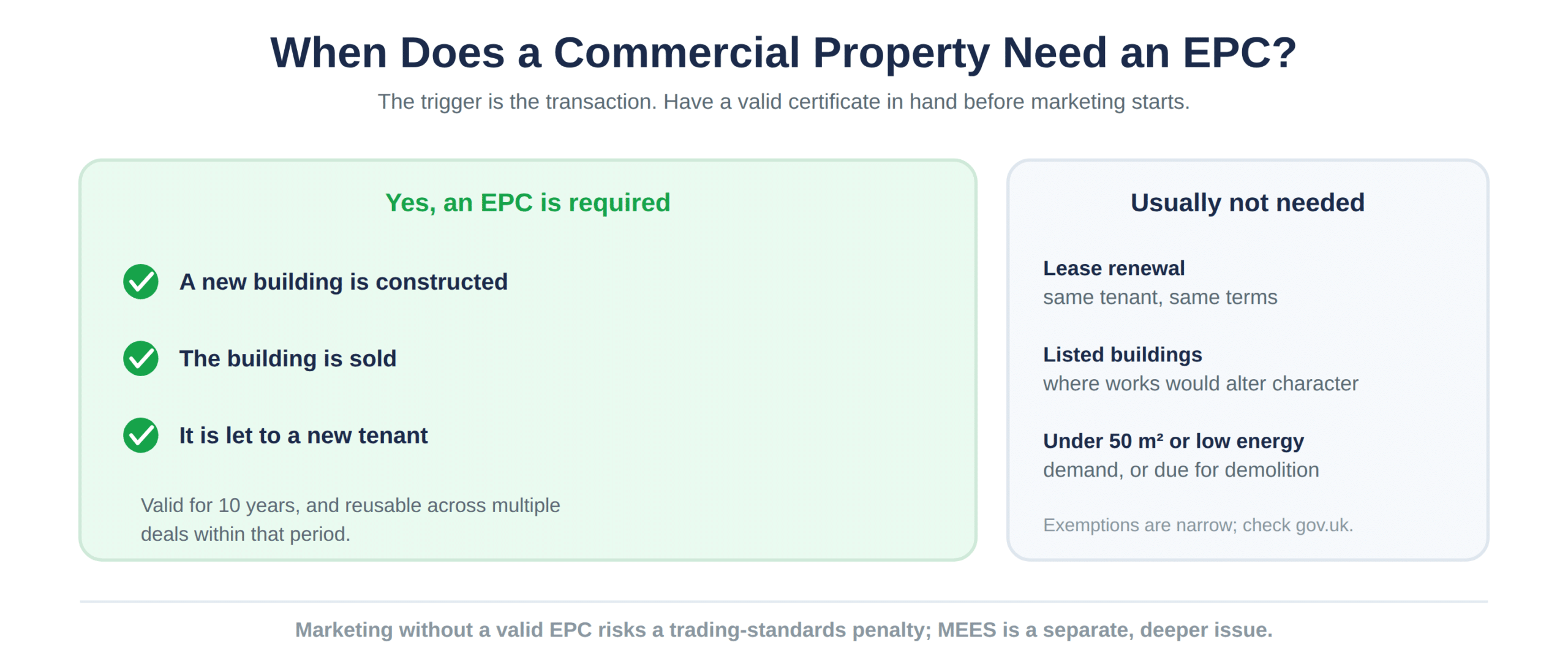
A valid EPC is required whenever a non-domestic building is constructed, sold, or let to a new tenant, and it should be commissioned before the property is marketed.
Buildings that are usually exempt
| Trigger event | EPC required? | What to check |
|---|---|---|
| New building constructed | Yes | Needed before it is first let or occupied |
| Building sold | Yes | In hand before marketing, not once a buyer is found |
| New letting to a new tenant | Yes | Agent should have it before the first viewing |
| Lease renewal, same tenant and terms | No, if a valid EPC exists | The trigger is the transaction itself |
| Listed building, works would alter character | Usually exempt | Confirm on gov.uk for your building |
Some categories are exempt, including certain listed buildings, places of worship, buildings under 50 m2, low-energy-demand industrial sites, and buildings due for demolition. The list is narrow, so check gov.uk EPC guidance rather than assuming one applies.
Who is responsible for arranging the EPC, landlord or seller?
The person marketing the property is responsible: typically the landlord when letting, or the seller when disposing of a freehold or long leasehold interest.
How it works in practice
Most landlords and sellers commission the EPC through a letting or selling agent, who arranges an accredited assessor to visit. The cost is usually a few hundred pounds depending on the size and complexity of the property.
Tenants renewing on the same terms generally do not need to commission a new certificate, but they should still check the existing rating, particularly if MEES compliance is in question.
How long does a commercial EPC stay valid?
A commercial EPC is valid for 10 years from the date of assessment, regardless of how many times the building is let or sold within that period.
When a new EPC is worth getting early
A single certificate can support multiple transactions across a decade, provided nothing material changes about the building’s fabric or systems. Check the assessment date on any EPC you are handed rather than assuming it is current.
If major works have been carried out, such as replacing the heating system or improving insulation, it is worth commissioning a fresh assessment even before the old one expires. A better rating can support a stronger asking rent or price.
What happens if you sell or let without a valid EPC in place?
Marketing or completing a sale or letting without a valid EPC breaches the regulations and can result in a financial penalty from trading standards, separate from any MEES issue.
Two separate rule sets
Enforcement sits with local trading standards teams. The deeper risk is letting below the minimum lawful rating under MEES, where penalties are tiered by rateable value up to £150,000 per property, as gov.uk’s MEES guidance sets out.
Our guide to the minimum EPC rating for commercial property covers that separate, and generally more serious, issue. Commission the assessment early, and treat a poor rating as a business problem rather than a box-ticking exercise.