

The current minimum EPC rating for commercial property in England and Wales is band E. Letting a building rated F or G is generally unlawful under the MEES Regulations 2015 unless a valid exemption is registered.
Landlords renewing a commercial lease or bringing a unit to market often assume any valid EPC is enough. It is not, because the rating itself has to clear a legal minimum before the letting can go ahead lawfully.
The Minimum Energy Efficiency Standards sit behind the certificate, and they have become one of the more consequential pieces of compliance in commercial property. This guide covers the standard, exemptions, and how it links to a commercial EPC.
Get this wrong and the consequences go beyond a compliance headache. A sub-standard rating without an exemption can block a letting, complicate a sale, and draw enforcement attention.
What are the MEES regulations and why do they exist?
The Minimum Energy Efficiency Standards, introduced under the Energy Efficiency (Private Rented Property) (England and Wales) Regulations 2015, set a minimum EPC band that rented buildings must meet before they can lawfully be let.
The problem MEES was built to fix
The regulations were designed to push landlords toward improving the least efficient stock in the private rented sector, rather than leaving tenants to absorb high running costs in poorly performing buildings.
Scotland runs its own separate energy efficiency regime for non-domestic buildings, so landlords with property north of the border should check the relevant Scottish guidance rather than assuming the England and Wales rules apply.
What EPC rating do you need to let a commercial property?
Under current MEES rules, it is generally unlawful to let or continue letting a commercial property with an EPC rating below E, unless a valid exemption has been registered.
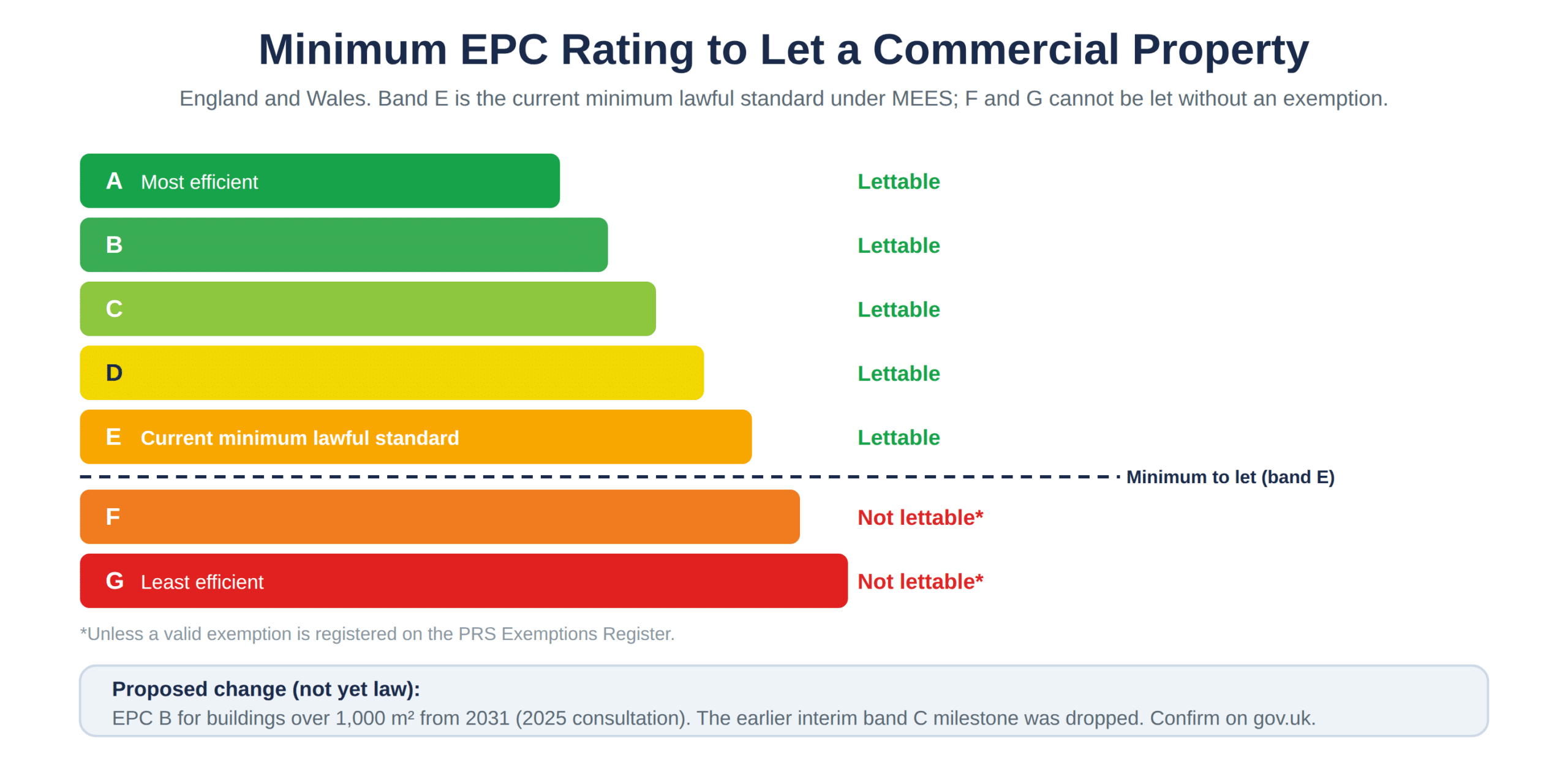
Which bands can and cannot be let
| EPC band | Currently lettable? |
|---|---|
| A | Yes |
| B | Yes |
| C | Yes |
| D | Yes |
| E | Yes, at the current minimum standard |
| F | No, unless a valid exemption is registered |
| G | No, unless a valid exemption is registered |
The rule applies to new lettings and, since April 2023, to continuing an existing lease on a sub-standard building. Check the property’s current, valid EPC before agreeing terms, alongside your business electricity running costs.
What counts as a valid exemption from MEES?
A landlord can register an exemption on the PRS Exemptions Register in specific circumstances, such as where required improvements would devalue the property or a third party refuses consent.
The grounds landlords can rely on
- All improvements made: relevant works are done and the rating still falls below E.
- Devaluation: a required improvement would cut market value by more than a set threshold.
- Consent refused: a tenant, lender or planning authority withholds needed consent.
- Recently acquired: a temporary exemption applies while improvements are arranged.
Exemptions last for a set period and need renewing, so a landlord cannot register one and consider the matter closed. Check gov.uk’s MEES exemptions guidance for the current grounds and evidence rules, since the specifics matter for a valid registration.
The register is public, so a prospective tenant, buyer or lender can check whether an exemption is genuinely in place. An unregistered exemption offers no protection: the registration itself is what makes the position lawful.
Could the minimum commercial EPC standard rise in future?
The Government has proposed raising the minimum standard for larger commercial buildings to EPC B from 2031, but this is still a consultation proposal, not settled law, and would need secondary legislation to take effect.
What the 2025 consultation actually proposed
The 2025 consultation set out a phased tightening for privately rented non-domestic buildings, with EPC B proposed for buildings over 1,000 m2 from 2031, as the government consultation describes. The earlier interim band C milestone floated in older proposals has been dropped.
Because none of this is law yet, treat the 2031 date as a direction of travel rather than a fixed deadline. Landlords planning long-term lease strategies should build in headroom above band E rather than sit exactly on it.
Residential MEES sits on a separate track with its own proposed targets, so do not assume a date quoted for homes applies to a commercial let. Always check current gov.uk guidance before relying on any specific future deadline.
What happens if you let a sub-standard property without an exemption?
Letting or continuing to let a commercial property below band E without a registered exemption breaches MEES, and enforcement authorities can issue a compliance notice followed by a financial penalty.
How penalties are set
Penalties for non-domestic breaches are tiered by the property’s rateable value and the length of the breach, up to a maximum of £150,000 per property, as gov.uk’s MEES landlord guidance sets out.
Enforcement sits with local trading standards teams, who can also publish details of a breach on the register. A published penalty can damage a landlord’s standing with future tenants and agents.
Beyond the direct penalty, a sub-standard rating without an exemption can complicate a sale, refinancing, or a tenant’s own due diligence. It is rarely just a compliance footnote.
How do you improve a property’s EPC rating before renewing a lease?
Start with a professional assessment of what is pulling the rating down, then prioritise the improvements with the best ratio of cost to rating impact, such as lighting, insulation and heating controls.
Common quick wins
- LED lighting: replace older fittings and add better controls.
- Insulation: improve loft, cavity or roof insulation where accessible.
- Heating controls: upgrade or better control heating and ventilation systems.
- Draught-proofing: seal doors, windows and loading bay openings.
A business energy audit is a useful starting point before committing to specific works, since it identifies where the biggest gains are likely to come from on that particular building.
Plan improvements against the lease calendar, not the deadline. Works are easier and cheaper to schedule during a void period or a fit-out than mid-tenancy, so a landlord who acts early tends to spend less and avoid a scramble.