

Most churches and places of worship overpay because they heat large, poorly insulated buildings for a handful of hours a week, on a business energy contract that was never checked against the panel, and often without claiming the VAT relief they are entitled to.
A parish church heated for a Sunday service, a midweek group and the occasional funeral is, from an energy view, an enormous volume of air warmed for a tiny fraction of the week. Stone walls, high ceilings and single glazing make that worse, not better.
Most congregations do not run the building as a business, yet the bill still arrives treated as a commercial supply. That mismatch, a domestic-style usage pattern billed at commercial rates, is where a lot of the problem sits.
Add a Victorian boiler, an inherited supplier nobody chose, and uncertainty about VAT relief, and it is easy to see why so many overpay. The picture overlaps closely with how charities get cheaper energy.
This guide covers where church energy costs go, the VAT and CCL relief most congregations can claim but do not, and the fixes worth prioritising given limited budgets.
Why do churches and places of worship use so much energy?
Heating dominates because these buildings combine high ceilings, large uninsulated surfaces and irregular occupancy, so the building is either being heated from cold for a service or sitting cold and unused, with little steady-state efficiency between.
The seasonal spike that catches treasurers out
A typical parish church might be in meaningful use for six to ten hours a week. Heating a stone building of that volume from cold each time is far less efficient than a steady background temperature, but few can justify running that continuously.
- Worship space heating: the largest single cost, driven by volume and occupancy.
- Church hall: a separate heating and lighting load, often underused overnight.
- Vestry, office, kitchen: smaller but continuous, especially fridges and water heaters.
- Older lighting: halogen and incandescent fittings in high, hard-to-reach spaces.
Winter services, funerals and the run-up to Christmas concentrate heavy demand into a few months. A church budgeting on an annual average can be caught out when a single winter quarter lands far higher than expected, and Ofgem guidance on back-billing is worth knowing if a corrected bill ever arrives late.
Can churches claim VAT relief on energy bills?
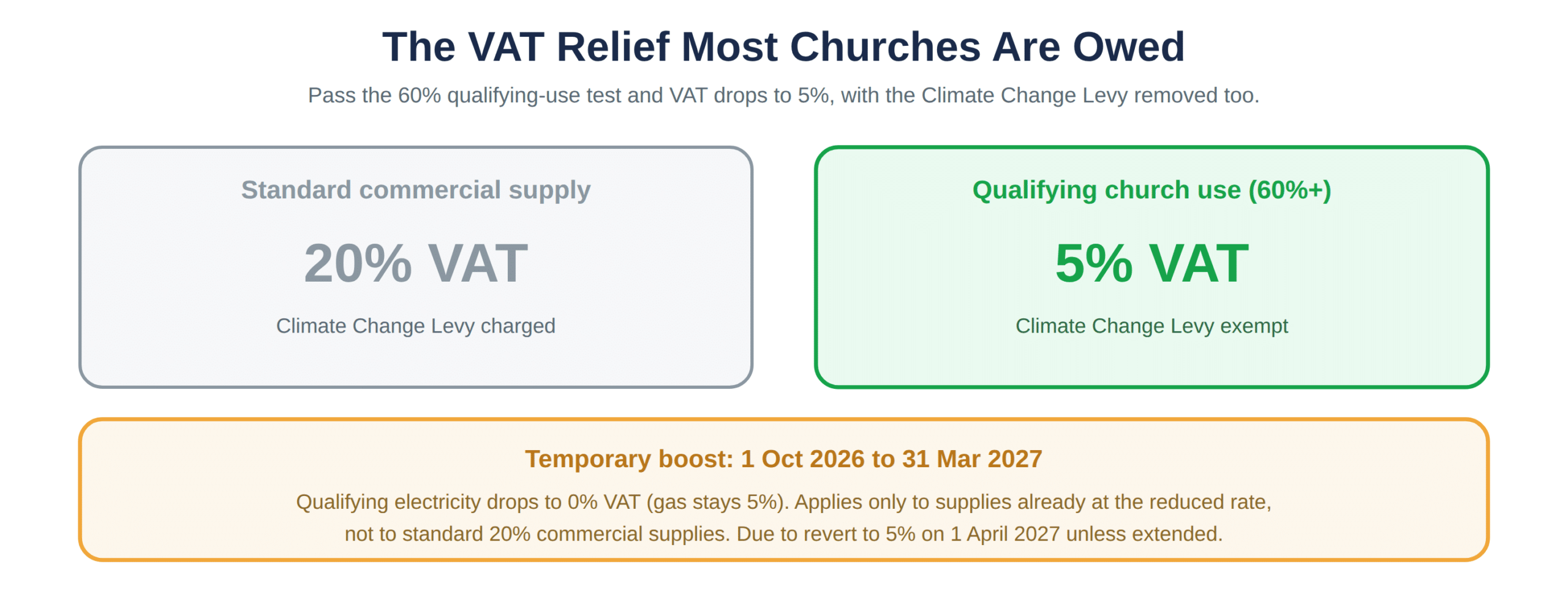
Yes. Where 60% or more of a church’s energy supply is used for non-business or qualifying charitable activities, VAT is charged at the reduced 5% rate instead of 20%, and the same supply is also exempt from the Climate Change Levy.
The temporary zero rate from october 2026
This relief, set out in HMRC VAT Notice 701/19, applies to registered charities and buildings used mainly for worship and charitable activity. Many qualify without realising, because nobody flagged it.
From 1 October 2026 to 31 March 2027, VAT on qualifying electricity drops to 0% instead of 5%, using the same 60% test. Gas stays at the reduced 5% for qualifying use, so it is electricity only, and the rate is due to revert to 5% on 1 April 2027 unless extended.
Importantly, this 0% applies only to supplies that already qualify for the reduced 5% rate. It does not turn a standard 20% commercial supply into a zero-rated one.
| Supply | VAT rate | CCL |
|---|---|---|
| Standard commercial use | 20% | Charged |
| Qualifying church use (60%+) | 5% | Exempt |
| Qualifying electricity, Oct 2026-Mar 2027 | 0% | Exempt |
| Qualifying gas, same window | 5% | Exempt |
How do you get the VAT declaration right?
Complete your supplier’s charity or reduced-rate VAT declaration form, confirming what percentage of the building’s use is qualifying, and review it every time you change supplier since it does not always transfer automatically.
What to check and keep
Get this wrong or skip it and you pay full VAT and CCL on a bill that should carry neither at that rate. Many churches also count as microbusinesses, bringing extra micro business energy protections under the Retail Energy Code.
- Check the 60% test: is most of the building’s use non-business or charitable?
- Complete the form: do not assume it carries over on a switch.
- Confirm both reliefs: VAT and CCL are linked but separate line items.
- Keep usage records: if the building also hosts paid lettings or hire.
Our guide to VAT on business energy bills walks through the declaration and what counts as qualifying use.
What reduces heating costs in an old building?
Zoned or localised heating, timed to switch on only ahead of scheduled use, saves more in most churches than any single equipment upgrade, because it stops the building being heated for hours nobody is inside it.
Listed building constraints
Pew heaters or localised radiant heating around occupied areas can cut costs sharply compared with warming the entire nave. Timers that pre-warm an hour or two before a service, rather than heating continuously, avoid paying for warmth nobody uses.
- Zone the heat: rather than warming the whole worship space uniformly.
- Time it: pre-warm before services, do not run continuously.
- Draught-proof: doors, porches and windows where listed status allows.
- LED where possible: switch remaining halogen fittings within existing fixtures.
A large share of UK places of worship are listed, limiting physical changes without consent. Heating controls, LED retrofits and draught-proofing that does not alter the fabric are usually achievable, but check with your diocesan advisory committee first.
Should a church switch supplier or renegotiate its current deal?
Comparing against the wider market before renewal is almost always worthwhile, because many places of worship have sat with the same supplier for years without checking whether the rate, and the VAT treatment, are still correct.
Making it manageable for a volunteer treasurer
Treasurers managing finances on a volunteer basis rarely have time to run a full comparison yearly, which is how contracts drift onto out-of-contract rates that run 40% to 80% above a negotiated deal, as our guide to business energy renewals explains.
A letter of authority lets a comparison service handle the switch on the church’s behalf, often the practical answer for a committee with limited admin capacity. Solar can help too, and our commercial solar guide covers low, irregular electricity use.