
For most businesses with parking, staff or a vehicle fleet, installing workplace EV charging is worth it. Grants like the Workplace Charging Scheme reduce the setup cost, and pairing charge points with commercial solar can cut the running cost much further.
Electric vehicles have stopped being a niche consideration for UK fleets and staff parking. Charge points have shifted from a nice-to-have to something clients, staff and tenants increasingly expect.
The real question is not whether EVs are coming, but whether you install infrastructure now while grants are available, or wait and pay full price later once demand has built up regardless.
Cost, DNO capacity, and how the charging load interacts with your supply all need working through first. It pairs naturally with commercial solar, which cuts the running cost of every charge.
This guide covers the benefits, the charger types, the Workplace Charging Scheme grant, and how EV charging works alongside solar on the same site.
What are the benefits of workplace EV charging?
Workplace charging supports staff and fleet vehicles switching to electric, can generate a modest revenue stream from visitor charging, and increasingly features in staff retention and tenant attraction.
Where the value shows up
For fleet operators, charging on site during the day is usually cheaper per mile than public rapid chargers, especially paired with a competitive business electricity rate or on-site solar.
Landlords and business parks increasingly find charge points a genuine differentiator when attracting tenants, in the same way secure parking or good broadband already are. It is becoming an expectation rather than a perk.
- Lower fleet cost: cheaper per mile than public rapid charging.
- Staff support: helps staff move to electric company or personal cars.
- Revenue option: metered and monetised for visitors or the public.
- ESG and appeal: strengthens credentials and tenant or client draw.
What types of business EV charge points are available?
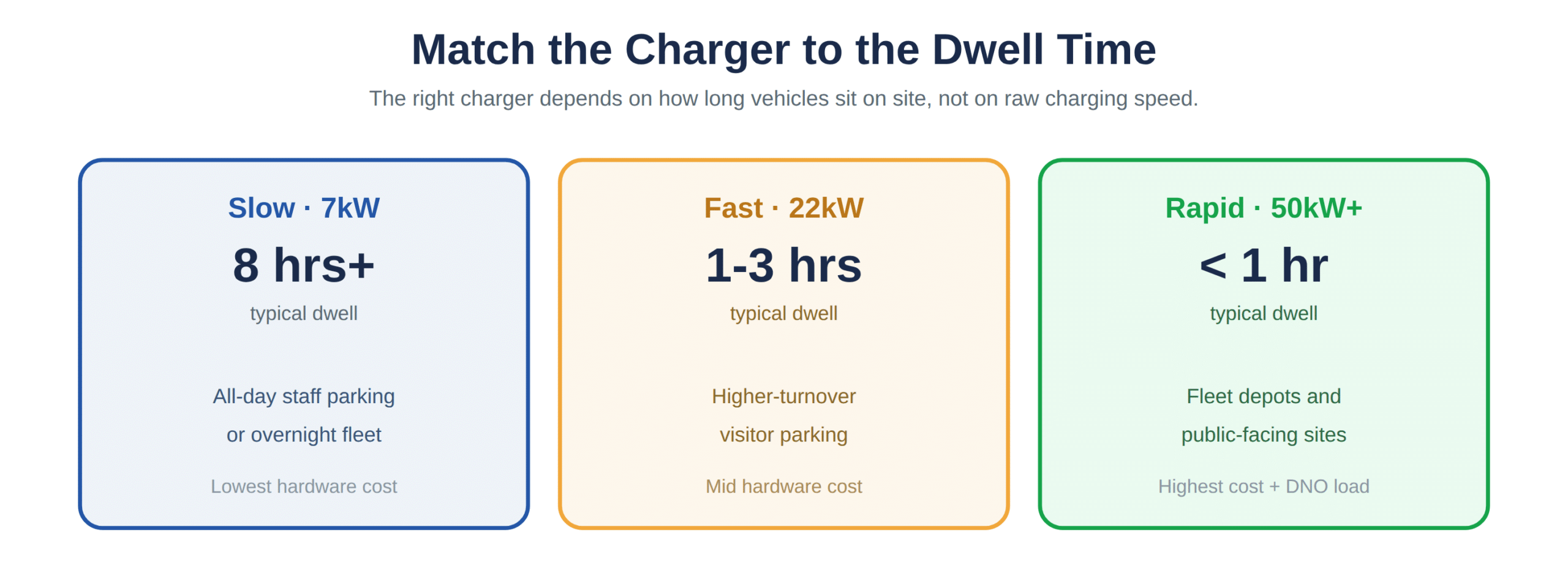
Business chargers range from slow 7kW units for overnight or all-day staff parking, through fast 22kW chargers for higher turnover, up to rapid units for fleet depots or public-facing sites.
Dwell time matters more than speed
A staff car park where vehicles sit for eight hours barely needs anything faster than 7kW, while a depot turning vehicles around quickly needs genuine rapid charging. Match hardware to dwell time.
| Charger type | Power | Best suited to |
|---|---|---|
| Slow | 7kW | All-day staff or overnight parking |
| Fast | 22kW | Higher-turnover visitor parking |
| Rapid / ultra-rapid | 50kW+ | Fleet depots and public-facing sites |
- Dwell time: how long vehicles typically stay on site.
- Load management: whether you need it across multiple charge points.
- Who charges: visitors and public, or staff and fleet only.
How does the workplace charging scheme (OZEV) grant work?
The Workplace Charging Scheme, run by the Office for Zero Emission Vehicles, offers eligible businesses a contribution towards installing EV charge points, up to a capped number of sockets per applicant.
Eligibility and keeping up with changes
Eligibility generally requires off-street parking, a genuine business need, and an OZEV-approved installer. Check the current Workplace Charging Scheme grant amount and criteria before budgeting, since the details shift between funding rounds.
Solar and EV grants are sometimes combined by installers into one project quote, since much of the site survey and DNO work overlaps. The wider low-emission vehicle grants collection lists what is currently open.
Do you need a DNO application to install EV charge points?
Yes, in most cases. Multiple chargers, or anything beyond a single low-power unit, usually needs notification or a formal application to your local Distribution Network Operator before installation.
How the DNO assesses your site
Your DNO assesses whether the existing connection can handle the extra demand or whether reinforcement is needed first. This is exactly where EV charging and solar planning collide on a combined project.
- Single low-power charger: often a simple notification.
- Multiple or higher-power units: usually a formal DNO application.
- Combined with solar export: connection and export assessed together.
Can EV charging be paired with commercial solar?
Yes, and it is an increasingly common pairing. Solar generation during daylight lines up well with staff and visitor dwell times, letting a business charge vehicles largely from its own generation rather than the grid.
How solar and storage smooth the load
Battery storage smooths the mismatch further, storing surplus output for when vehicles arrive or generation dips. Our guide to financing commercial solar covers the funding routes installers extend to cover charging hardware too.
A combined project improves the overall payback, since both systems reduce what you would otherwise buy at the standard rate, which is central to whether solar is worth it for your site.
What should you check before choosing an EV charging installer?
Confirm the installer is OZEV-approved if claiming the grant, check they have handled the DNO process before, and ask for references from similar commercial sites rather than domestic installs alone.
Why commercial experience matters
Business charge points involve more complex load management, back-office billing for visitor charging, and network integration than a single domestic driveway charger, so commercial-specific experience matters.
Get a written breakdown of what is included: hardware, installation, any groundworks, DNO fees, and ongoing maintenance or software subscription costs for managing the network.
Get your DNO position checked early whichever route you take. Capacity constraints are the most common reason a well-planned EV charging project gets delayed, and they are far cheaper to design around than to discover late.