
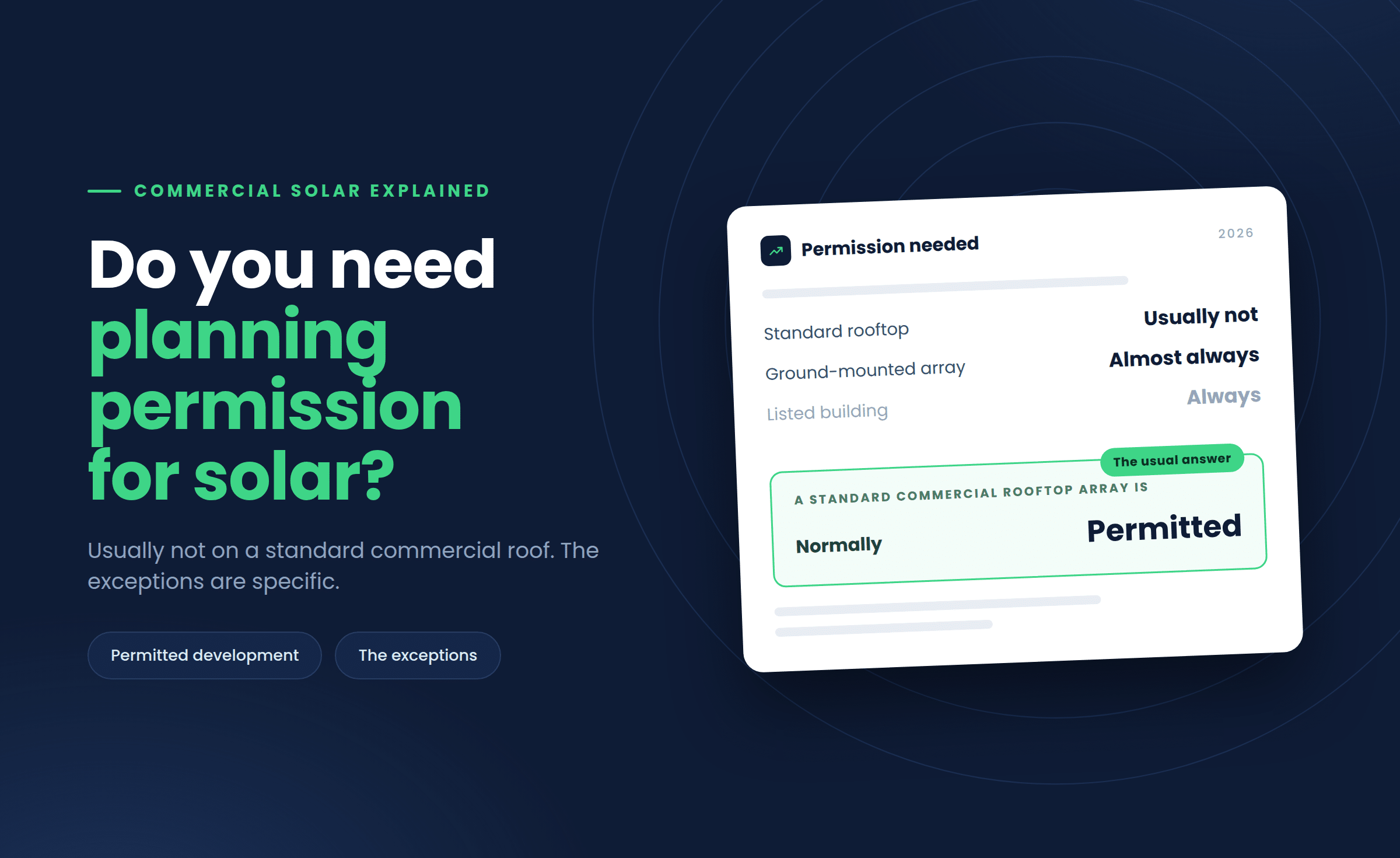
Usually not. Most commercial rooftop solar falls under permitted development and can go ahead without a planning application, but listed buildings, conservation areas, and ground-mounted or particularly large arrays generally need formal permission.
Many business owners assume solar panels need council sign-off, the way an extension or a shopfront change would. For a standard rooftop system, that is usually not the case.
Permitted development rights exist so a simple renewable install does not sit in a planning queue for months. But the exceptions catch out plenty of businesses, which is why they matter before you weigh whether solar is worth it.
Where your business sits, what building it occupies, and how big the array is all change the answer. A flat-roofed distribution unit is a very different case to a Georgian building on the high street.
This guide covers when commercial solar counts as permitted development, which sites need full permission regardless, and what happens if you install first and ask questions later.
When does commercial solar count as permitted development?
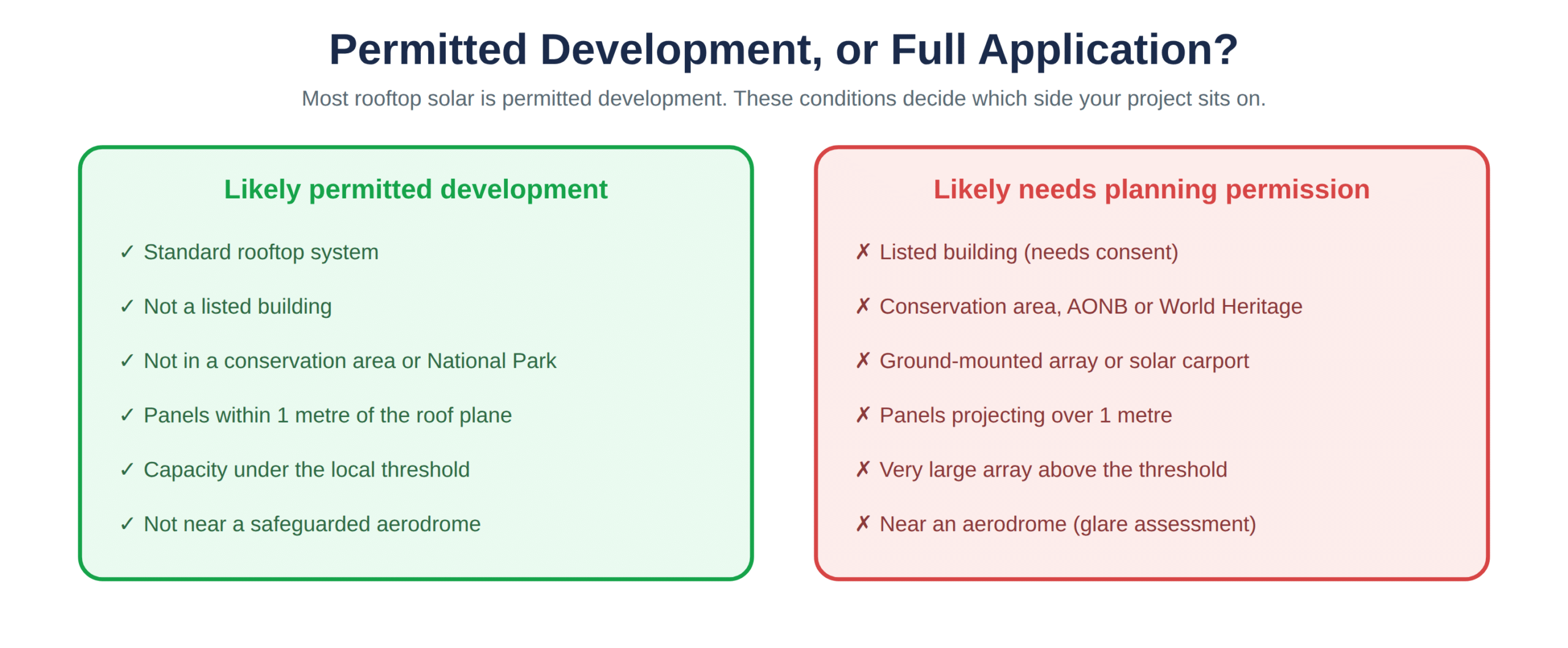
A standard rooftop installation on a commercial building generally counts as permitted development across the UK, meaning it can be installed without a specific planning application, subject to a set of size and position conditions.
The conditions that apply
It applies under the permitted development rules for non-domestic microgeneration, covering offices, shops, warehouses, factories and agricultural buildings. The Planning Portal sets out the current conditions.
- Minimal visual impact: panels sited to limit their effect on the building’s appearance.
- Within the roof plane: not protruding significantly above a pitched roof.
- Removed when redundant: taken down if no longer used for microgeneration.
Which buildings and locations need planning permission?
Listed buildings always need planning permission for solar, and buildings within a conservation area, an Area of Outstanding Natural Beauty, a National Park or a World Heritage Site often need it too, even for a standard rooftop system.
Where the rules get stricter
The rules get stricter the more protected the site or its surroundings are. A shop in a conservation area high street is treated very differently from an identical shop on a modern retail park, as Historic England guidance explains.
Safeguarded aerodrome land near airports and certain scheduled monuments also carry extra restrictions, since panel glare and reflection can be a genuine safety consideration near flight paths.
| Site type | Usual planning position |
|---|---|
| Flat or pitched roof, unprotected site | Permitted development |
| Listed building | Listed building consent required |
| Conservation area or National Park | Usually needs permission |
| Ground-mounted array or carport | Full permission required |
| Very large rooftop array | May exceed the threshold |
What size limits apply to permitted development solar arrays?
For non-domestic buildings, permitted development typically allows rooftop solar as long as panels do not extend more than 1 metre beyond the roof plane, and total installed capacity across the site sits under a defined threshold before a full application is triggered.
A quick self-check before you assume
Larger commercial roofs, such as distribution centres or manufacturing plants, can exceed the standard thresholds simply because there is so much roof space to fill. A call to the local planning authority settles it.
- Listed or protected? listed, conservation area, National Park or AONB.
- Near an aerodrome? within a few kilometres of a flight path.
- Projecting far? any panel more than 1 metre from the roof surface.
- Ground-mounted? not a rooftop system at all.
A larger array that pushes past permitted development limits often needs a different finance structure too, so read our solar finance guide in parallel.
Do you need planning permission for a ground-mounted array?
Yes, in most cases. Ground-mounted commercial solar, such as a solar carport or a field-based array, is treated as a change of land use and almost always needs full planning permission.
Why ground-mount is treated differently
This surprises businesses with spare land who assumed rooftop permitted development would extend to a car park canopy or an adjacent field. It does not, because a ground structure is new development in its own right.
Larger ground-mounted solar farms may also trigger an Environmental Impact Assessment, particularly where agricultural land, ecology or drainage are affected, so factor extra lead time into any ground-mounted project.
How do you apply for planning permission for commercial solar?
Applications go through your local planning authority, usually alongside site plans, elevation drawings showing the panels, and sometimes a heritage or glare assessment for sensitive locations.
What the application should include
A pre-application enquiry is worth the modest fee. Officers often flag concerns before you commit to a full design, and many installers listed through our commercial solar comparison handle the paperwork as part of the project.
- Site location plan: existing roof or land layout.
- Elevation drawings: panel position and height.
- Heritage statement: if listed or in a conservation area.
- Glare assessment: if near an aerodrome.
What happens if you install solar without the right permission?
The council can issue an enforcement notice requiring you to remove or alter the installation, and meanwhile it may count as unauthorised development, which can complicate insurance, mortgage or lease arrangements.
Why checking first is always cheaper
Retrospective applications are possible but far from guaranteed, and you will have spent the install cost before finding out. Checking with the planning authority first, even on an obviously permitted project, is always cheaper than unwinding a refusal.
Once permission is confirmed, or confirmed unnecessary, the next step is comparing installers and the cost of a system so the project can move forward. Understanding how commercial solar works helps you brief them well.