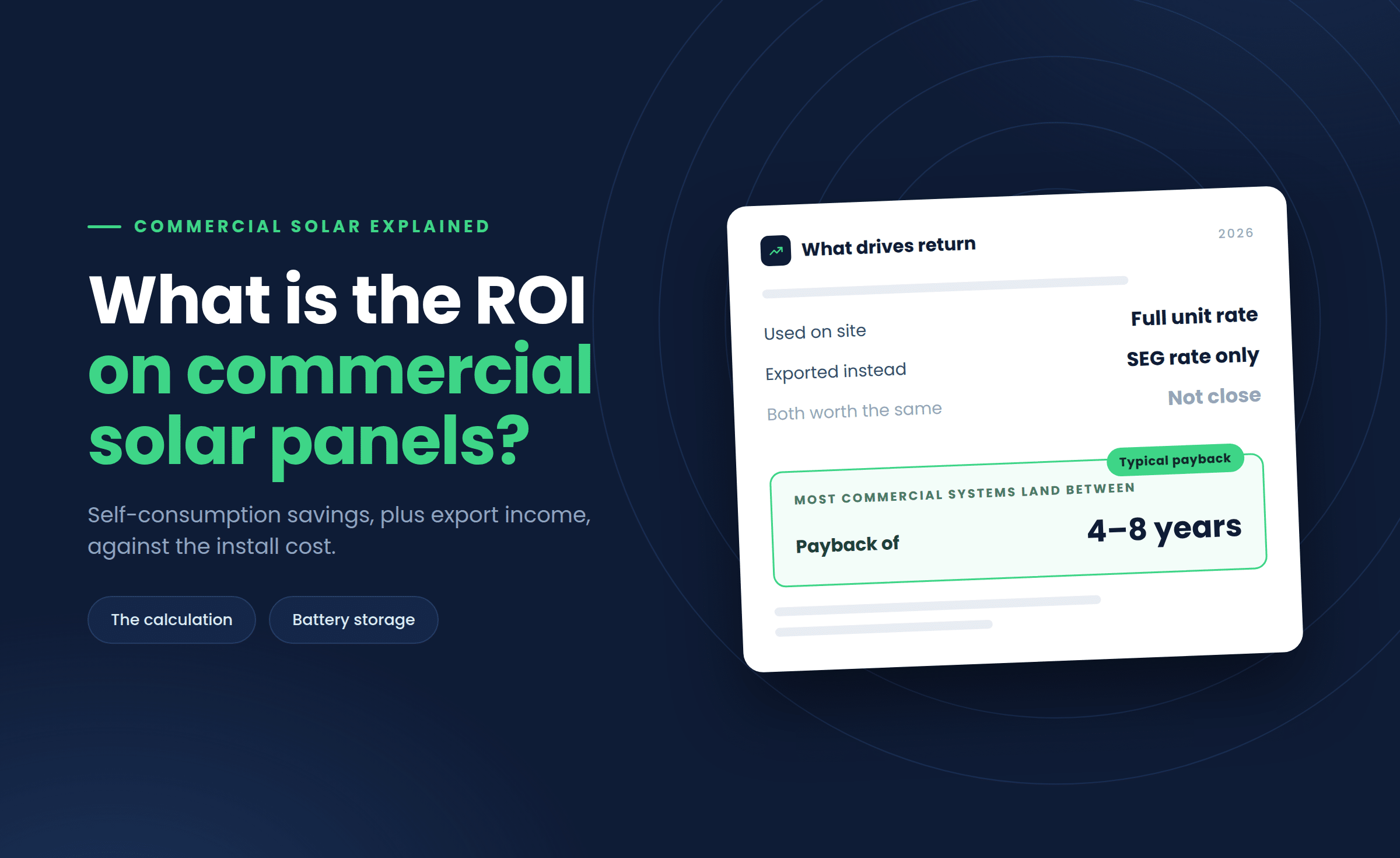

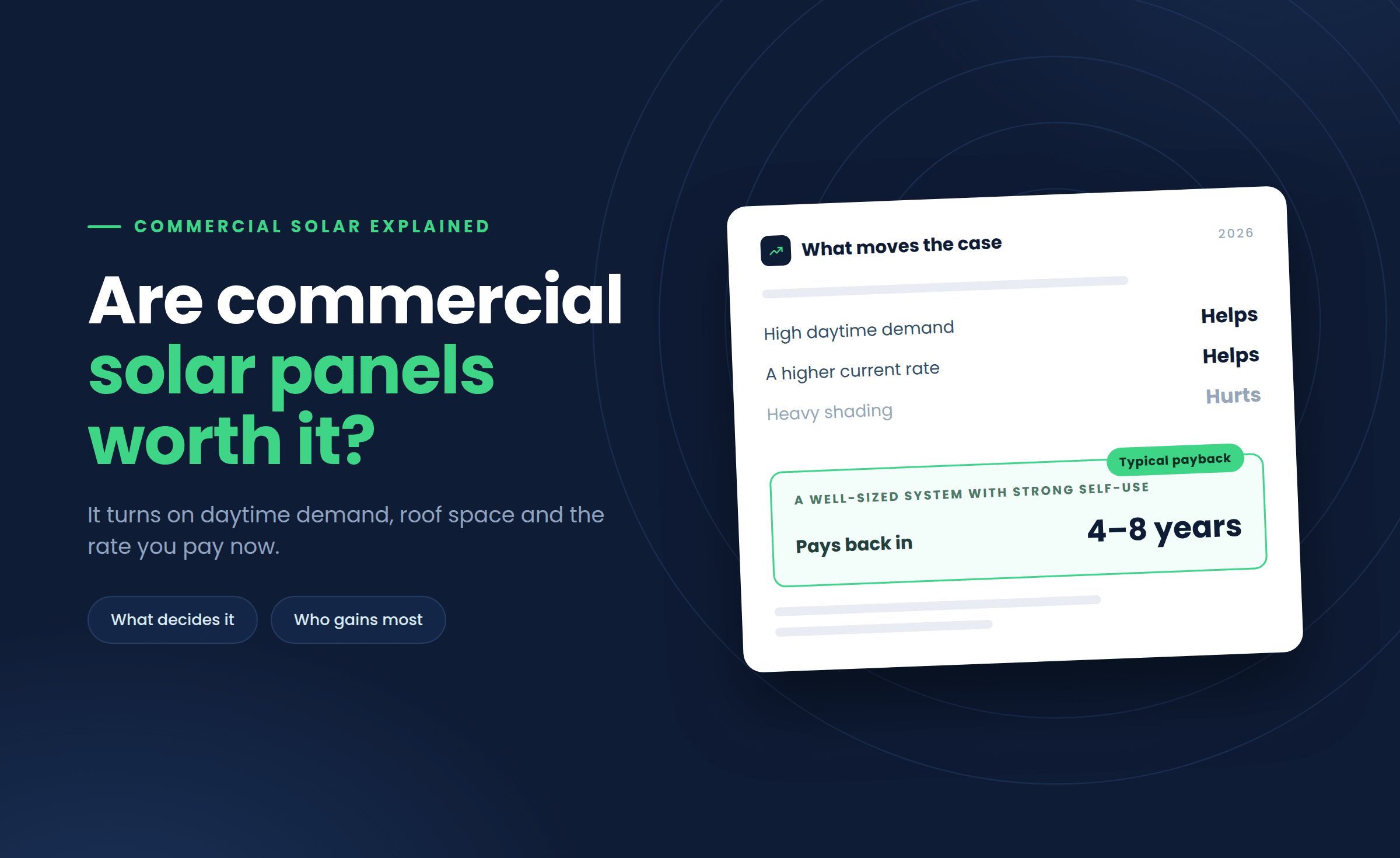
For most businesses with usable roof space and meaningful daytime electricity use, yes. Commercial solar in the UK typically pays back within roughly 4 to 8 years, then keeps generating low-cost power for the remaining 15 to 20-plus years of a system’s life.
Business electricity rates have climbed sharply over the past five years, even after last year’s dip, and that has pushed many finance directors to look seriously at generating some of their own power.
The hesitation is understandable. Upfront costs run into the tens of thousands for anything beyond a small system, and there is confusion around planning rules, grid approval and how the numbers stack up.
Whether it is worth it for your business depends less on the technology and more on how your site uses electricity through the day. Our guide to commercial solar costs covers the spend side.
This guide looks at what drives the value, realistic payback expectations, and which types of business tend to see the strongest returns.
What determines whether solar is worth it for your business?
Three things matter most: how much of your electricity use happens during daylight, how much usable, unshaded roof space you have, and your current electricity rate. Higher daytime demand and a higher rate both push the numbers in solar’s favour.
The factors that move the payback
A site that is empty from 6pm to 8am but busy all day gets far more value than one running mostly evening shifts. Unused generation only earns the lower export rate rather than offsetting a bought unit.
- Roof orientation and pitch: and how much direct sun it sees through the day.
- Shading: from nearby buildings, trees or rooftop plant.
- Daytime usage share: what percentage of your demand falls in daylight.
- Your current electricity rate: the cost each self-consumed unit avoids.
- Site status: whether it is a listed building or in a conservation area.
How much can commercial solar realistically save on bills?
Every unit of solar power you use on-site avoids buying that unit from your supplier at your current rate. Every unit you export instead earns a lower Smart Export Guarantee rate, so self-consumption is where most of the value sits.
Why business type drives the saving
A warehouse running conveyors and lighting all day, or a care home with constant heating, laundry and kitchen demand, soaks up far more of its own generation than a business that closes by mid-afternoon.
With UK business electricity averaging around 24p per kWh, every self-consumed unit is worth far more than an exported one. Matching generation to demand is the single biggest lever on the saving.
Export rates are set by suppliers under the Ofgem Smart Export Guarantee, and they sit well below what you pay to buy a unit. That gap is exactly why using your own generation on-site beats selling it back.
What is the payback period for commercial solar panels?
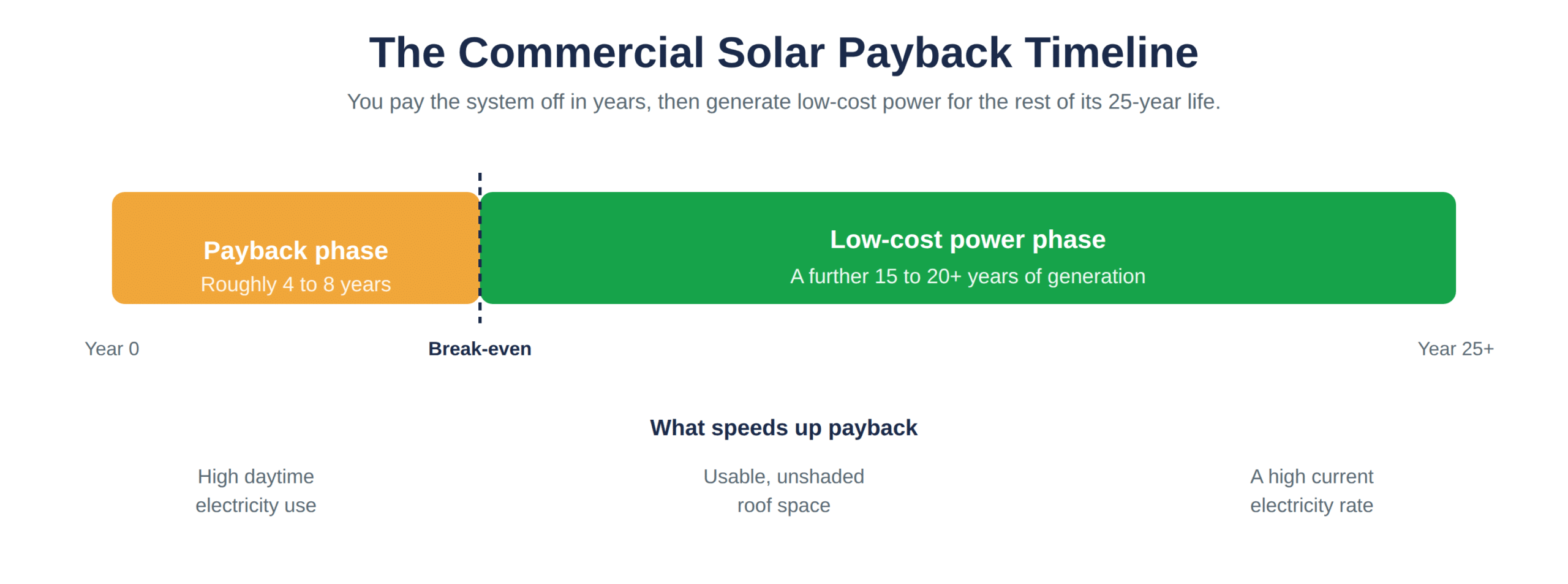
Most well-sized commercial systems with strong daytime self-consumption pay back within roughly 4 to 8 years. Oversized systems that export heavily, or sites with heavy shading, tend to push that further out.
The long tail of savings after payback
Payback is not the end of the story. A system that pays for itself in year six can keep generating largely free electricity for another 15 to 20 years, which is where our guide to solar ROI picks up the full calculation.
Panel output declines only gradually, usually a fraction of a percent a year. Most of the working life sits well after the payback point, so the later years carry the strongest returns.
Adding battery storage can shorten the effective payback for sites whose demand does not line up with daylight. It stores midday surplus for use later, turning would-be exports into avoided purchases.
Do you need planning permission or grid approval first?
Most commercial rooftop solar falls under permitted development, so no separate planning application is usually needed. Larger arrays, ground-mounted systems, and listed or conservation-area sites are common exceptions.
Sorting planning and your DNO application
Grid approval is a separate matter, and every export-capable system needs a DNO application: a G98 notification for smaller installs or a full G99 for larger arrays. Our guide to commercial solar planning permission covers the planning side.
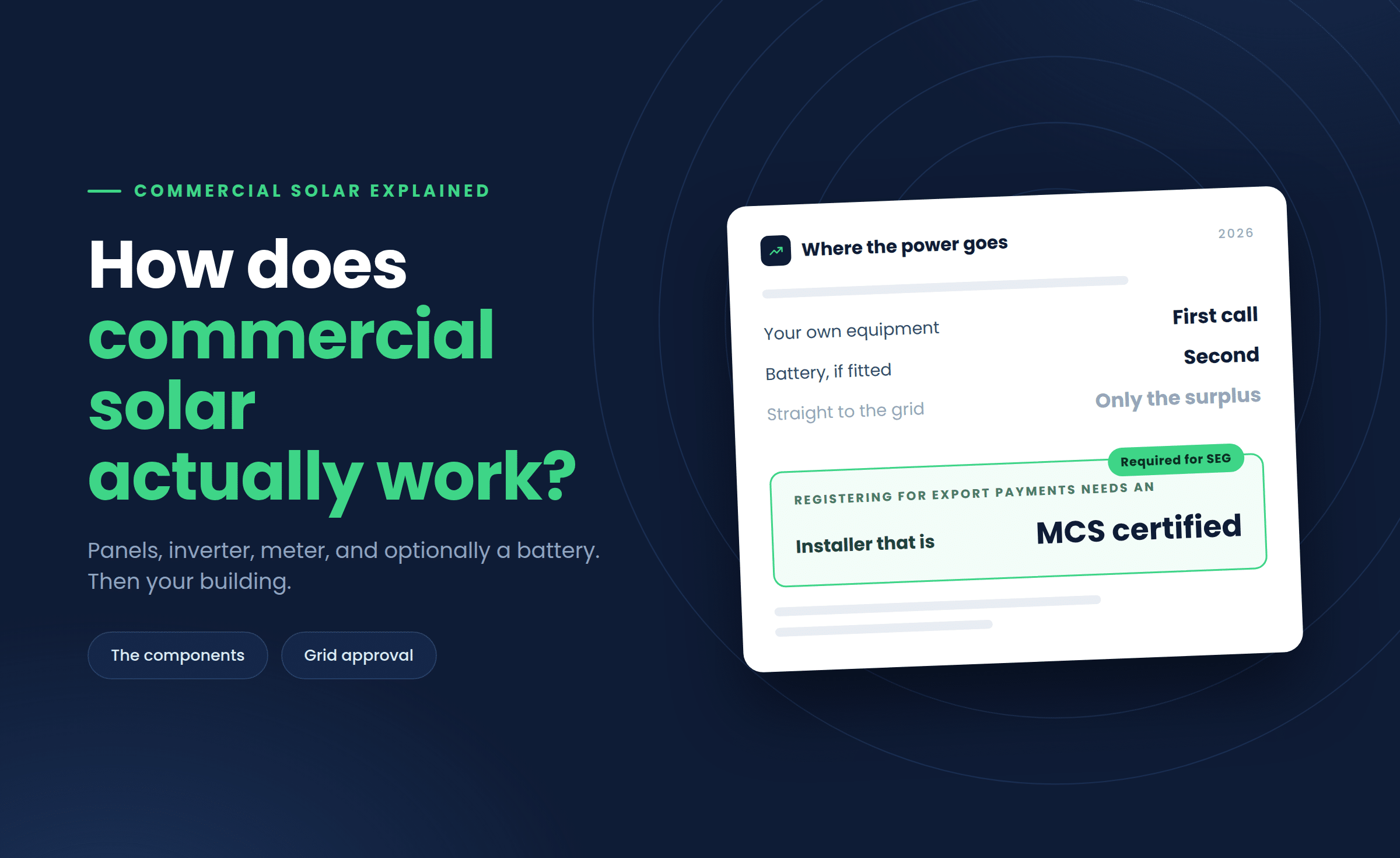
Use an MCS-certified installer throughout. MCS certification is required to register for the Smart Export Guarantee and gives assurance the work meets recognised UK technical standards.
Which types of business get the most out of commercial solar?
Businesses with high, steady daytime demand see the fastest returns, because they use most of what they generate rather than exporting it at a lower rate.
The strongest-fit sectors
Warehousing, care homes, catering and hospitality, and retail units running fridges and HVAC through opening hours all sit at the strong end of the spectrum. Steady daylight demand is the common thread.
Offices and manufacturing sites that run standard daytime hours also tend to do well. The weaker fit is any business that sits empty during the day and only comes alive in the evening.
| Business type | Why solar fits well |
|---|---|
| Warehouse / logistics | Large flat roof, daytime-heavy demand |
| Care home | Constant daytime heating, laundry, kitchen |
| Hospitality / catering | Kitchens and refrigeration through service |
| Retail with cold storage | Fridges and HVAC through opening hours |
If your demand is mostly in daylight, the case is strong. Weigh it against your current business electricity rate, since that is the cost every self-consumed unit avoids.