
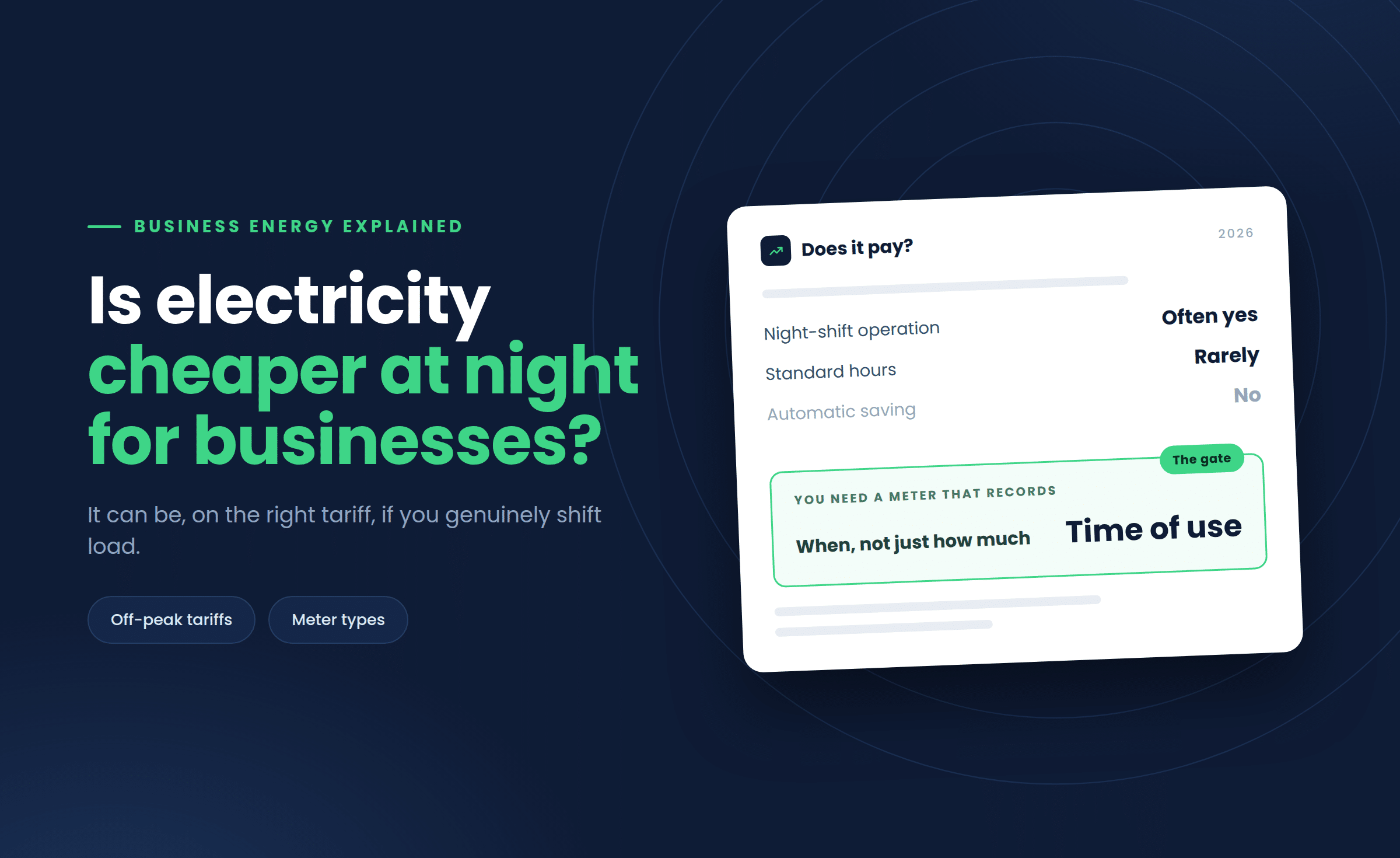
Yes, night-time electricity can be cheaper for businesses, but only on a tariff structured to price it that way and only if your operation actually uses enough power overnight to make the saving worthwhile.
It comes up most from businesses running equipment around the clock, or anyone who has heard a competitor mention shifting production to off-peak hours to cut costs.
Off-peak pricing exists, but it is not automatic. You need the right meter, the right tariff structure, and a genuine chunk of your usage sitting outside standard daytime hours for it to move the needle.
For a business running a typical 9-to-5 operation, chasing a night rate usually is not worth the switch. For a business with a night shift, cold storage or automated production running through the small hours, it can be.
What is off-peak business electricity and how does it work?
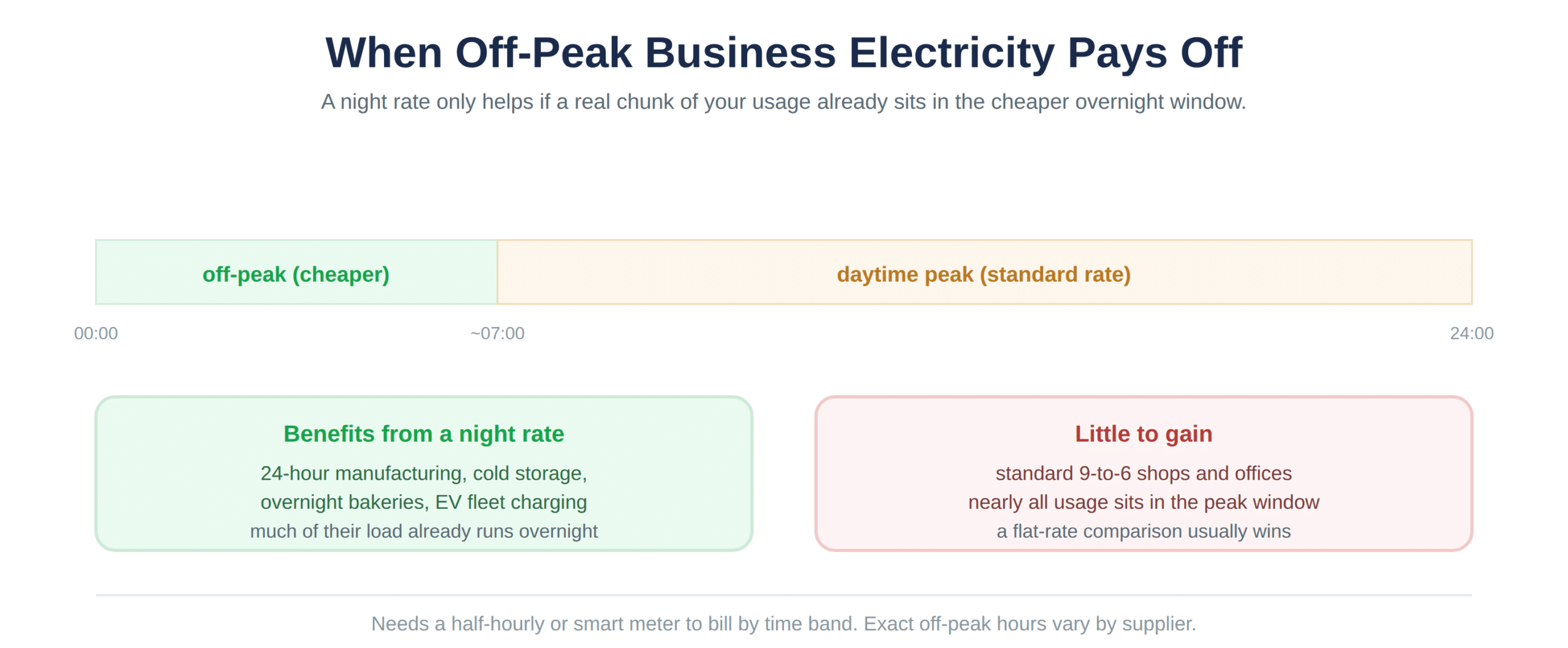
Off-peak business electricity is priced through a time-of-use tariff that charges a lower unit rate during set overnight hours and a higher rate during the day, reflecting how demand and wholesale prices change through the day.
A different structure, not a discount
Electricity demand across the grid drops sharply overnight, which pushes wholesale prices down, and NESO balances that shifting demand. Time-of-use tariffs pass some of that saving to customers who can shift consumption into those hours.
It is a genuinely different tariff structure from a flat-rate contract, not just a discount code. Your meter needs to record usage separately by time band for a supplier to bill it that way.
Which businesses actually benefit from cheaper night-time rates?
Businesses that already run a lot of equipment overnight, such as bakeries, 24-hour manufacturing, cold storage and EV fleet charging depots, see the most benefit from off-peak business electricity.
Match it to your load profile
| Business type | Typical overnight usage | Off-peak potential |
|---|---|---|
| 24-hour manufacturing | High, continuous | Strong |
| Cold storage warehousing | High, constant baseline | Strong |
| Overnight commercial bakeries | High, scheduled | Strong |
| EV fleet or depot charging | High, schedulable | Strong |
| Standard retail, 9am to 6pm | Very low | Limited |
| Office-based business | Minimal | Limited |
If your load profile looks like the top half of that table, it is worth investigating. If it looks like the bottom half, a flat-rate comparison is likely to deliver more, and our guide to average small business energy use helps you gauge your own profile.
What meter type do you need for time-of-use pricing?
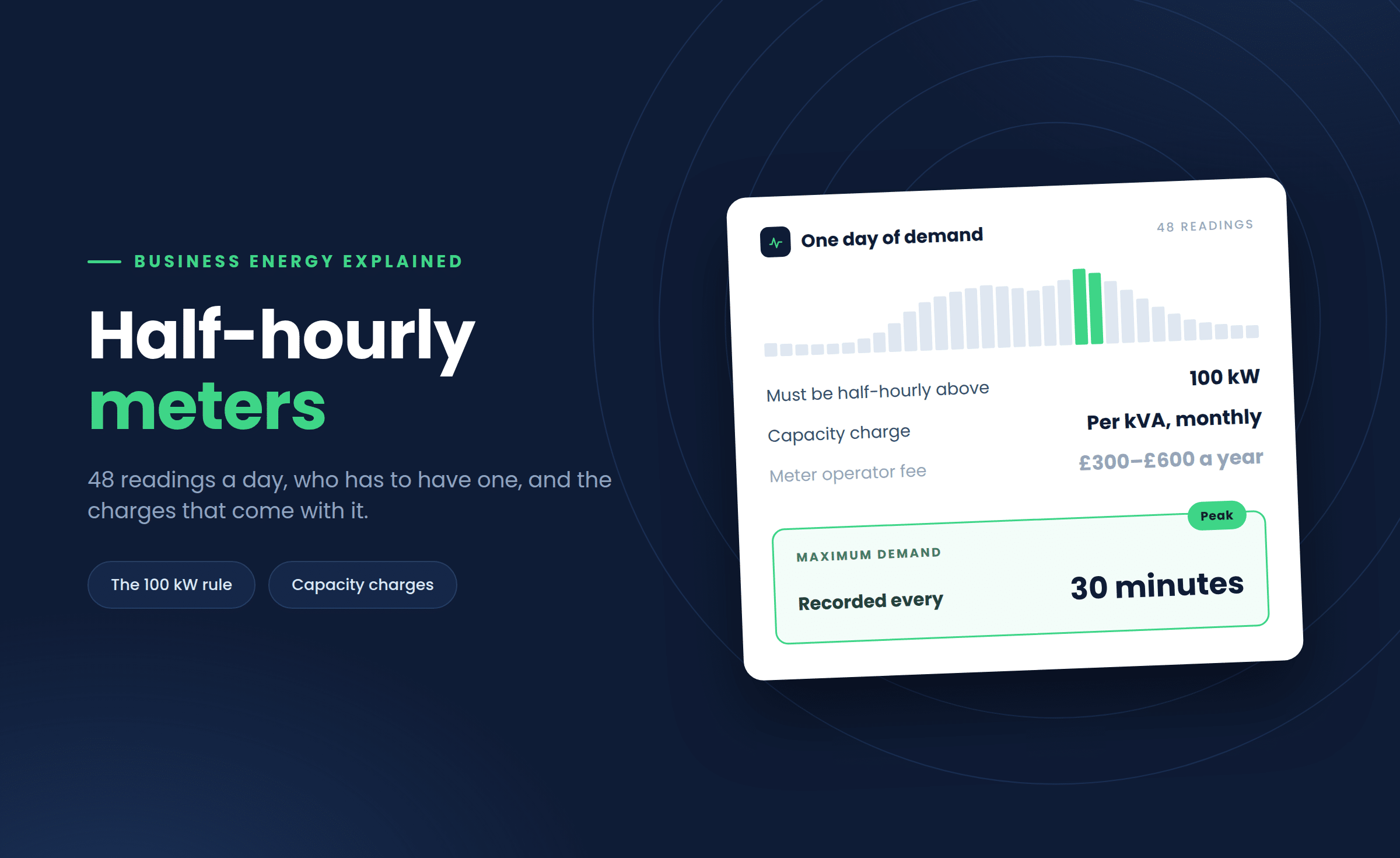
You typically need a meter that records consumption by time period, either a half-hourly settled meter or a smart meter with time-of-use functionality, rather than a standard single-register meter.
How your profile class affects eligibility
A standard meter only records total usage, with no way to separate day and night. Our guide to half-hourly meters explains how settlement works for meters that capture this detail, and a smart meter can also support time-of-use billing.
Smaller non-half-hourly sites are grouped into standard profile classes for settlement, which can limit access to genuinely granular time-of-use pricing.
Is economy 7 still available for business electricity?
Economy 7 style tariffs exist for some business customers, but they are far less common commercially than domestically, and most suppliers now offer bespoke time-of-use structures rather than a standard branded Economy 7 product.
Meters inherited from a previous tenancy
Economy 7 for business works on the same principle: roughly seven off-peak hours overnight priced lower than the day rate. The exact hours and the size of the differential vary by supplier and region, so it is not a standard published figure.
If your business already has an Economy 7 style meter from a previous tenancy, it is worth flagging during a comparison. Not every commercial supplier will continue it, and some will move you onto a standard flat tariff by default.
How do you work out if shifting usage to off-peak is worth it?
Pull your half-hourly or time-banded usage data and check what proportion genuinely falls overnight, since a time-of-use tariff only helps if a meaningful share of consumption can realistically move or already sits in that window.
Three checks before you switch
- Get a day/night breakdown: from your supplier’s meter data.
- Compare against a flat rate: check the off-peak differential beats a strong flat deal.
- Factor in operating cost: any staffing or supervision of overnight running.
For larger sites, our energy procurement service can model this from your actual data. The only reliable comparison is one run against your own recent bill and usage.