
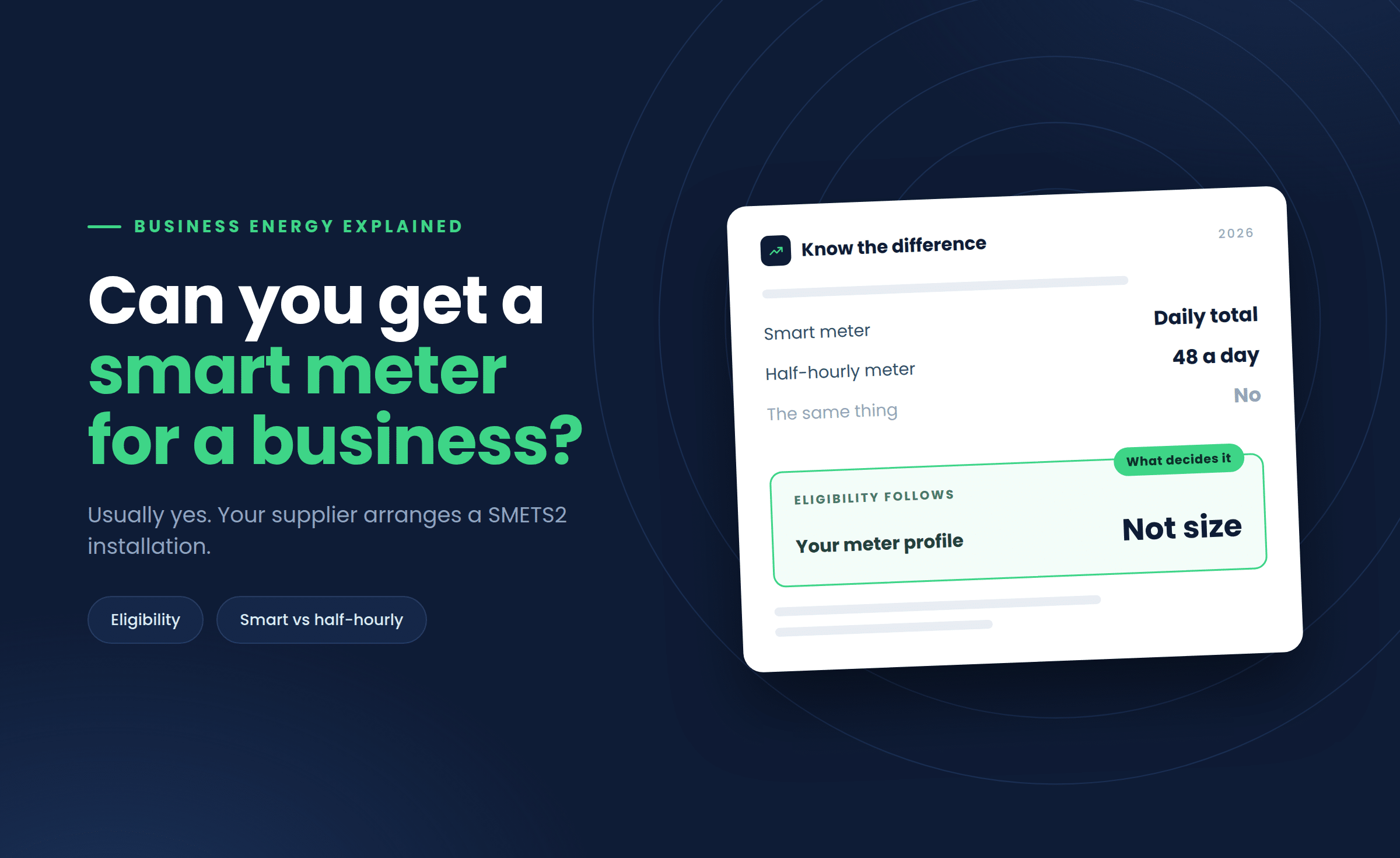
Yes, most businesses, from a single-site shop to a multi-unit warehouse, can have a SMETS2 business smart meter fitted, and your supplier arranges the installation as part of your energy contract. Larger sites above certain consumption thresholds are moved onto half-hourly settlement instead.
Smart meters are not just a domestic story anymore. Business energy suppliers have been rolling them out to commercial customers for several years, largely to remove manual meter reading from the billing process.
A business smart meter sends your electricity and gas usage straight to your supplier over a secure national network, so bills reflect what you have actually used rather than an estimate. That alone eliminates a common source of billing disputes.
Not every business needs the same type of smart metering. Consumption, meter age and whether you are already on half-hourly settlement all affect what gets installed.
What is a SMETS2 business smart meter?
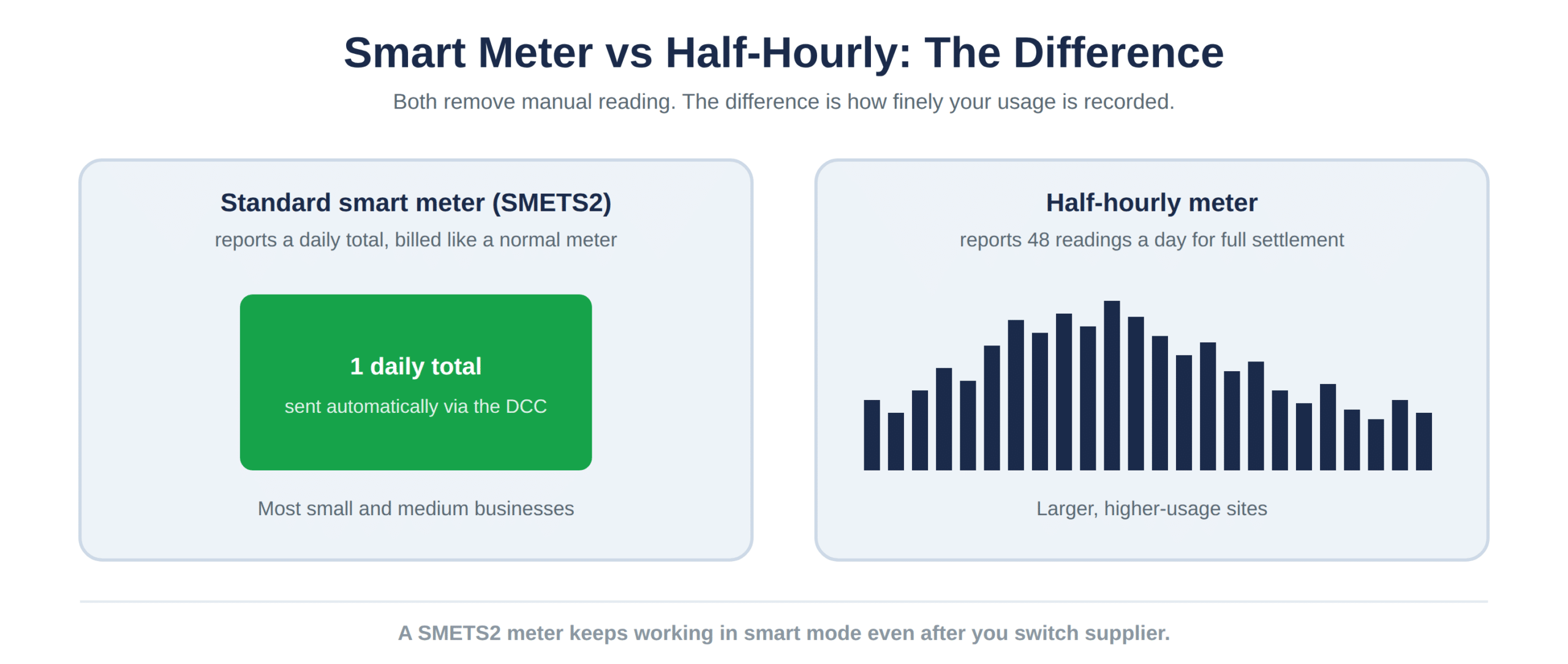
SMETS2 stands for the second-generation Smart Metering Equipment Technical Specification, the current industry standard that lets a smart meter keep working accurately even if you switch supplier.
How the DCC fits in
Older SMETS1 meters, still found on some premises, sometimes lose their smart functions and revert to manual reading after a switch. SMETS2 meters avoid that by connecting through the Data Communications Company, the national network that manages smart meter data for the whole industry.
The DCC carries readings from your meter to your supplier automatically, roughly every half hour or day depending on the mode. It is the same infrastructure whether you are a household or a business, and Smart Energy GB tracks the wider rollout.
Is every business eligible for a smart meter?
Almost every business premises with a standard electricity or gas meter is eligible for a smart meter upgrade, regardless of size or sector.
Who’s the most common candidate
Micro and small businesses on standard credit or prepayment meters are the most common candidates, since these were traditionally read manually. Our guide to micro business energy covers other rules that apply to smaller commercial customers.
- Shops, offices, hospitality: eligible as standard.
- Warehouses and industrial units: eligible, though larger sites may already be half-hourly.
- Care and healthcare premises: eligible, and often prioritised for accurate billing.
Some rural or basement sites with poor signal occasionally need an alternative communications hub for a reliable connection, but this is the exception rather than the rule.
How does business smart meter installation work?
Your supplier books an engineer visit, usually under an hour, to remove the old meter and fit a SMETS2 replacement at no extra cost in most cases.
What to expect on the day
You will typically need someone on site to give the engineer access, and a short supply interruption during the swap. Once fitted, the meter registers automatically against your MPAN and starts sending readings without any further action.
Businesses with multiple meters or complex three-phase supplies sometimes need a longer appointment or a specialist engineer, which your supplier flags in advance. Our guide to who installs a business electricity meter covers the wider roles involved.
What’s the difference between a smart meter and a half-hourly meter?
A standard business smart meter reports usage automatically but is still billed like a normal meter, while a half-hourly meter reports consumption in 48 separate 30-minute blocks every day for full half-hourly settlement.
When half-hourly settlement applies
| Meter type | Best suited to | How readings are collected |
|---|---|---|
| Traditional meter | Very small, low-consumption sites | Manual read, in person or self-submitted |
| SMETS2 smart meter | Most small and medium businesses | Automatic, via the DCC network |
| AMR meter | Larger sites near half-hourly thresholds | Automatic, at set intervals |
| Half-hourly meter | High-usage commercial and industrial sites | Automatic, every 30 minutes for settlement |
Half-hourly settlement typically applies once a site’s consumption crosses a set threshold, though smaller sites can sometimes opt in voluntarily. Our guide to half-hourly meters explains that process, and comparing business gas alongside electricity keeps both aligned.
What are the benefits of switching to a business smart meter?
Accurate billing based on real usage, no more manual readings, and better visibility of when and where your business uses energy are the main practical benefits.
Where the data pays off
- No estimated bills: usage is reported automatically.
- Usage by day: useful for spotting waste or a fault, without manual readings.
- Smoother switching: SMETS2 meters keep working after a change of supplier.
For businesses juggling several sites, that consumption visibility often flags a problem, like equipment left running overnight, long before it shows up as an unusually high bill.