
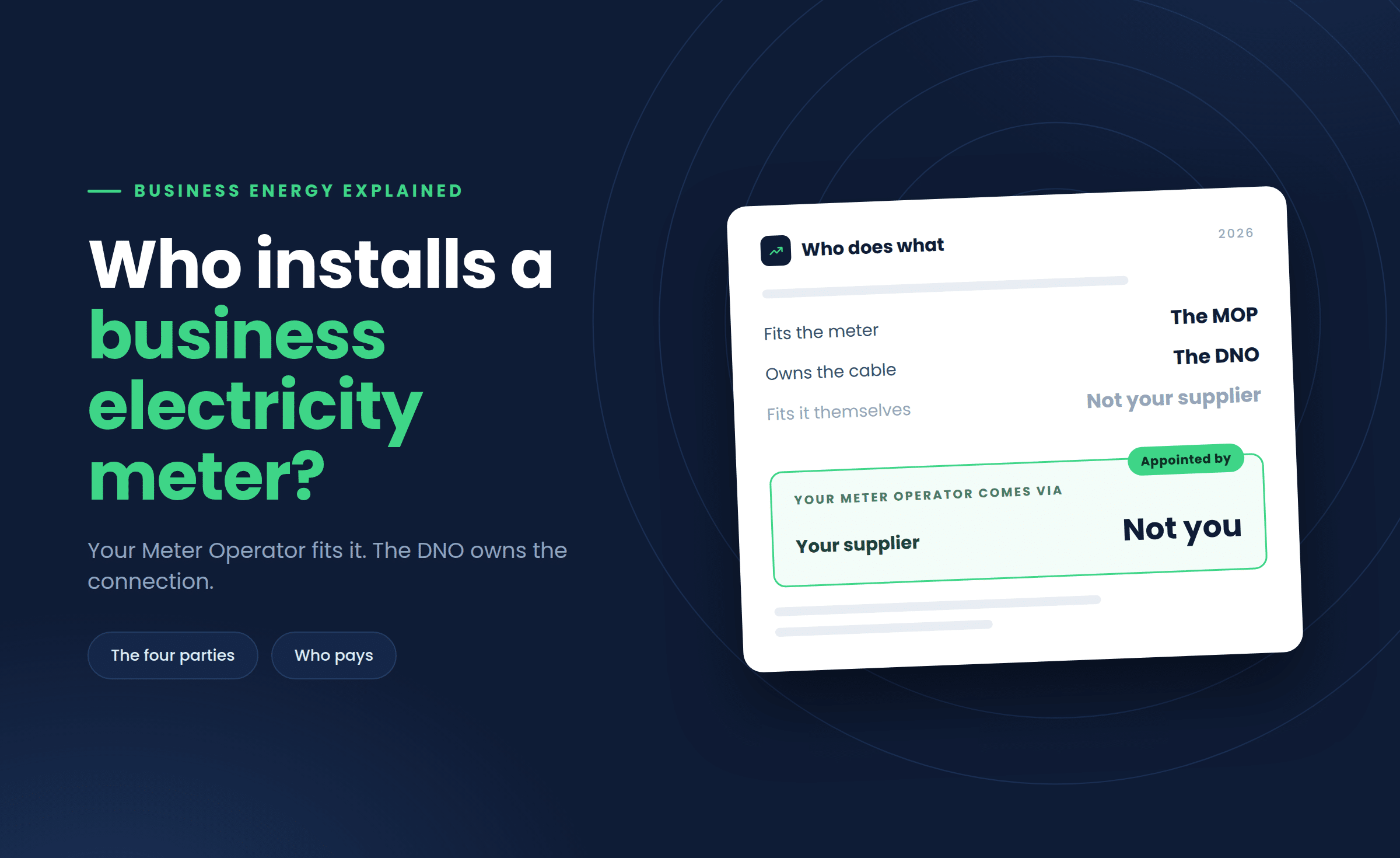
Your Meter Operator (MOP), appointed through your energy supplier, carries out the physical meter installation. The Distribution Network Operator for your area owns the local wires and connects the supply, but a separate MOP contract covers fitting and maintaining the meter itself.
It is a fair question, because a new business site involves several different organisations before the lights come on. Working out who does what saves a lot of confused phone calls between your supplier, your electrician and the network operator.
The roles are not always obvious from a supplier’s welcome pack. There is a difference between who owns the wires, who owns the meter, and who actually turns up with a screwdriver.
There is also a difference between installing a brand new meter at a new connection and swapping an existing one, which changes who you need to contact first.
What is a meter operator (MOP) and what do they do?
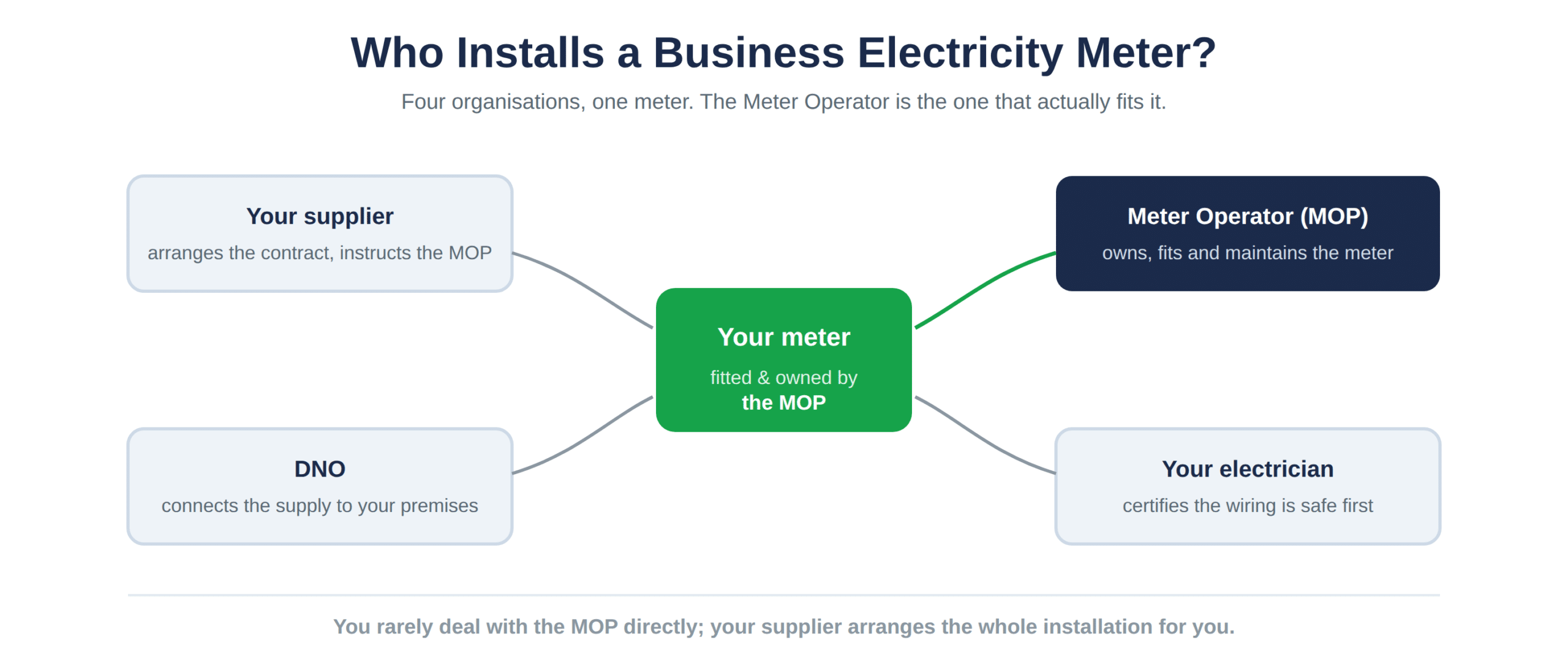
A MOP is the company contracted to install, own and maintain your electricity meter, and it is usually appointed on your behalf by whichever supplier you are with.
Do you get to choose your own MOP?
Large suppliers often run an in-house MOP arm or use a specialist third party. Either way the MOP is a separate commercial relationship sitting underneath your energy contract, and you rarely deal with it directly unless the meter hardware faults or a smart meter needs attention.
Larger businesses sometimes negotiate their own MOP contract separately, particularly on complex or half-hourly metered sites. Smaller businesses almost always inherit whichever MOP their supplier has arranged as standard.
How does business electricity meter installation actually work?
Once your supply contract is confirmed, your supplier instructs the MOP, who books a qualified engineer to fit or replace the meter at an agreed appointment.
The install sequence
For a brand new connection, the DNO first energises the supply to your premises. The MOP’s engineer then fits the actual meter once the electrical installation has been signed off by a qualified electrician.
- Supplier instructs a MOP: once your contract is confirmed.
- MOP schedules an engineer: at a time that suits your business.
- Engineer fits the meter: and registers it against your MPAN.
The meter details are then logged on the ECOES database so any future supplier can find them when you switch.
Who pays for a new business electricity meter?
Routine meter installation and replacement is normally included within your energy contract, but a brand new supply connection carries a separate connection charge from the DNO.
Existing meter versus a new supply
If you are moving into premises with an existing working meter, there is typically nothing extra to pay beyond your standard supply charges. A genuinely new supply, or an upgrade to higher capacity, is priced separately by the DNO based on the work involved.
Costs for a new connection vary enormously depending on distance from the network, the capacity you need and your local DNO, so always get a formal quotation. Our guide to a new business electricity connection covers that process.
What’s the difference between the DNO and the MOP?
The DNO owns and maintains the cables, substations and network infrastructure that bring electricity to your premises, while the MOP owns the meter that measures what you use once it arrives.
Switching supplier won’t change your DNO
| Party | Role in meter installation |
|---|---|
| Supplier | Arranges your contract and instructs the MOP |
| MOP (Meter Operator) | Owns, installs and maintains the meter |
| DNO | Owns the local network and connects the supply |
| Electrician | Certifies your internal wiring is safe first |
| ECOES | Records which meter and supplier sits on each MPAN |
Six operator groups run 14 distribution licence areas across Great Britain, and whichever covers your postcode is your DNO. Switching supplier never changes it, as our guide to who your DNO is explains, though it can change your MOP.
How long does meter fitting take for a business?
A simple meter swap or new fit at an existing connection usually happens within a couple of weeks of your contract starting, while a genuinely new electricity connection can take considerably longer.
What affects the timeline
Appointment availability, site access and whether the meter is single-phase or three-phase all affect the timeline. Sites needing a half-hourly meter sometimes take longer because of the extra data equipment involved.
Comparing business electricity and business gas quotes at the same time is worth doing while the paperwork is fresh.