
Care homes cut energy costs fastest by controlling heating, which is by far their biggest expense, then tackling hot water and lighting, improving insulation, and reviewing the energy contract itself. A 24/7 operation heating a building for vulnerable residents has little slack, so the savings come from running the building well rather than turning things off.
A typical 20-bed care home uses around 395,000 kWh of energy a year, roughly what 18 small houses use combined. On a 24-hour operation that never fully powers down, the bill runs into tens of thousands of pounds.
That makes energy one of the largest controllable costs a home carries. This guide works through where it goes and the changes that move the needle, alongside our guide to reducing business energy consumption.
None of it should compromise resident comfort. The point is to spend less heating and lighting the building, not to make it colder or darker.
Where does a care home’s energy actually go?
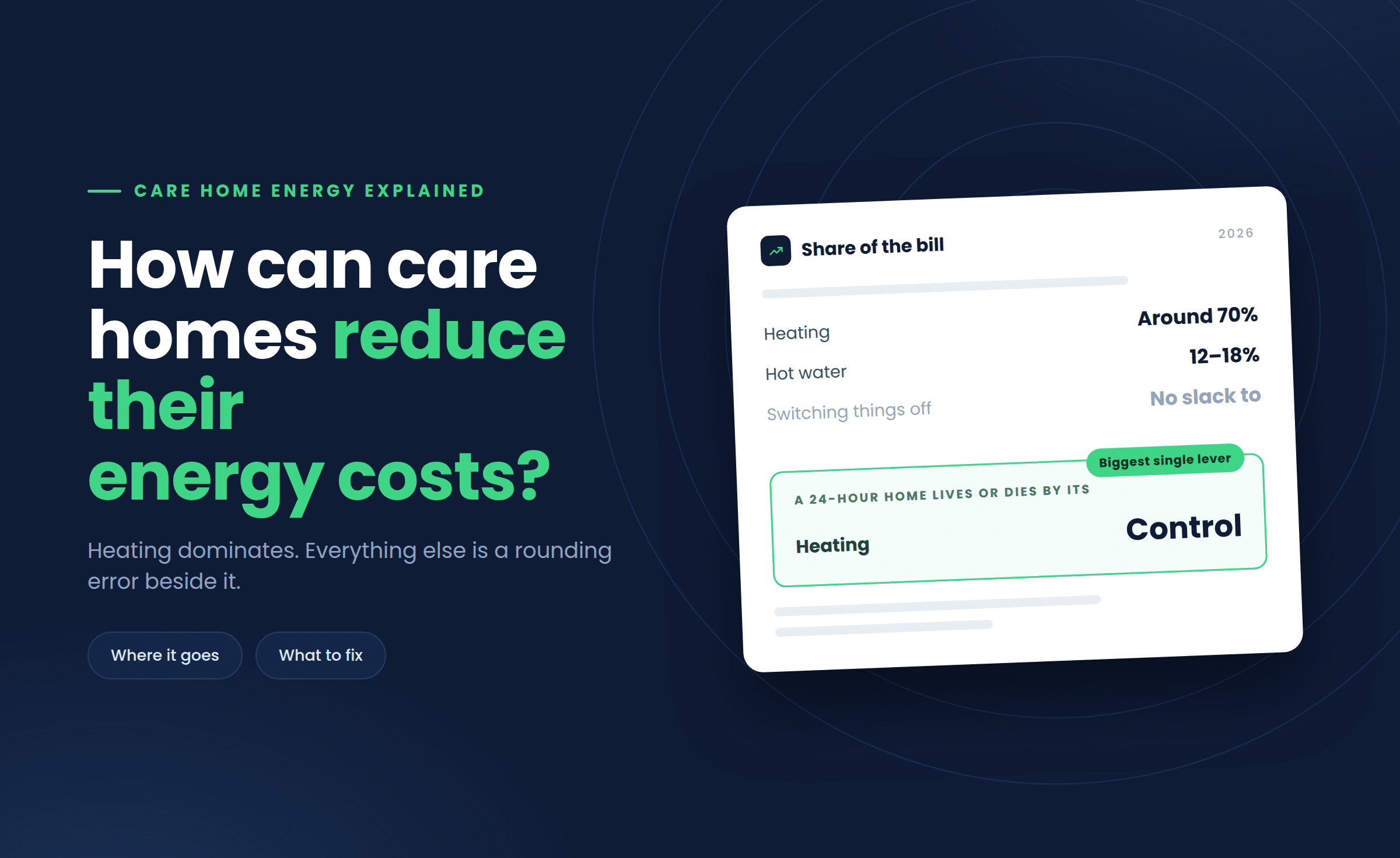
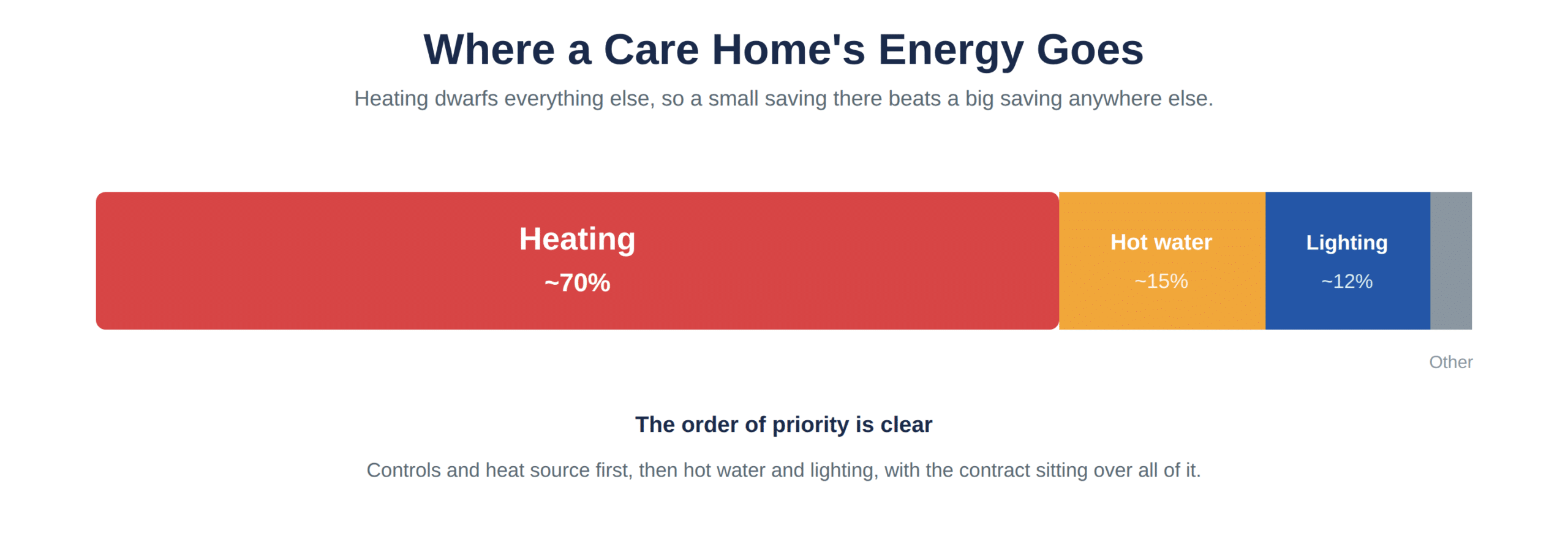
Heating dominates, accounting for around 70% of a care home’s running costs, with hot water at roughly 12 to 18% and lighting at 10 to 15%. That split tells you exactly where to focus first.
Why the split matters
Because heating is such a large share, a small percentage saved there is worth more than a big saving on lighting. It is the single most valuable place to concentrate effort and budget.
Reading a recent bill is the honest starting point. It shows your unit rates, your standing charges and how your usage splits between gas and electricity, which is the roadmap for everything below.
How can care homes cut heating costs?
Set a comfortable but controlled temperature, fit smart controls, and upgrade an ageing boiler or move to a heat pump. Heating is the biggest cost, so it is where the biggest savings sit.
Controls first, then the heat source
The comfortable range for elderly residents is 18 to 21°C. Reducing the thermostat by just 1°C can cut heating fuel use by around 8%, and smart thermostats and thermostatic radiator valves can trim 16 to 19% off a heating bill by matching warmth to when rooms are actually used.
On the heat source, a modern A-grade boiler can save roughly £580 a year against an old one, while a commercial heat pump delivers three to four units of heat per unit of electricity, a step change in efficiency for the right building.
Service boilers and heating plant at least annually. Most homes heat and provide hot water on gas, so a competitive business gas rate matters as much as the equipment, and well-maintained systems are far less likely to fail during a cold snap.
How can care homes reduce hot water and lighting costs?
Fit low-flow and eco shower heads, insulate hot water pipes, switch remaining lighting to LED, and add motion sensors in low-traffic areas. These are low-cost measures that pay back quickly.
Small fixes that add up
Eco shower heads use around 40% less water while keeping the pressure, and insulating hot water pipes keeps water hot for longer so the boiler works less. Encouraging showers over baths cuts both water and the energy to heat it.
On lighting, LED fittings use far less power than fluorescent or halogen and last many times longer, saving a few pounds per fitting each year. Motion sensors in corridors and stairwells cut waste further, and improving the whole lighting system can lower the lighting bill by around 30%.
Is insulation and glazing worth it for a care home?
Yes. A large share of a care home’s heat escapes through uninsulated lofts, walls and old windows, so insulation and glazing directly reduce the heating bill that dominates the overall cost.
Where the heat escapes
Around a quarter of heat can be lost through an uninsulated loft and roughly a third through uninsulated cavity walls. Loft insulation is the most cost-effective fix, and draught-proofing around doors, windows and pipe entries costs little for a real return.
| Measure | Indicative annual saving |
|---|---|
| Loft insulation (to recommended depth) | Around £215 |
| Solid wall insulation | Around £300 |
| Modern A-grade boiler vs old | Around £580 |
| Double glazing (vs single) | Cuts window heat loss sharply |
Older windows are a weak point too. Double glazing greatly reduces heat loss compared with single-glazed panes, and it has the bonus of a quieter, more comfortable environment for residents.
Should a care home switch its energy supplier?
Almost always worth checking. Business energy is not price-capped by Ofgem, so a care home left on an out-of-contract or rolled-over rate can pay far more than a negotiated deal on every unit it uses.
Why the contract is the biggest single lever
Efficiency measures help, but the contract is often the largest saving of all, because it applies to your entire consumption at once. Comparing business energy suppliers against a recent bill is the fastest way to check where you stand.
A care home’s usage profile, steady demand around the clock, matters when choosing a tariff. Our guide to what a care home should look for in an energy contract covers the terms worth checking before you sign.
What grants and renewable options are available?
Government and local schemes can offset the cost of efficiency upgrades and low-carbon heating, and on-site solar can cut reliance on the grid for a home with suitable roof space.
Schemes and on-site generation
Support such as the Boiler Upgrade Scheme and various insulation schemes can reduce the upfront cost of the biggest measures. Eligibility shifts over time, so treat any named scheme as a starting point and check current criteria.
For homes with the roof space, commercial solar can serve daytime demand, and the Energy Saving Trust publishes sector guidance worth reading first. Any solar install should use an MCS-certified installer.