
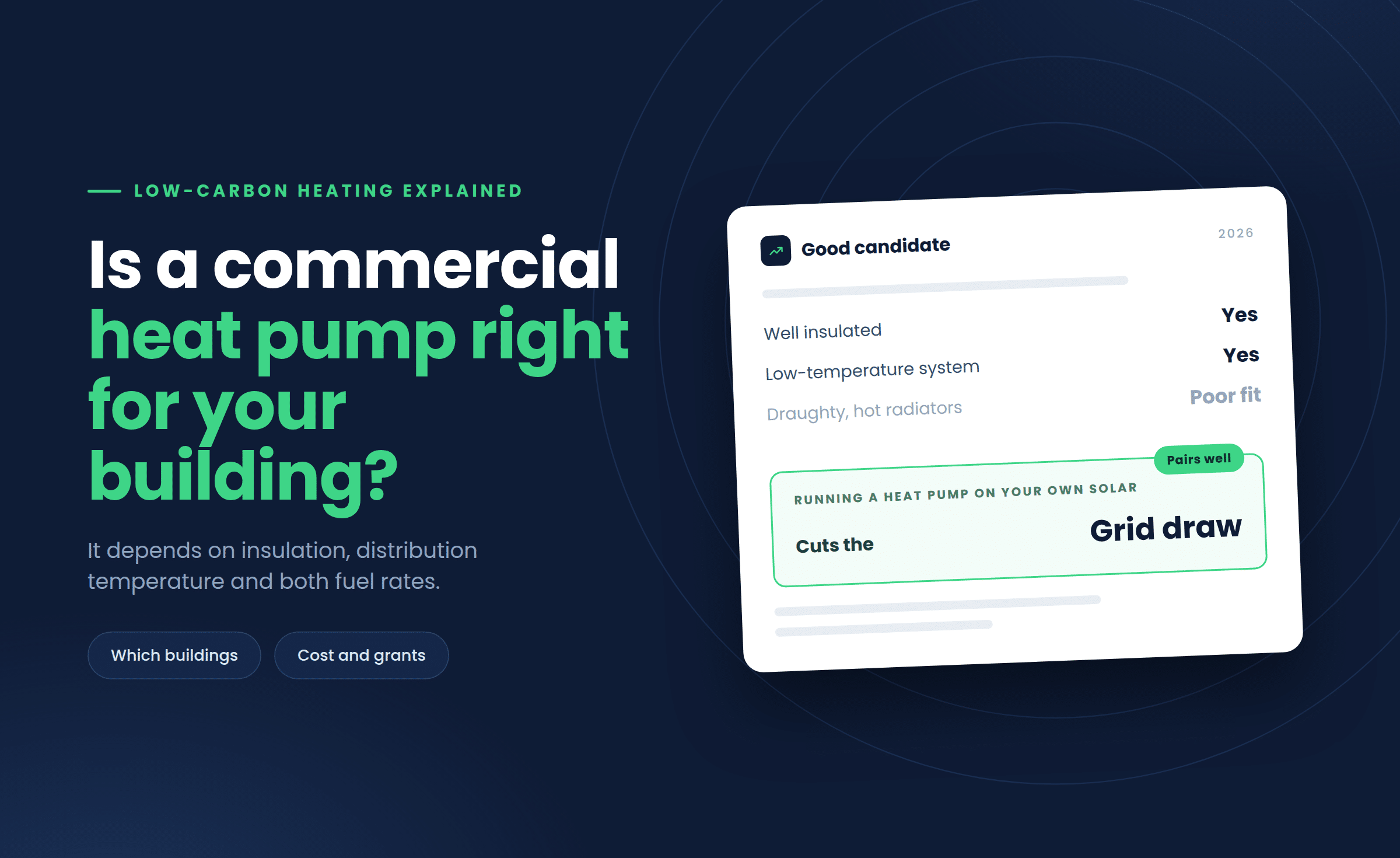
A commercial heat pump usually makes sense for a well-insulated building with a modern heating distribution system and predictable heat demand, such as an office, retail unit or care home. Older, poorly insulated buildings with high-temperature process heat are a harder case.
Gas boilers have run commercial heating for decades. That is changing fast, partly because of rising gas costs and partly because of pressure from landlords, investors and regulation to decarbonise.
A commercial air source heat pump is the option most businesses land on first, since it avoids the ground works a ground source system needs and suits a much wider range of sites.
The catch is that a heat pump is not a like-for-like swap for a boiler. It works differently, costs more upfront, and does not suit every building equally well.
This guide covers how commercial heat pumps work, what the cost really looks like, and how to tell whether your building is a genuinely good fit before you commit.
How does a commercial heat pump work?
A commercial air source heat pump extracts heat from outside air, even in cold weather, and concentrates it using a refrigerant cycle before distributing it around the building through water-based heating or warm air.
Ground source versus air source
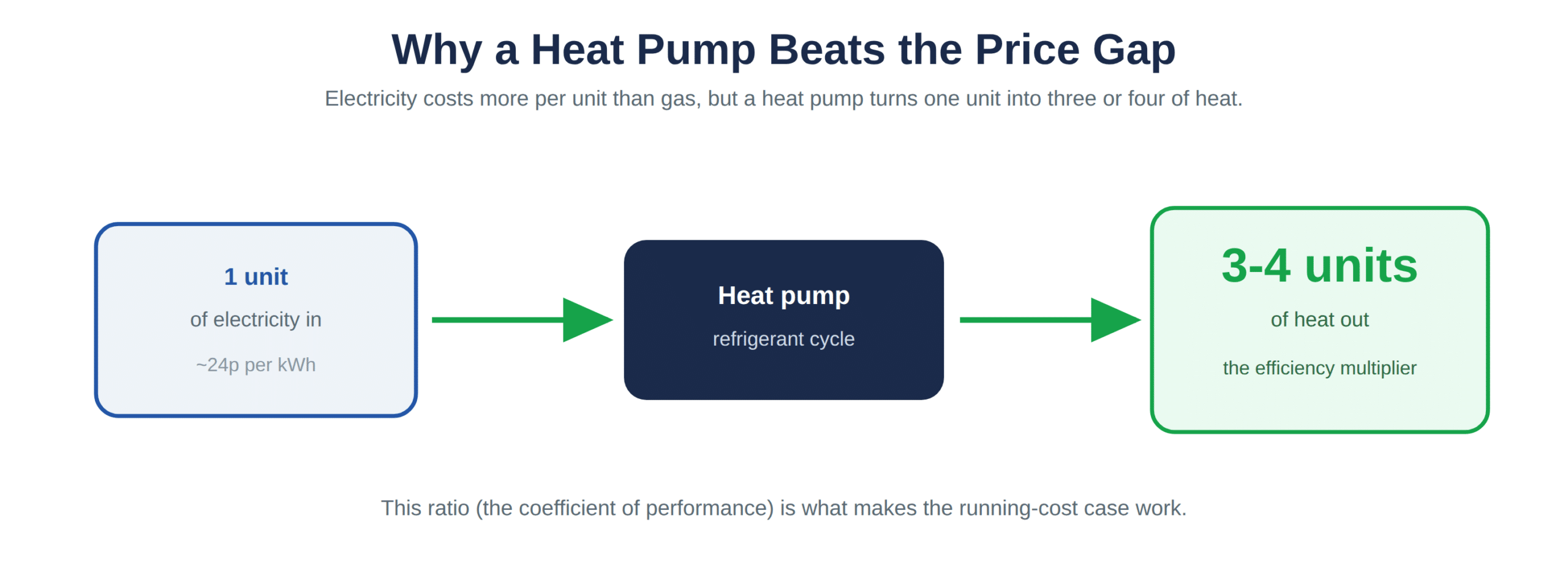
It runs on electricity rather than gas, and for every unit of electricity it consumes, a well-specified system typically delivers three to four units of heat. That ratio is what makes the running cost case work.
- Air source: quicker to install, works on almost any site with outdoor space.
- Ground source: higher efficiency, but needs land for boreholes or trenches.
- Hybrid: pairs a heat pump with an existing boiler for peak demand, common in retrofits.
What does a commercial heat pump cost to install?
Cost varies enormously by building size and heat demand, but a small office or retail unit typically sits in the tens of thousands of pounds, while a larger building runs considerably higher once distribution upgrades are included.
Why distribution upgrades drive the cost
The heat pump itself is often the smaller line item. Upgrading radiators, pipework or air handling to work efficiently at lower flow temperatures usually adds more than most businesses expect.
A building with underfloor heating or oversized radiators already fitted needs less retrofit work, which is one reason cost estimates vary so widely between two buildings of similar size.
Which buildings suit a commercial heat pump best?
Buildings with decent insulation, a lower-temperature distribution system such as underfloor heating or oversized radiators, and a fairly steady heat demand suit a commercial heat pump best.
A quick fit check before a survey
Offices, retail units, care homes and schools tend to fit well. Our guide to reducing care home energy costs covers a sector where heating runs almost constantly.
- Insulation: reasonable levels in the walls and roof.
- Low-temperature heating: underfloor or oversized radiators already fitted.
- Steady demand: rather than occasional bursts of high-temperature process heat.
- Outdoor space: for an air source unit, away from noise-sensitive areas.
| Building type | Heat pump fit |
|---|---|
| Office or retail unit | Strong, with reasonable insulation |
| Care home or school | Strong, steady daytime heat demand |
| Modern warehouse (space heating) | Good, subject to DNO capacity |
| Older industrial, process heat | Harder, usually needs fabric upgrade |
How much could a heat pump change your energy bill?
Switching from gas to a well-specified heat pump shifts heating cost from a gas bill to an electricity bill, and whether that is cheaper overall depends heavily on your building’s efficiency and the rates you pay on each fuel.
How the fuel price gap really compares
UK average business gas runs around 5p per kWh against average business electricity of around 24p. On paper the gap looks stark, but the efficiency multiplier is what closes it.
Three or four units of heat from one unit of electricity changes the real comparison substantially. Get a site-specific survey rather than a generic online calculator, since insulation, boiler efficiency and your tariff all move the outcome, and bodies like the Energy Saving Trust publish useful efficiency guidance first.
What grants and schemes help offset the cost?
Several routes support commercial heat pump adoption, including capital allowances on qualifying equipment, sector-specific decarbonisation funding, and the wider policy push from UK ETS and Climate Change Agreements for larger users.
Where the business case is clearest
Availability shifts often as schemes open, close and get replaced, so treat any specific grant name as a starting point. The Annual Investment Allowance on qualifying equipment is one of the steadier levers.
Larger businesses already reporting under SECR or ESOS often have the clearest case, since a heat pump switch feeds directly into the decarbonisation targets those frameworks are built around.
Does a heat pump make sense alongside commercial solar?
Yes, pairing a heat pump with on-site solar is one of the more effective combinations available, since the heat pump’s electricity demand can be met partly, or at times wholly, by your own generation rather than the grid.
Why the pairing works so well
Our guide to commercial solar covers what an installation involves, including the MCS-certified installer and DNO connection any grid-connected system needs. A heat pump running through daylight hours on a solar site cuts grid reliance meaningfully.
That matters more as electricity becomes the dominant fuel for both heating and general use. It also strengthens the case for whether solar is worth it, since a heat pump raises daytime demand the panels can serve.