
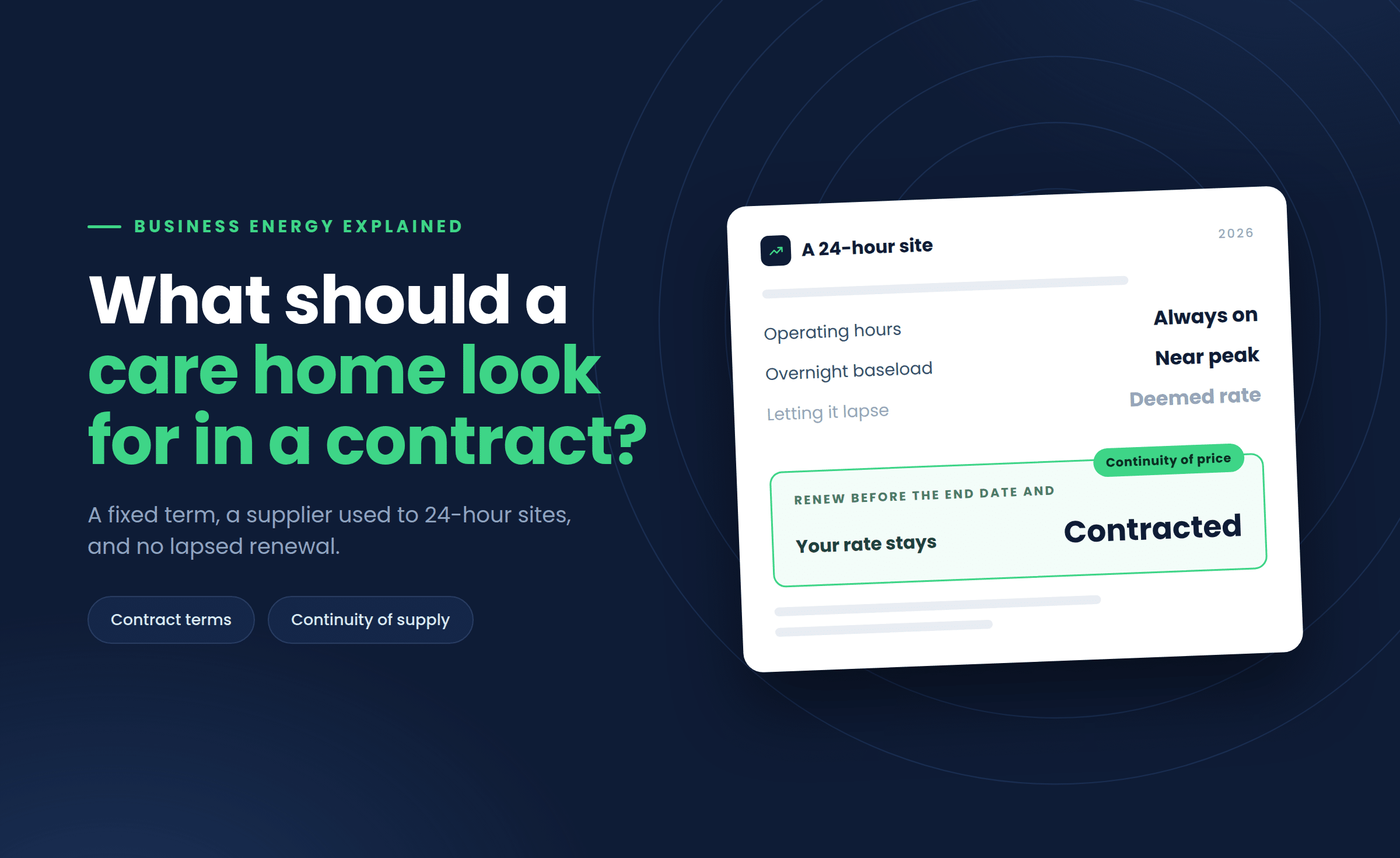
A care home should prioritise a fixed-term contract with a supplier that understands 24-hour, CQC-regulated operation, half-hourly metering if the site qualifies, and a renewal process that never lets the contract lapse onto a deemed rate. Continuity of supply matters more here than in almost any other sector.
Nursing home energy costs do not behave like a normal commercial building’s. Heating has to run to a higher, more consistent standard for elderly residents, hot water demand is constant, and the building never actually closes.
That changes what matters in a care home energy supplier relationship. Price is still important, but continuity, billing accuracy and terms that survive a change of ownership or CQC inspection cycle matter just as much.
Getting the contract wrong does not just cost money. A lapsed contract on a deemed rate, or a supplier failure handled badly, creates real operational risk in a building full of vulnerable residents, as our care homes sector guide explains.
Why is a care home’s energy profile different from a normal business?
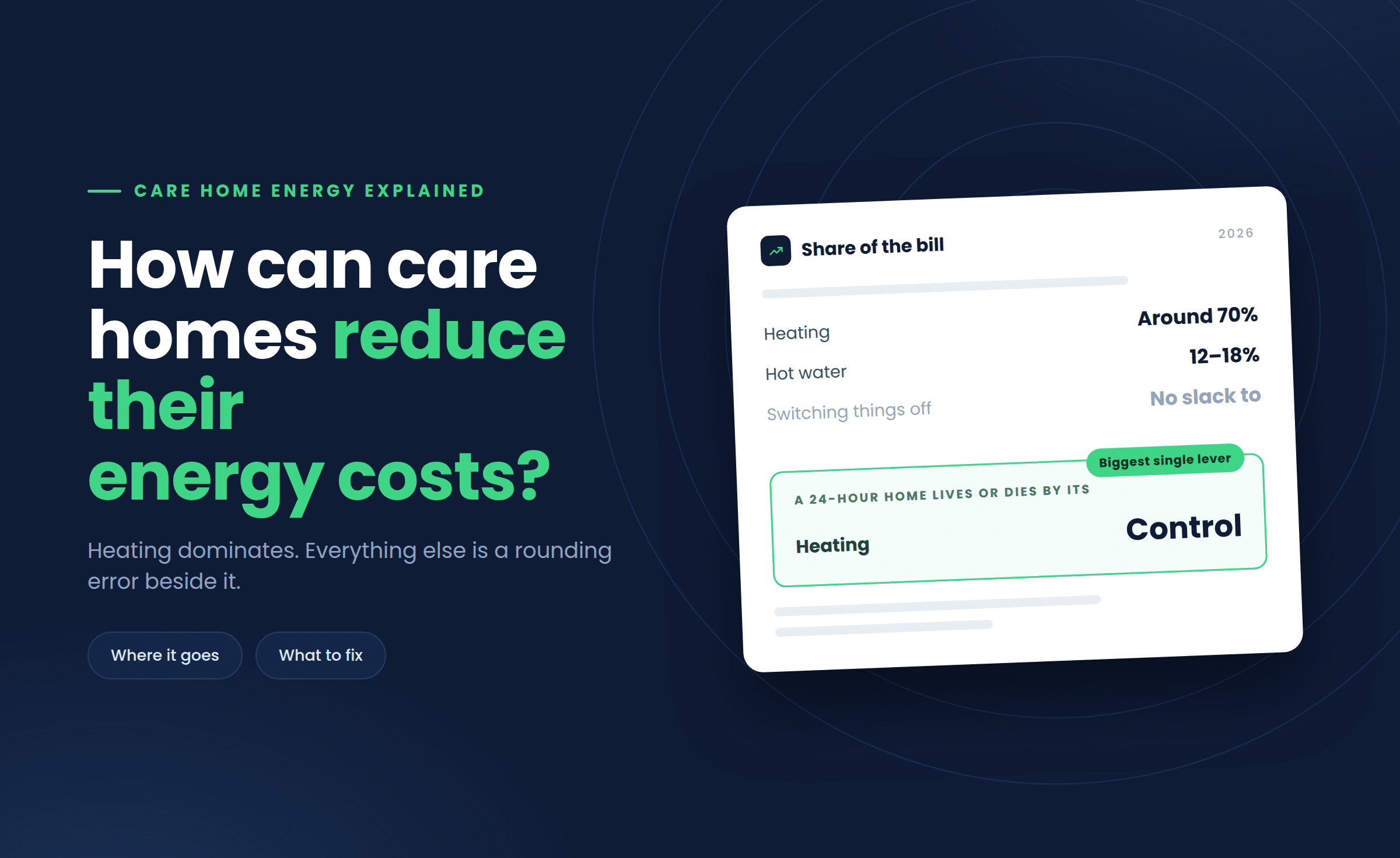
A care home runs 24 hours a day, 365 days a year, with heating held several degrees warmer than an office to protect residents with lower mobility, alongside constant hot water and laundry demand.
No overnight setback
There is no overnight setback the way there is in an office. Corridors, lounges and bedrooms all stay warm through the night, and our healthcare sector guidance covers how that shapes usage.
Infection control adds another layer. Many homes run enhanced ventilation and higher-frequency laundry cycles than a standard residential setting, both of which push demand up further.
| Driver | Why it matters | Contract implication |
|---|---|---|
| 24/7 heating and hot water | No overnight setback for resident welfare | Baseload never drops, so unit rate and standing charge both matter |
| Laundry and infection control | Higher-frequency washing and ventilation | Usage may sit in a higher band than building size suggests |
| CQC inspection continuity | Supply interruption is a safeguarding risk | Reliability outweighs marginal price differences |
| Building age and fabric | Many homes occupy older, converted buildings | Higher heat loss raises gas usage regardless of tariff |
What contract length suits a care home best?
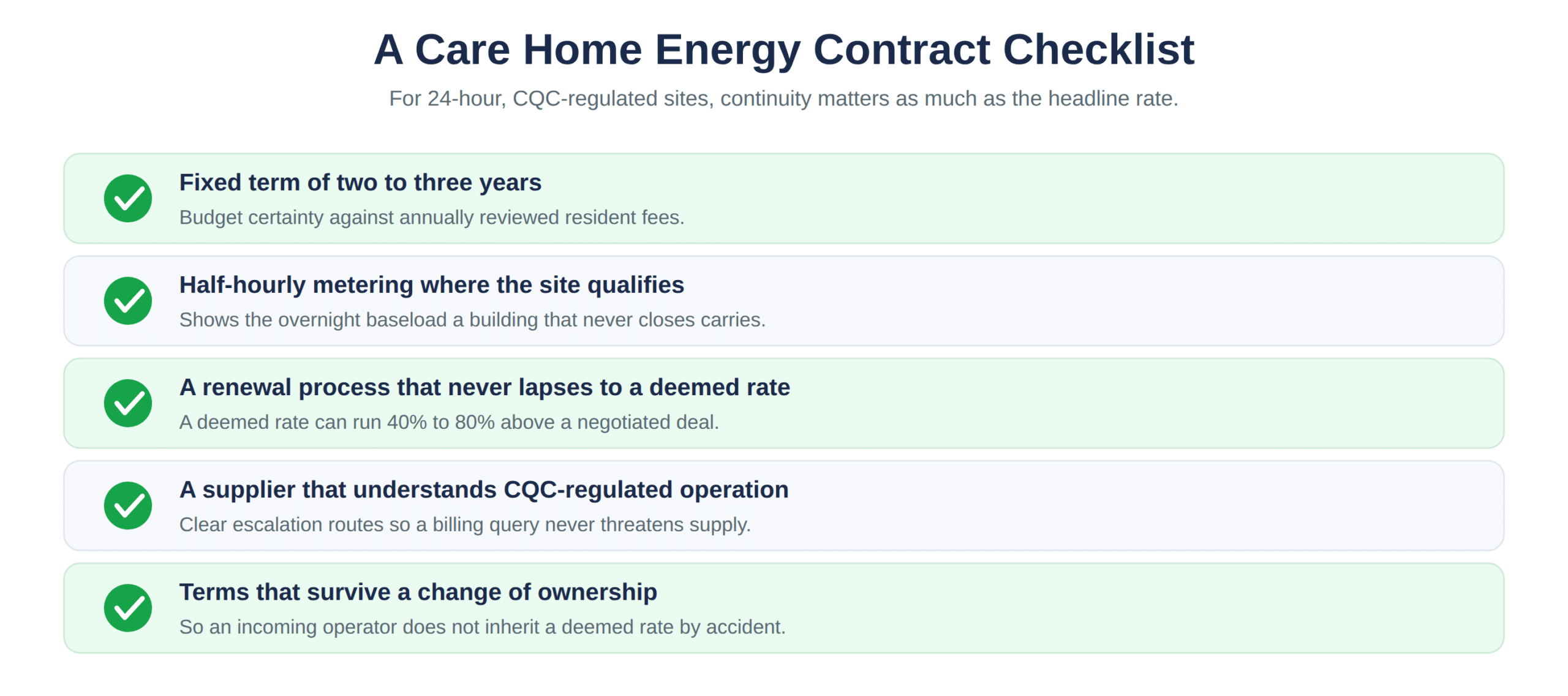
Most care homes are best served by a fixed-term contract of two to three years, which gives budget certainty against a resident fee structure that is typically reviewed annually and cannot easily absorb sudden energy spikes.
Why a longer fixed term helps
A shorter one-year deal exposes the home to renewal risk more often, which matters when a lapsed contract defaults to a deemed rate that can run 40% to 80% above a negotiated one. Our guide to business energy contracts covers how fixed-term lengths interact with market pricing.
A longer fixed term smooths that risk out. It also removes the annual scramble to renew, which is easily missed in a setting where operational priorities always come first.
Should a care home have a half-hourly meter?
Larger care homes and groups running several sites often qualify for or benefit from half-hourly metering, which gives a detailed, hour-by-hour picture of electricity use across the day and night.
Comparing overnight and daytime usage
For a building that never goes quiet, that data is genuinely useful, showing how much the overnight baseload costs against the daytime peak. Our guide to half-hourly meters sets out the thresholds and what the switch involves.
Compare business energy prices with Utility Saving Expert and see live rates in 60 seconds, or compare a full panel of business energy suppliers experienced with care settings.
What happens if a care home’s supplier fails?
If a care home’s supplier fails, Ofgem appoints a Supplier of Last Resort to keep the site supplied without interruption, though the home is usually moved onto that supplier’s standard rate until a new contract can be arranged.
Supply is safe, the rate is the risk
Supply itself is never at risk during a failure, as Ofgem’s guidance confirms. The real cost is landing on an uncompetitive rate for weeks or months while the transition settles.
Our guide to failed energy companies explains what happens step by step and how quickly a new contract can realistically be put in place.
How does CQC-regulated operation affect the contract?
CQC-regulated settings need a supplier and broker who understand the home cannot go without heating or hot water while a billing query is resolved, which makes account management and clear escalation routes as important as the headline rate.
Ownership changes and deemed rates
A disputed bill still has to be paid on time to protect supply continuity while the dispute runs, so our guide to disputing an incorrect business energy bill covers how to raise one without risking a payment default.
Ownership changes are common in care too, and a change of tenancy needs handling correctly so the incoming operator does not inherit a deemed rate by accident.
The practical test of a good supplier here is not the rate at all. It is how quickly a named contact answers when a bill looks wrong and heating cannot wait for a call-centre queue.