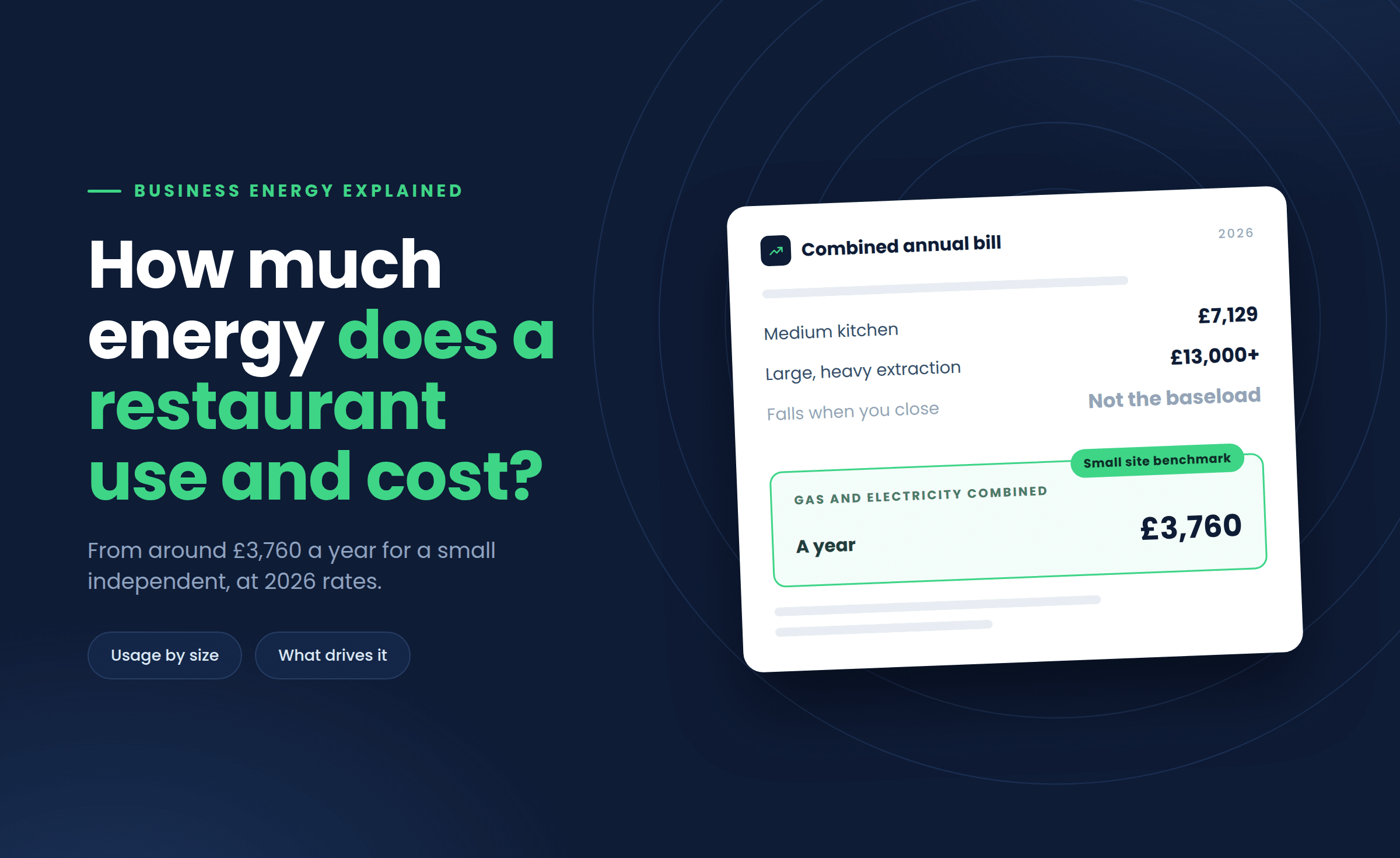


Schools save the most on energy by treating procurement as seriously as any other line in the budget, because term-time-only usage, holiday shutdowns and a large, draughty estate mean the contract and the heating schedule matter far more than any single piece of kit.
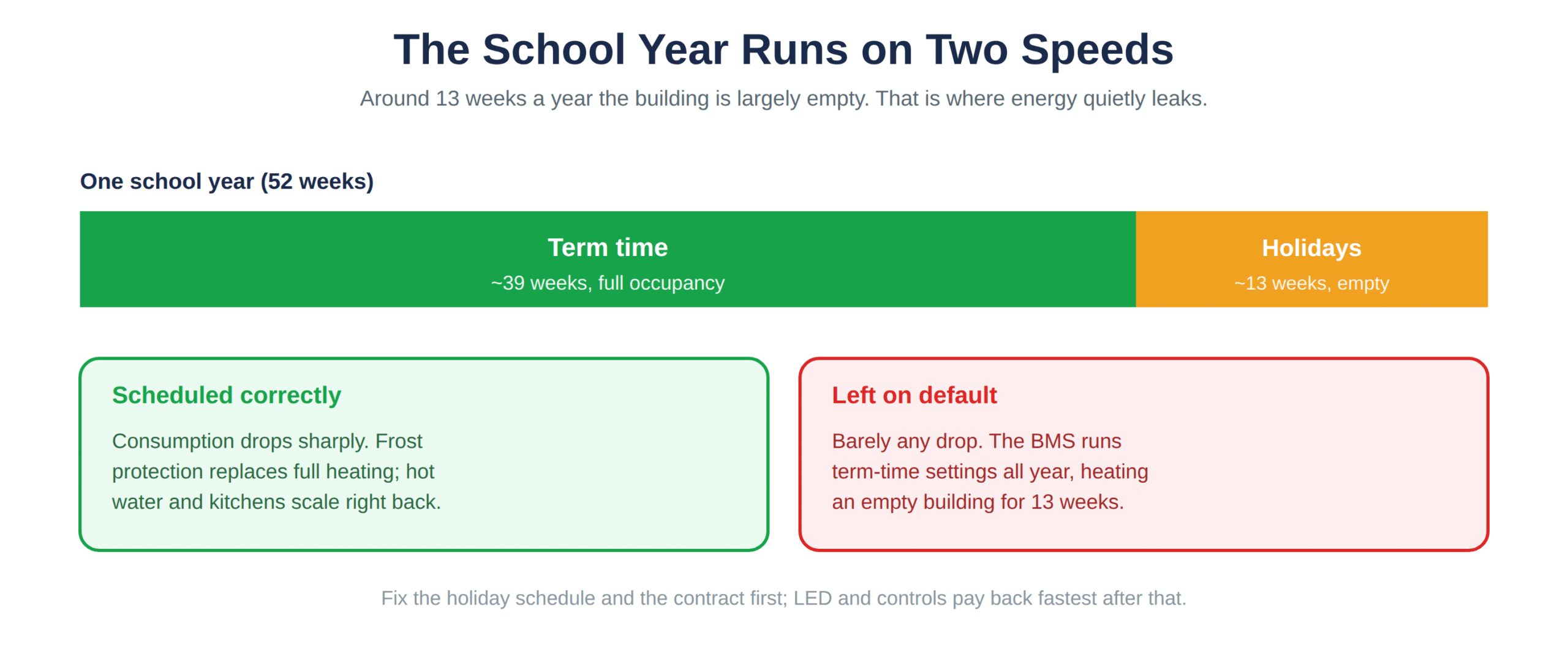
A school building runs on a rhythm nothing else in business energy quite matches. Term time brings full occupancy five days a week for around 39 weeks, then for the remaining thirteen the building sits largely empty.
That holiday baseload is where school energy costs quietly leak, because heating and hot water often carry on regardless. Our sectors we cover hub frames where schools sit against other estates.
Add ageing buildings, many built in the 1960s and 70s with limited insulation, and you have an estate that is expensive to run even when everything is configured correctly.
Where does a school’s energy budget go?
Heating and hot water dominate a school’s energy bill, typically followed by lighting across long corridors and large hall spaces, with kitchens adding a sizeable and often underestimated load where meals are cooked on site.
Halls, labs and kitchens
A primary school hall doubling as dining, assembly and PE space needs heating and lighting most of the day. Secondary schools add science labs, workshops and sports halls, each with its own equipment load on top of core building services.
- Heating and hot water: the largest cost across most school types.
- Lighting: corridors, halls and classrooms running full school hours.
- Kitchens: ovens and extraction at mealtimes, refrigeration constant.
- ICT and whiteboards: small individually, but a real load across a large secondary.
Schools with a sports hall or, less commonly, an on-site pool carry a disproportionate cost relative to floor area. Pool heating in particular runs continuously to hold water temperature, regardless of how many lessons use it that week.
How much do UK schools typically spend on energy?
A typical primary school using around 25,000 kWh of electricity a year sits in the medium business usage band, paying roughly £5,563 annually at current average rates, with secondary schools and larger academies running considerably higher.
Cost by school type
| School type | Approx. electricity use | Electricity cost | Gas cost |
|---|---|---|---|
| Small primary | up to 15,000 kWh | £2,884 | £876 |
| Typical primary | up to 25,000 kWh | £5,563 | £1,566 |
| Large primary / small secondary | up to 50,000 kWh | £10,606 | £2,837 |
| Secondary with hall / kitchen | up to 100,000 kWh | £19,356 | £5,440 |
These are 2026 UK average business rates, including the Climate Change Levy and excluding VAT. Compare business electricity and business gas against a recent bill, since a trust multiplies this across every site.
What is different about academy energy procurement?
Academy energy procurement usually happens at trust level rather than per school, giving multi-academy trusts the buying power of a much larger consumer, but only if contracts across the trust’s sites are actually consolidated and renewed in sync.
Consolidate to gain buying power
A trust with eight schools on eight separate end dates, each negotiated individually, loses most of the bargaining power scale should provide. Aligning renewal dates lets a trust negotiate once for the whole estate.
- Confirm authority: check which sites hold a letter of authority allowing a broker to negotiate for the trust.
- Benchmark usage: use half-hourly data to compare consumption across schools.
- Check VAT: most school energy does not qualify for the reduced rate charities can claim.
How do holiday periods affect a school’s energy bill?
Holiday periods should show a sharp drop in consumption if heating, hot water and ventilation are properly scheduled, but many schools see barely any reduction because building management systems default to term-time settings all year round.
Configure, do not default
Thirteen weeks a year is a substantial chunk of the calendar to be heating an empty building. Frost protection settings keep pipes safe without heating to full occupancy temperature, but they need to be configured rather than left as delivered.
- Winter holidays: configure frost protection rather than full heating.
- Hot water: switch to standby or off where kitchens are not in use.
- Lighting timers: review security lighting set more generously than needed.
- Planned maintenance: use holidays for work that cuts waste once term resumes.
Summer carries the least risk of frozen pipes but the biggest opportunity, since hot water, kitchen refrigeration checks and any air conditioning can often be scaled right back or switched off for maintenance periods.
What changes make the biggest difference to school energy costs?
Correcting the contract and the holiday shutdown schedule together typically outweighs any equipment upgrade, though LED lighting retrofits and improved controls are worthwhile once those two fundamentals are sorted.
Monitoring for governors and finance committees
Schools that have never benchmarked their rate often pay out-of-contract rates 40% to 80% above a negotiated deal without anyone realising. Public-sector funding through Salix Finance can then help fund LED or controls once the contract is right.
Presenting spend clearly to governors, with half-hourly data where available, justifies investment, and the Carbon Trust has school-specific guidance. Our guide to how to read a business energy bill helps finance staff who are not energy specialists.