
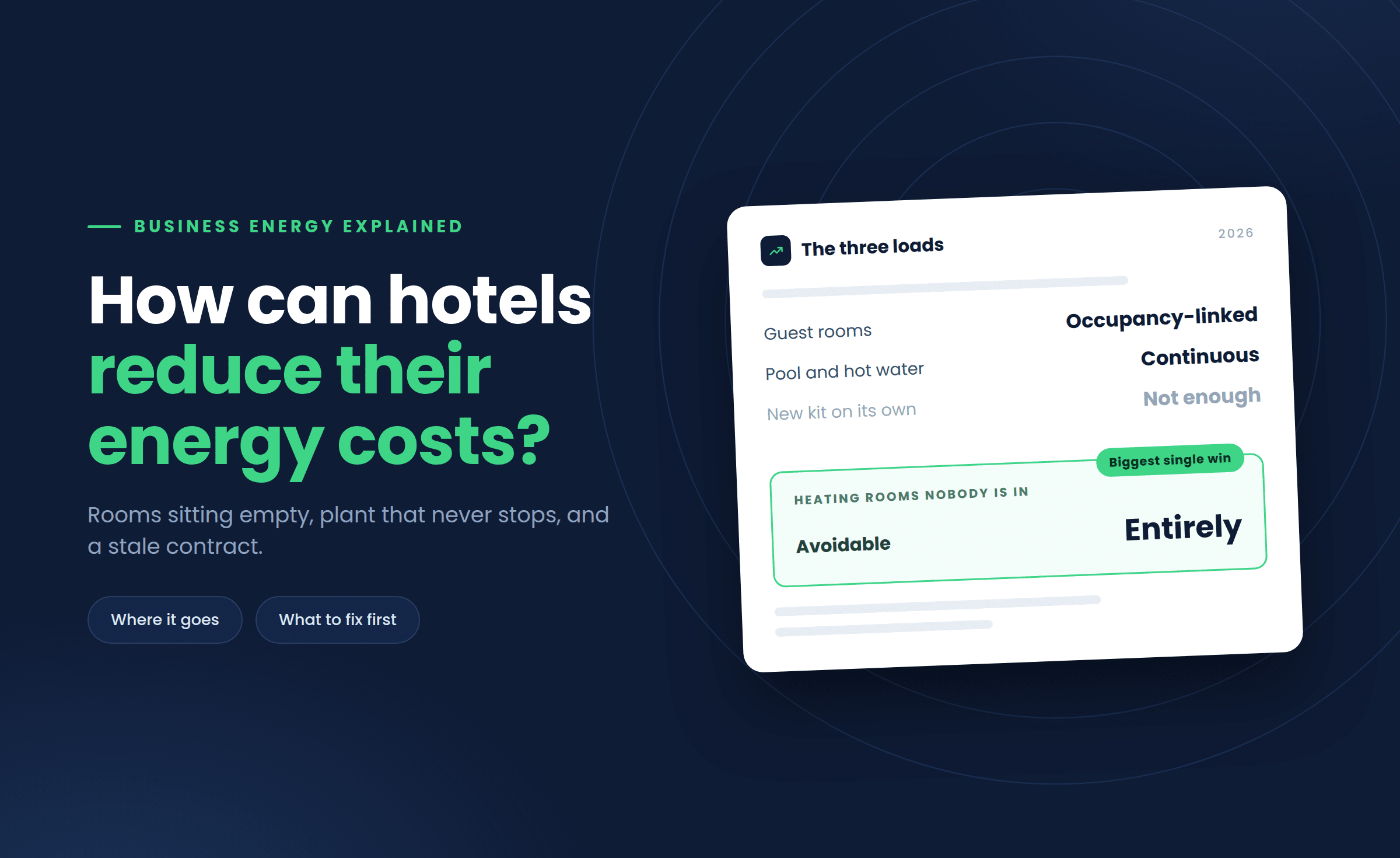
Hotels cut energy costs fastest by tackling three areas: heating and cooling guest rooms that sit empty for hours, pool and hot water plant that runs continuously, and a contract that has not been reviewed since the last renewal. Occupancy-linked heating controls and a fixed, competitively priced contract usually beat any single piece of new kit.
A hotel does not run to office hours. Reception, corridors, kitchens and plant rooms are live 24 hours a day, and a chunk of the building is always heating or cooling rooms nobody is currently standing in.
That is what makes hotel utility costs different from almost any other sector. UKHospitality members regularly flag energy as one of the fastest-growing lines on the P&L, with heating, hot water, laundry and leisure all running at once.
The good news is that hotel energy saving does not require a full refurbishment to move the needle. Most of the opportunity sits in how existing plant and rooms are controlled, as our hospitality and leisure guidance sets out.
Where does a hotel’s energy go?
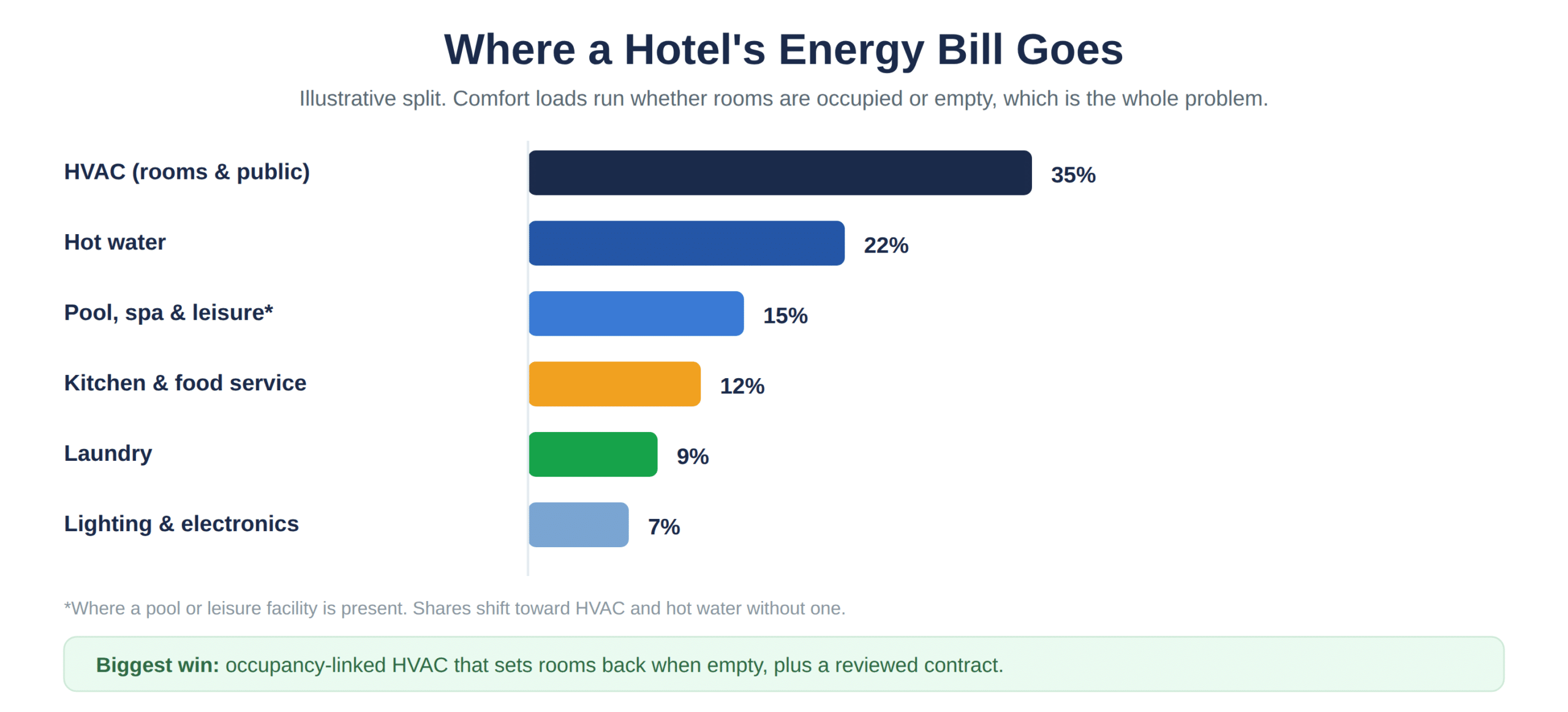
Heating, ventilation and air conditioning typically dominate a hotel’s energy bill, followed by hot water, kitchens and laundry, with guest room lighting and electronics making up a smaller share than most owners expect.
Several profiles at once
The building runs several different profiles simultaneously. Bedrooms need comfort conditioning on demand, corridors need constant low-level conditioning, and back-of-house kitchens and laundries run their own intensive loads.
| Area | Typical energy driver | Runs when |
|---|---|---|
| HVAC (rooms and public) | Comfort heating and cooling | Nearly continuously, varying by season |
| Hot water generation | Showers, kitchens, laundry | Around the clock, with morning and evening peaks |
| Kitchen and food service | Cooking, refrigeration, extraction | Breakfast through to dinner service |
| Laundry | Washing, drying, pressing | Daily, often overnight or early morning |
| Pool, spa and leisure | Heating, filtration, dehumidification | Continuously while the facility is open |
How much do heating and hot water cost a hotel?
Heating and hot water are usually the two largest gas costs on a hotel’s bill, because guest comfort expectations mean rooms and water are kept at a consistent temperature regardless of occupancy levels.
What a hotel might typically pay
Unlike an office that can drop heating to a minimum overnight, a hotel still needs hot water on tap and rooms warm enough for late check-ins. That is a genuine constraint, not an oversight.
A medium-sized hotel’s combined gas and electricity bill can sit well into the £7,129 medium usage band or above, depending on room count, occupancy and on-site facilities. Our guide to business energy contracts covers how usage bands affect the rate you are offered.
Electricity carries the cooling, lighting and leisure load, so it is worth comparing business electricity and gas separately rather than assuming one deal covers both well.
Can smarter room controls cut a hotel’s energy use?
Yes. Occupancy sensors and key-card-linked HVAC controls, which set heating or cooling back when a room is empty and restore it before a guest returns, are one of the most reliable hotel energy saving measures available.
Retrofit controls, not a rebuild
- Key-card thermostats: set back HVAC automatically when a room is unoccupied.
- Presence-detection lighting: in corridors and public areas rather than timers alone.
- Housekeeping flags: for rooms left with windows open or heating on full.
None of these need a capital project. Most are retrofit controls that pay for themselves through reduced runtime rather than reduced comfort.
The saving compounds with occupancy. A hotel running at 60% occupancy is heating four empty rooms in every ten unless controls set them back, night after night across the year.
Does a hotel’s pool and spa plant matter for the bill?
Where a hotel has a pool, spa or leisure facility, that plant is often one of the single biggest continuous loads in the building, because pool heating, filtration and dehumidification all run whether the pool is busy or empty.
Cutting pool and spa running costs
A pool cover overnight cuts heat loss considerably and is one of the cheapest interventions available. Filtration run-times can often be reduced outside peak bathing hours without breaching water quality rules, and the Carbon Trust rates covers among the best-value leisure measures.
Dehumidification in the pool hall is easy to overlook, but it runs hard whenever the air is warm and humid, which is most of the time a pool is in use.
How does seasonality affect a hotel’s energy contract?
Seasonal hotels with a summer or event-driven occupancy pattern often carry a fixed contract sized for peak demand all year round, which means paying for capacity that goes unused for months at a time.
Matching your contract to demand
A contract that matches your actual usage profile, rather than a generic tariff, makes a real difference here, and working with a service that understands seasonal patterns pays off. Review contract length against your plans too, as our guide to business energy renewals explains.
The fastest single move is usually reviewing the contract itself, since a hotel on an out-of-contract rate can be paying 40% to 80% more than a negotiated deal, dwarfing most operational savings.