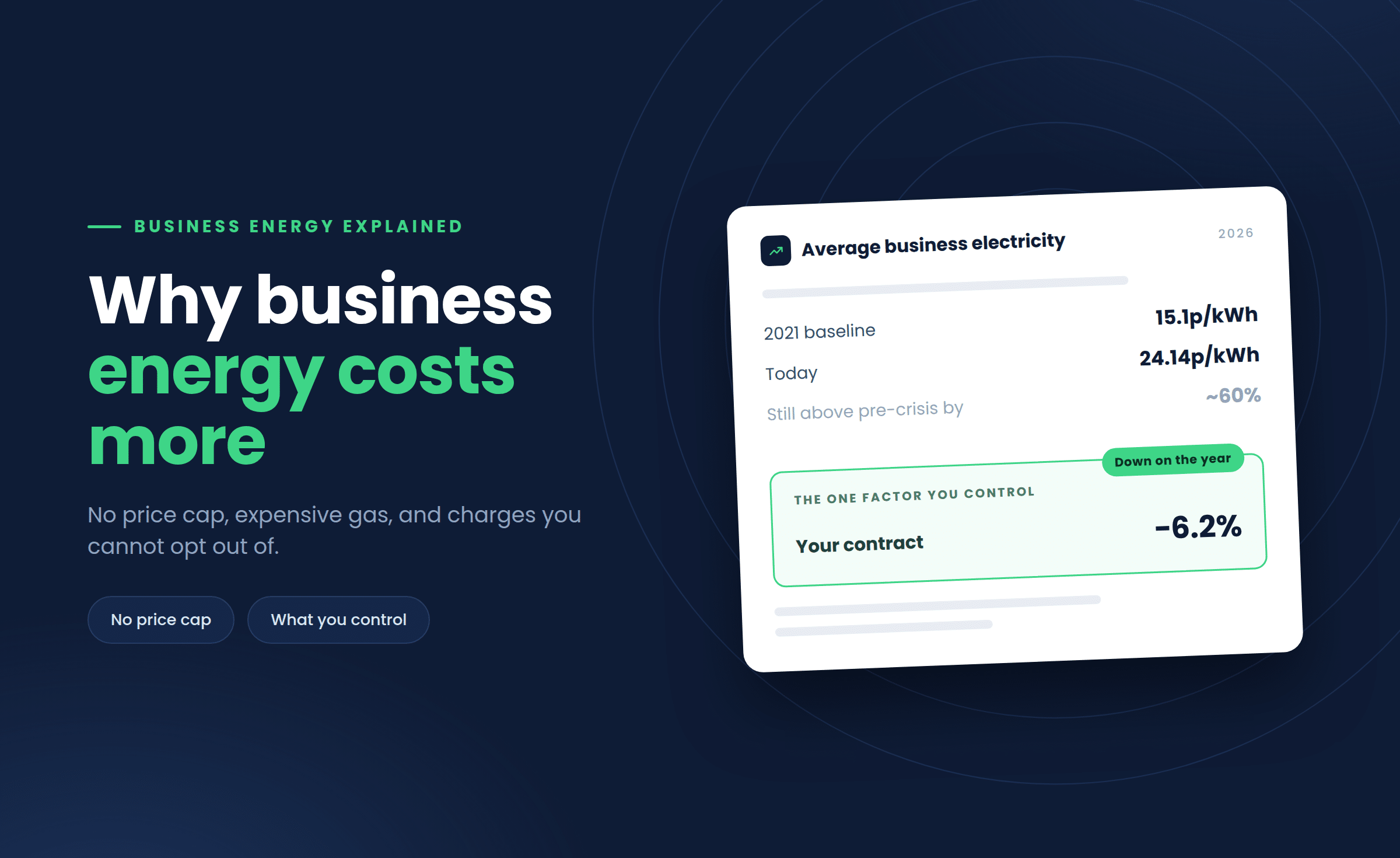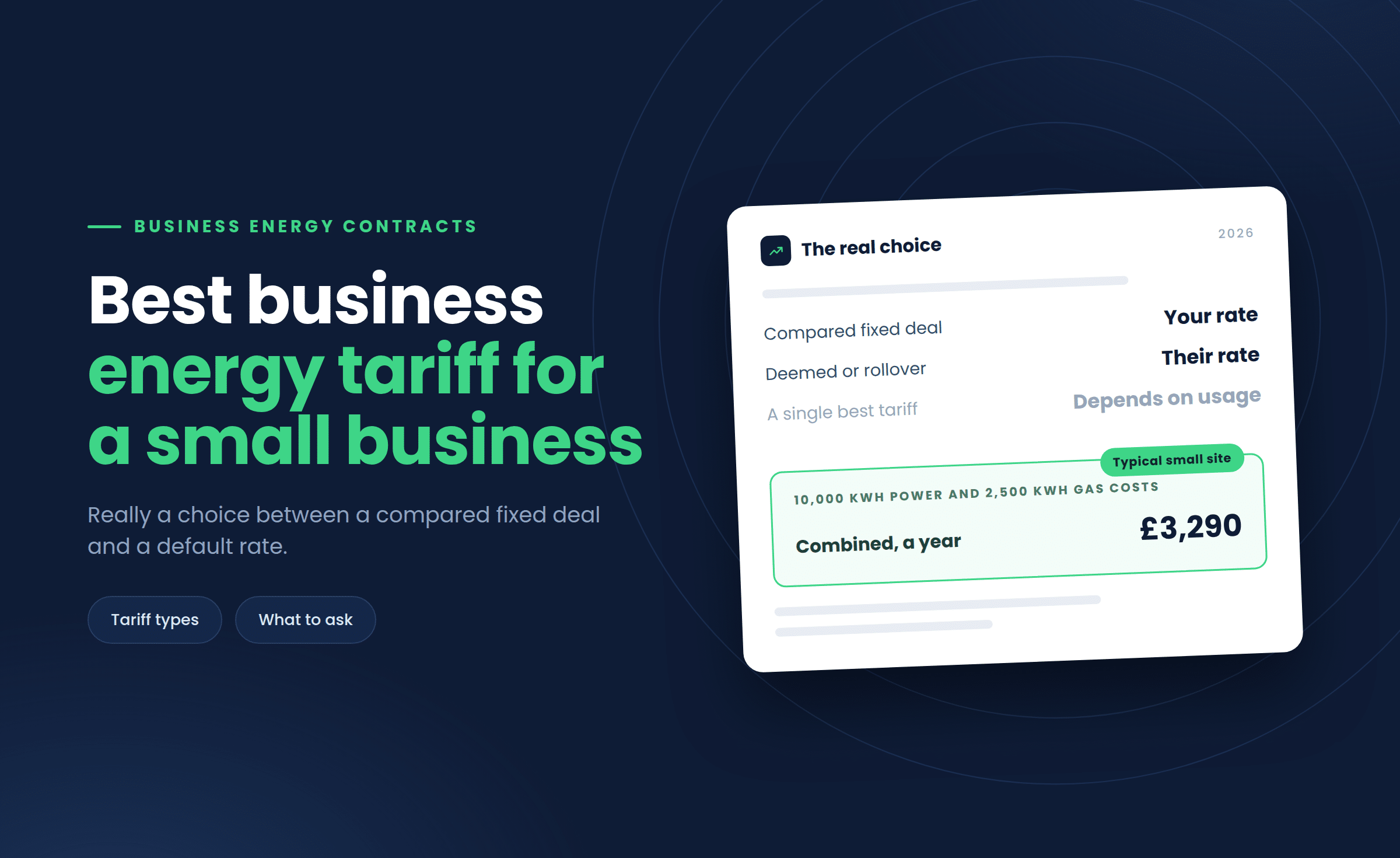

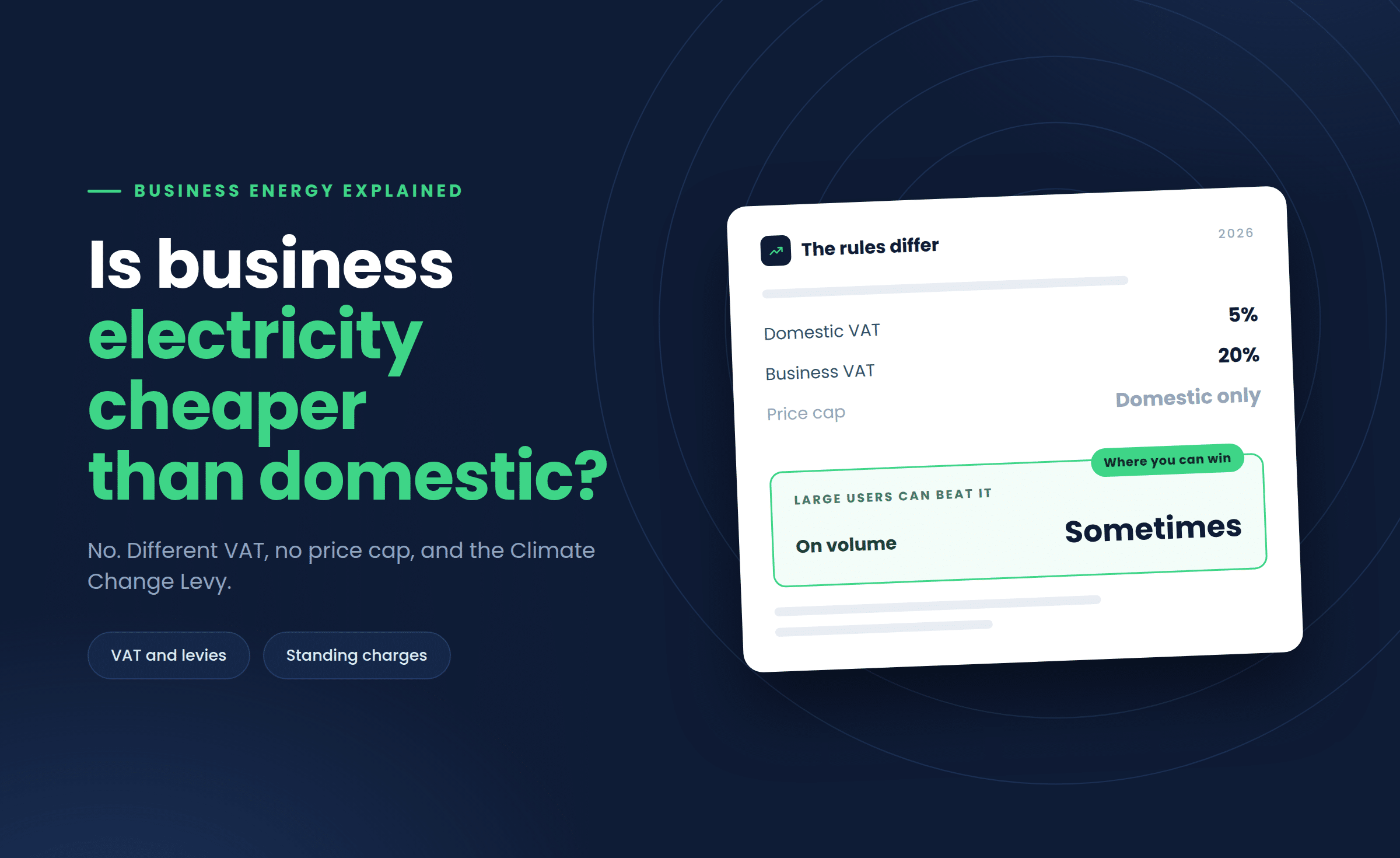
No, business electricity is typically more expensive per unit than domestic electricity. Businesses pay standard-rate VAT rather than the reduced household rate in most cases, get no price cap protection, and often carry the Climate Change Levy on top of the unit rate.
It catches a lot of new business owners off guard, especially anyone moving from running a household bill to running a commercial one for the first time.
The domestic market has a price cap, a reduced VAT rate and a 14-day cooling-off period built in. None of those protections carry across to a commercial contract, because businesses are legally treated as capable of negotiating their own terms, and there is no business energy price cap.
That does not mean business electricity is a bad deal, it just runs on entirely different rules. Understanding those rules is what lets a business compete on price rather than accepting whatever a renewal letter says.
What actually separates a domestic electricity price from a business one?
Domestic electricity is protected by Ofgem’s price cap and a default set of consumer rights, while business electricity is individually negotiated, unregulated on price, and locked into a fixed-term contract with no statutory cooling-off period.
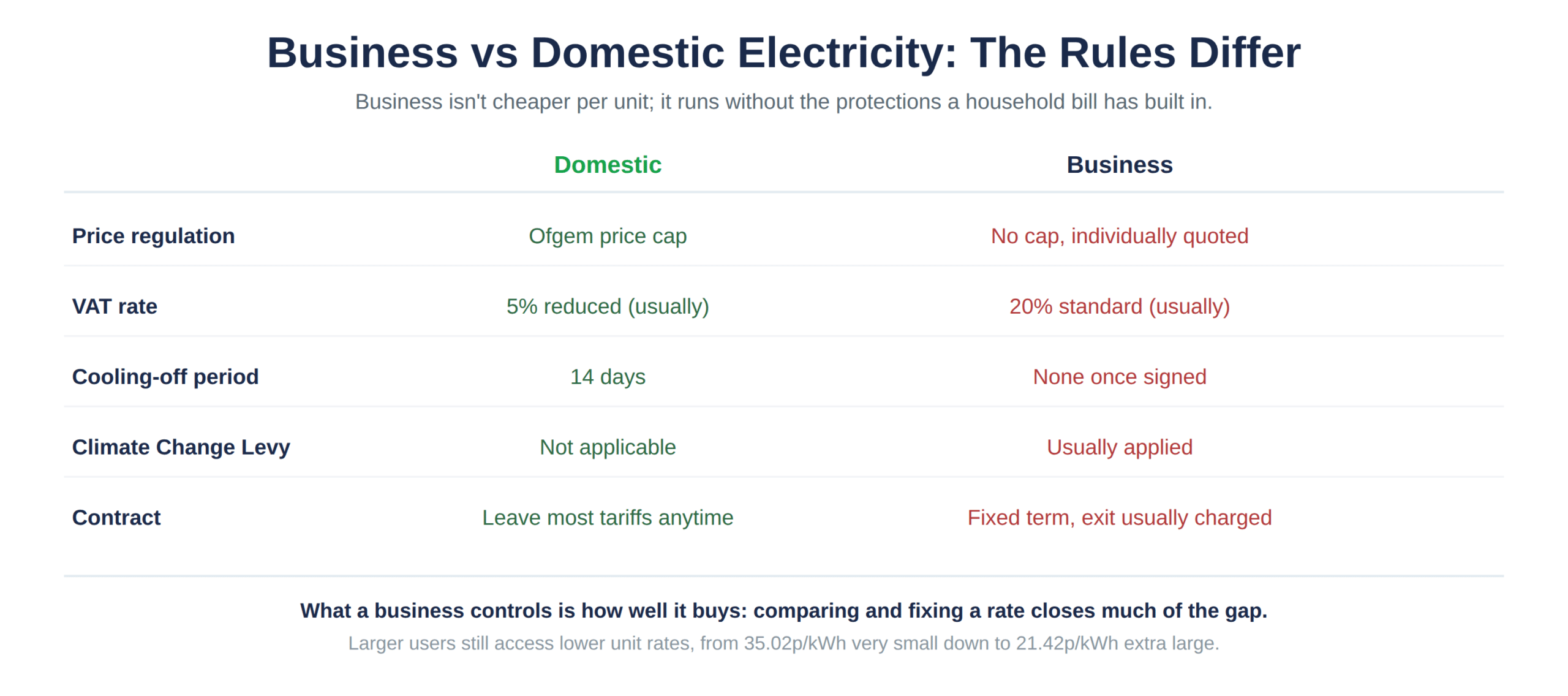
Five differences that set the rules
| Feature | Domestic | Business |
|---|---|---|
| Price regulation | Ofgem price cap | No cap, individually quoted |
| VAT rate | 5% reduced (usually) | 20% standard, unless usage qualifies |
| Cooling-off period | 14-day statutory right | None once signed |
| Climate Change Levy | Not applicable | Usually applied, unless exempt |
| Contract | Leave most tariffs anytime | Fixed term, early exit usually charged |
Those five differences, not the raw wholesale cost, are what make a business bill behave so differently from a household one.
Why do businesses typically pay more per unit than households?
Business electricity carries additional cost layers households do not, including the Climate Change Levy and typically standard-rate VAT, and suppliers price commercial risk differently because there is no regulatory cap limiting what they can charge.
Average business rates in 2026
Domestic suppliers must stay within the household price cap, which forces a ceiling on both the unit rate and standing charge. There is no equivalent ceiling on the business side, so unit rates reflect wholesale costs, network charges and margin, from DESNZ data, without a limit.
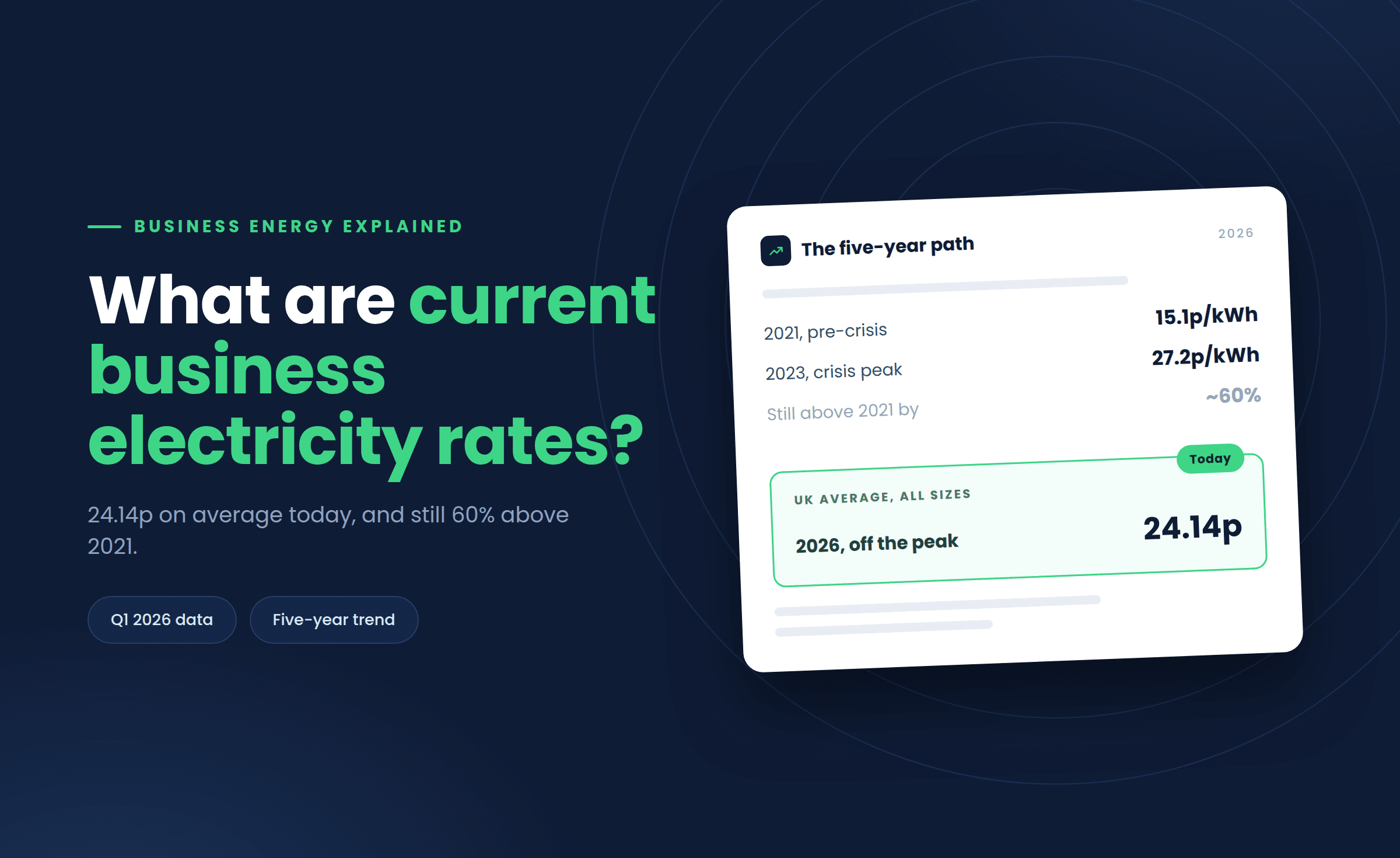
UK average business electricity sits at 24.14p/kWh across all sizes in 2026, ranging from 35.02p/kWh for very small users down to 21.42p/kWh for the largest. There is no government-published business price cap to compare it against.
How do standing charges compare between business and domestic supplies?
Business standing charges tend to run higher than domestic ones because commercial meters, particularly three-phase or half-hourly settled ones, cost more to maintain and settle than a typical household supply.
The unit-rate versus standing-charge trade-off
A business also has more choice over how the standing charge and unit rate are balanced, and our guide to unit rate versus standing charge explains how that trade-off plays out by usage pattern.
- High, steady usage: often prefers a lower standing charge and higher unit rate.
- Seasonal or low usage: often prefers a lower unit rate even with a higher standing charge.
Does VAT make business electricity more expensive than domestic?
Usually yes. Most business electricity is charged at 20% standard-rate VAT, compared to the reduced 5% rate most households pay, though some low-usage businesses and specific sectors can qualify for the reduced rate too.
Common VAT mistakes on bills
The qualifying rules are specific rather than a matter of judgement, and our guide to who qualifies for the reduced 5% VAT rate runs through de minimis thresholds, charities and other qualifying uses, alongside VAT on business energy bills.
From 1 October 2026 to 31 March 2027, VAT on qualifying electricity, the same charity, de minimis and mixed-use supplies, drops to 0% rather than 5%. It applies to electricity only, reverts to 5% on 1 April 2027 unless extended, and standard 20% business electricity outside those categories is unchanged throughout.
Are there any ways a business electricity account works out cheaper?
Businesses that use energy efficiently, qualify for reduced VAT, or negotiate a strong fixed-term rate through comparison can end up paying a lower effective rate than an equivalent household, even without a price cap.
Where volume works in your favour
Larger consumers on higher usage bands access noticeably lower unit rates, from 28.76p/kWh at the small end down to 21.42p/kWh for extra large users, a gap domestic tariffs do not offer at all.
The panel-based comparison model that works for households applies just as well commercially. Businesses switching through a supplier panel save an average of £1,952, which narrows or reverses the domestic-versus-business gap in practice.