
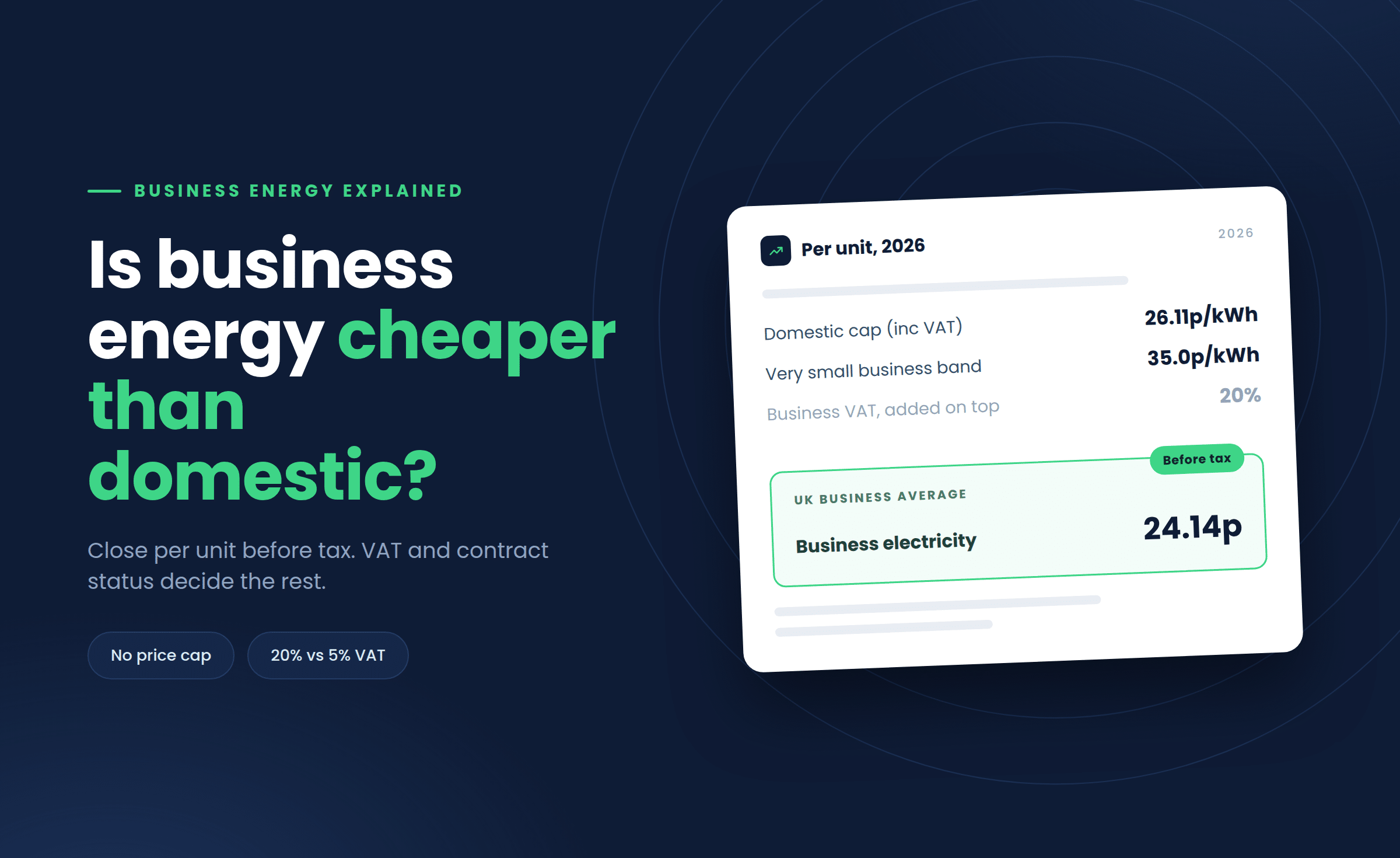
Not automatically. Business energy sits outside Ofgem’s household price cap, so a commercial rate can run higher or lower than a domestic one depending on your size, meter and contract.
It is a fair question, and one that trips up a lot of people moving from running a home to running a business. Surely a bigger customer gets a better deal?
Sometimes. A large site with high, predictable use can negotiate a sharper rate than a household ever sees, while a small business on a poor contract can pay more per kWh than the house next door.
How is domestic energy priced?
Domestic energy in Great Britain is protected by Ofgem’s price cap, which sets a maximum unit rate and standing charge for customers on a default tariff, reviewed every three months.
The price cap
The cap does not fix your total bill, since it still moves with usage, but it limits what a supplier can charge per unit. For the current period it sets electricity at 26.11p per kWh, as Ofgem’s cap figures show, and households can also fix a tariff outside the cap if they choose.
The reduced VAT rate
VAT on domestic energy is charged at a reduced 5% rate, reflecting its treatment as a basic household cost under the VAT rules on fuel and power. That 5% is already included in the capped rate above.
How is business energy priced?
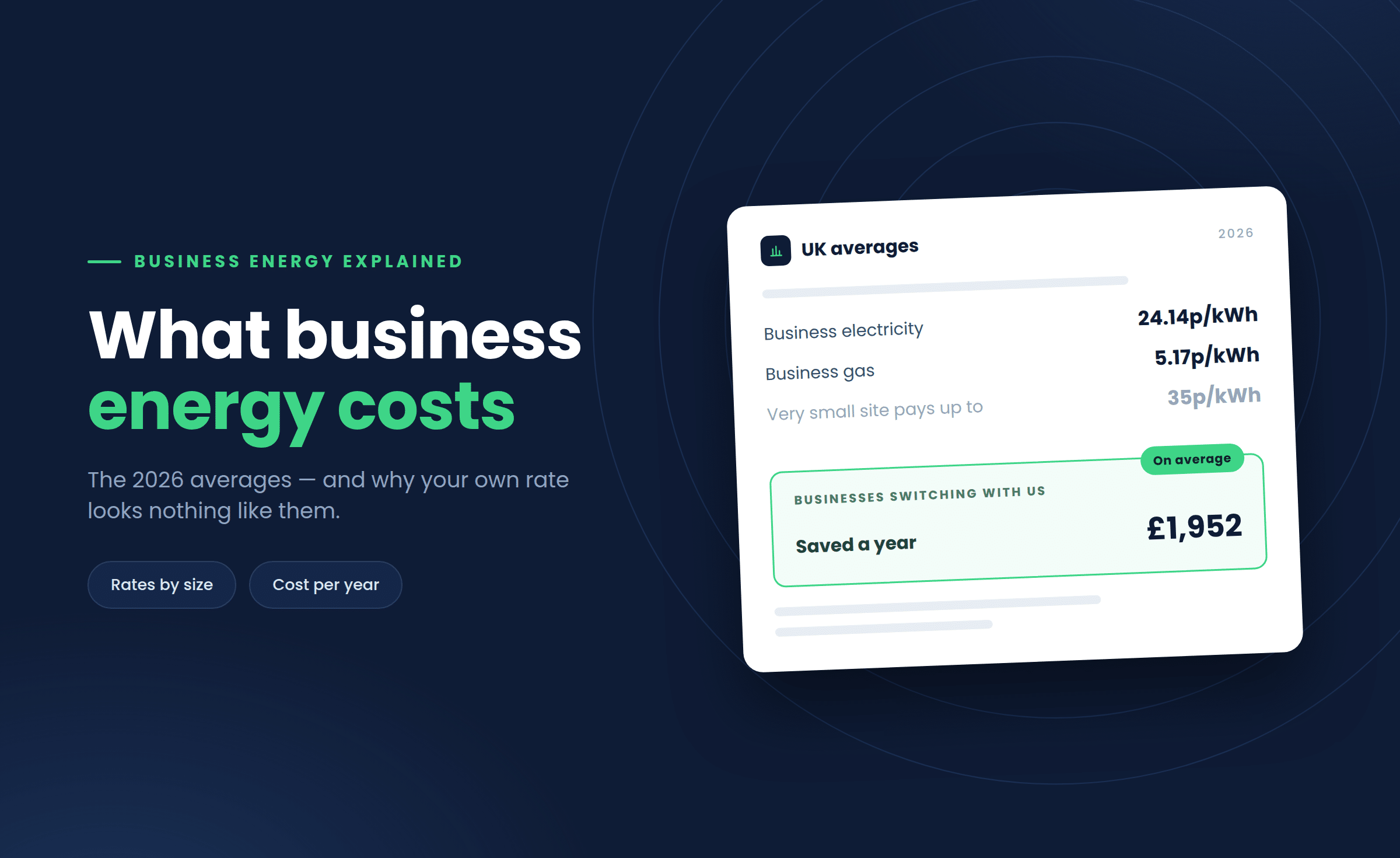
Business electricity and gas are priced entirely through negotiated contracts, with no equivalent cap, and rates vary sharply by size. The UK average is 24.14p per kWh for electricity and 5.17p for gas in 2026.
Rates by business size
Those averages hide a wide spread, drawn from government price data. A very small firm pays far more per unit than a large one.
| Business size | Annual electricity use | Average rate (p/kWh) |
|---|---|---|
| Very small | 0 to 20 MWh | 35.0p |
| Small | 20 to 500 MWh | 28.8p |
| Medium | 2,000 to 20,000 MWh | 25.0p |
| Large | 20,000 to 70,000 MWh | 23.9p |
| Extra large | Over 150,000 MWh | 21.4p |
| UK average | All businesses | 24.14p |
The 20% VAT rate
Business energy usually carries 20% VAT, four times the domestic rate, unless a firm qualifies for the reduced rate through low usage or charitable status. You can check live business gas and business electricity rates against your own bill.
What are the key differences between business and domestic energy?
The biggest differences are the missing price cap, higher standard VAT, weaker cooling-off protection, and half-hourly settlement for larger business meters. Per unit before tax, the two are closer than most people expect.
Cap, VAT, cooling-off and settlement
Household energy is capped and lightly taxed, while business energy is negotiated and taxed at the standard rate. The comparison below sets the two side by side.
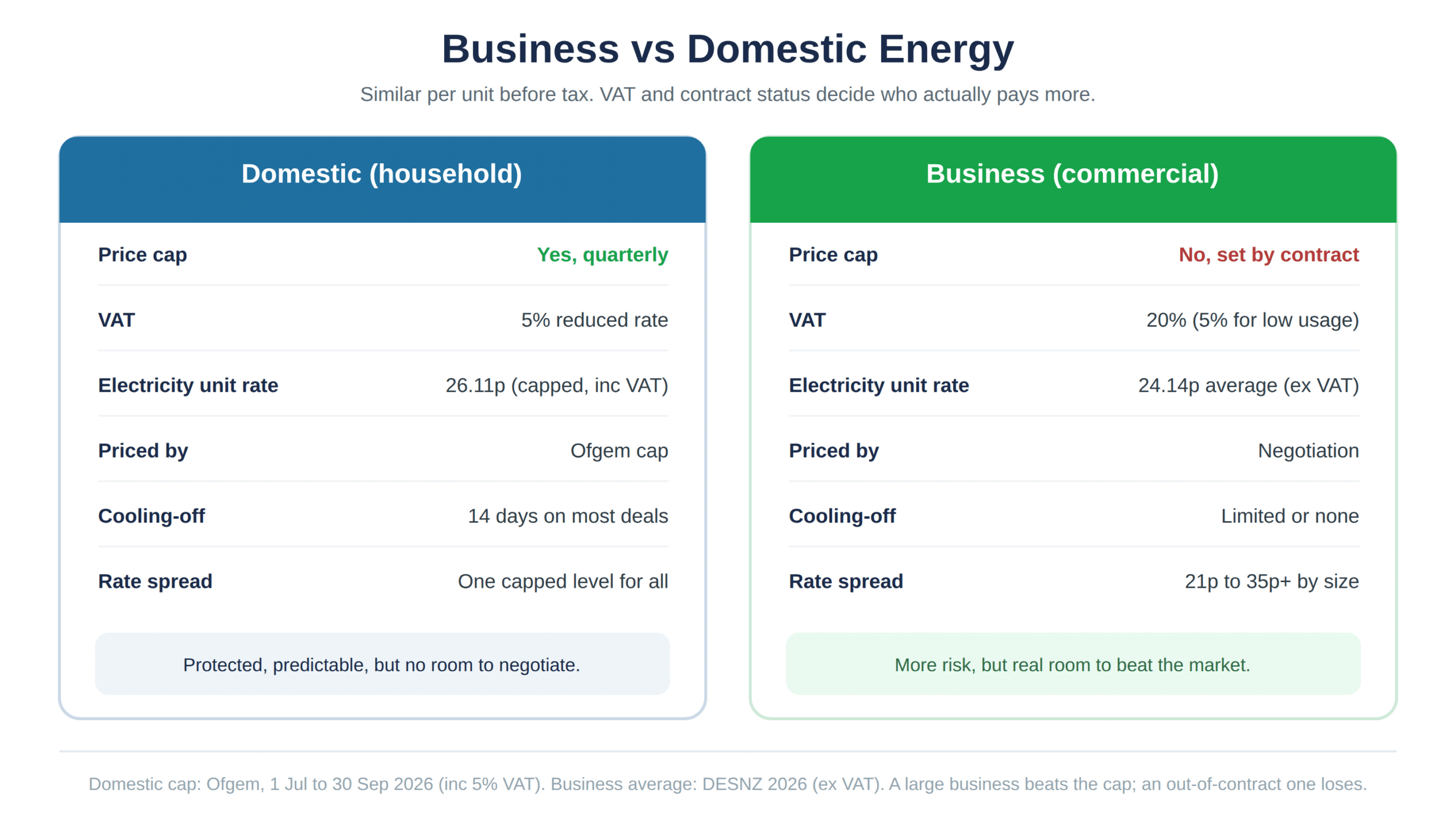
| Energy type | 2026 average rate | Price cap? |
|---|---|---|
| Business electricity | 24.14p/kWh (ex VAT) | No, set by contract |
| Business gas | 5.17p/kWh (ex VAT) | No, set by contract |
| Domestic electricity | 26.11p/kWh (capped, inc VAT) | Yes, reviewed quarterly |
The VAT twist
On the headline rate the two are close, at roughly 24p for the business average against 26p for the capped domestic rate. But domestic includes 5% VAT while business adds 20% on top, so an average business often pays more once tax is counted.
Is business energy cheaper or more expensive overall?
It genuinely depends on your size band. A large business on around 24p per kWh can beat many domestic rates, while a very small one on 35p plus 20% VAT can end up paying more than a comparable household.
It depends on your band
Blanket claims about business being cheaper or dearer do not hold up. The honest answer depends on your consumption band, your contract status and your VAT position, which our guide to how much business energy costs breaks down in full.
Out-of-contract loses badly
One thing is consistent: a business left on an out-of-contract or deemed rate, running 40% to 80% higher than a negotiated deal, will almost always lose the comparison. That is the position to avoid at all costs.
The fix is simple. Compare business energy suppliers and switch before your contract ends rather than drifting onto a default rate.
Which matters more, business status or usage?
Usage and contract status matter more than the business-versus-domestic label. Two businesses of different sizes can see a bigger gap between each other than either sees against a typical household.
Usage and how it is measured
How your usage is measured and settled feeds directly into your rate, which is why your MPAN number and profile class matter. A comparison against your specific size band and region tells you far more than any general business-versus-domestic figure.
Moving from home to business premises
Sole traders moving out of a home office into their first unit often assume energy works as it did at home. It does not, because the premises needs its own business contract and its own supply, usually triggered by a change of tenancy.
Take opening meter readings on day one to avoid disputed estimates, and compare quotes rather than accepting the site’s deemed rate by default.