
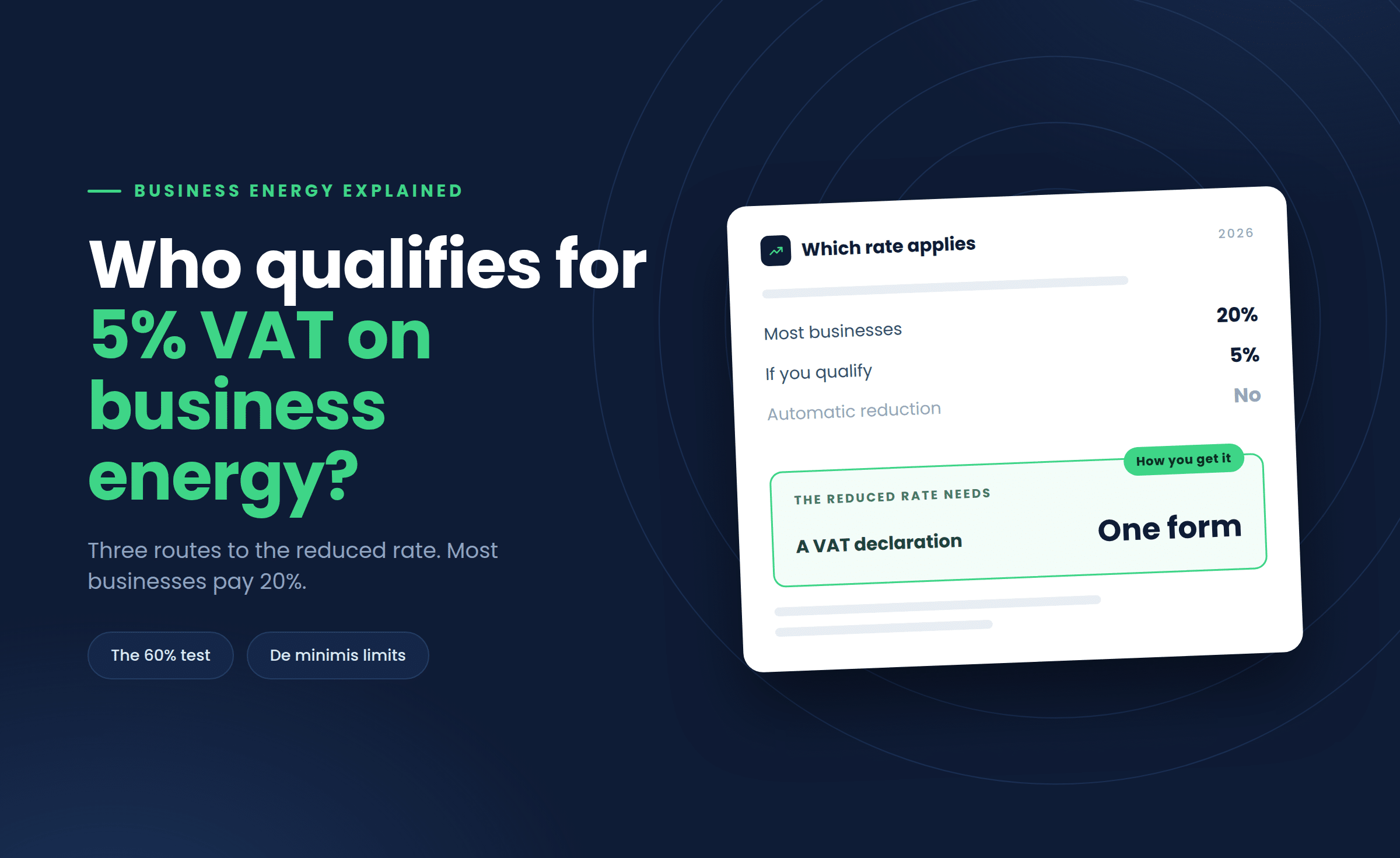
Most businesses pay VAT at 20% on gas and electricity, but you qualify for the reduced 5% rate if at least 60% of what you use is for domestic, residential or charitable non-business purposes, or if your usage falls below HMRC’s de minimis threshold.
A typical small business paying a few thousand pounds a year for gas and electricity can easily miss that VAT alone adds hundreds of pounds to the figure. Most owners assume the rate is fixed and move on.
It is not always fixed. HMRC treats energy VAT differently depending on how the premises is used, not just who the customer happens to be.
Care homes, places of worship, small guesthouses with a live-in owner and any business using very little energy can all end up paying the same 5% rate households pay. The trouble is that suppliers will not apply it automatically, as our guide to VAT on business energy bills explains.
What is the standard VAT rate on business energy?
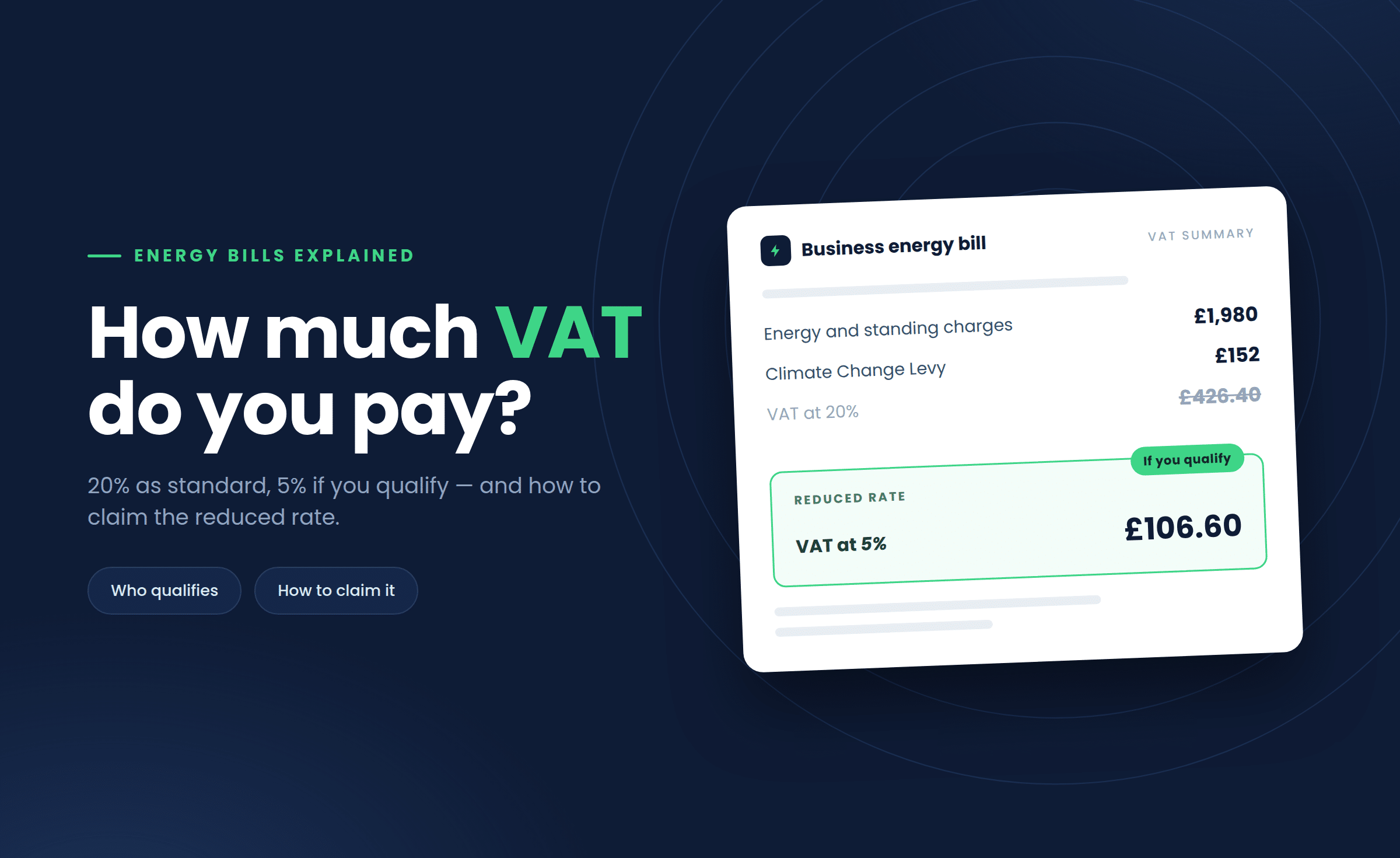
Business electricity and gas is charged at the standard 20% VAT rate by default under HMRC rules, roughly four times the 5% rate applied to most domestic household energy use.
Where VAT sits on the bill
That single difference explains why two premises using an identical amount of gas can end up on very different total bills. The unit rate might be the same; the tax on top is not.
Suppliers apply 20% automatically unless you tell them otherwise in writing. Our guide to how to read a business energy bill shows exactly where VAT sits on your statement if you want to check what you are currently being charged.
| Illustrative annual electricity cost | VAT at 20% | VAT at 5% | Saving if you qualify |
|---|---|---|---|
| £1,000 (micro) | £200 | £50 | £150 |
| £3,000 (small) | £600 | £150 | £450 |
| £6,000 (medium) | £1,200 | £300 | £900 |
| £12,000 (large) | £2,400 | £600 | £1,800 |
Which businesses qualify for the reduced 5% VAT rate?
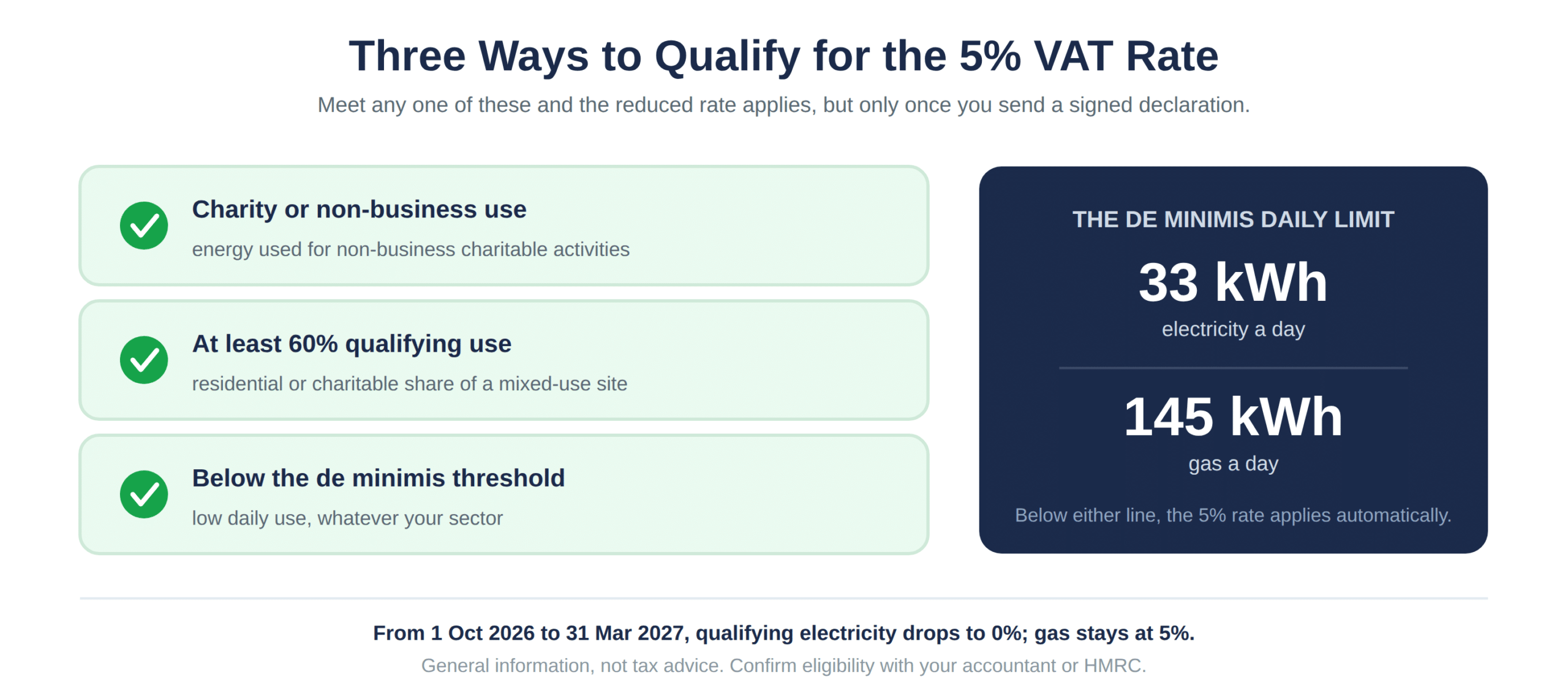
You qualify for 5% treatment if your average daily use is below the de minimis threshold, 33 kWh of electricity or 145 kWh of gas a day, or if at least 60% of the energy supplied goes towards qualifying use.
Qualifying use is broader than most expect
- Charities and not-for-profits: using energy for non-business activities.
- Residential accommodation: such as care homes, children’s homes and student halls.
- Places of worship: and church halls.
- Low-usage sites: any micro business under the de minimis line, regardless of sector.
A guesthouse where the owner lives on site, a small hairdresser working alone from a converted garage, or a village hall run by volunteers can all sit comfortably under that de minimis line. It is worth checking your actual daily average before assuming you do not qualify.
How does a VAT declaration form for energy actually work?
You confirm eligibility by sending your supplier a signed VAT declaration form, sometimes issued as a certificate alongside the equivalent Climate Change Levy declaration, stating what percentage of your usage qualifies for the reduced rate.
What happens if the form is wrong
There is no single universal document. Most suppliers have their own version, so the practical first step is asking your account manager for their specific paperwork rather than searching for a generic template.
Once submitted, the supplier applies the 5% rate from the date they process it, and some will backdate an eligible claim. HMRC can recover any VAT that should have been charged at 20%, plus interest, if a declaration is wrong, so HMRC’s fuel and power guidance is worth checking before you sign.
Can mixed-use premises get a partial VAT reduction?
Yes. If part of a building is used for qualifying purposes, such as a flat above a commercial unit, you can apply the 5% rate to that percentage of usage and pay 20% on the rest under a split VAT arrangement.
When the whole supply can qualify
This is common for landlords running a shop with a residence attached, or a pub with living quarters upstairs. Suppliers need the split confirmed in writing rather than estimated verbally.
If the residential proportion exceeds the 60% qualifying-use threshold on its own, the whole supply can sometimes be treated at the reduced rate instead of split. A call to HMRC’s VAT helpline or your accountant will confirm which applies.
From 1 October 2026 to 31 March 2027, VAT on qualifying electricity supplies drops to 0% rather than 5%, covering the same charity, de minimis and mixed-use categories. It is electricity only, gas stays at 5%, and the measure is due to revert to 5% on 1 April 2027 unless extended.
What’s the link between reduced VAT and the Climate Change Levy?
Businesses that qualify for the 5% VAT rate are usually also exempt from paying the Climate Change Levy on those same units, because CCL exemption follows the same de minimis and qualifying-use rules HMRC applies to VAT.
One declaration can clear both
That means one declaration can often clear both charges at once, rather than needing two separate applications. Our guide to Climate Change Levy exemption covers how the CCL side works if your business also has energy-intensive operations on site.
Pair that check with a proper comparison of your underlying unit rate, since a 5% rate on an overpriced tariff is still an overpriced bill. Comparing business gas and business electricity quotes at renewal is the moment to confirm both.