
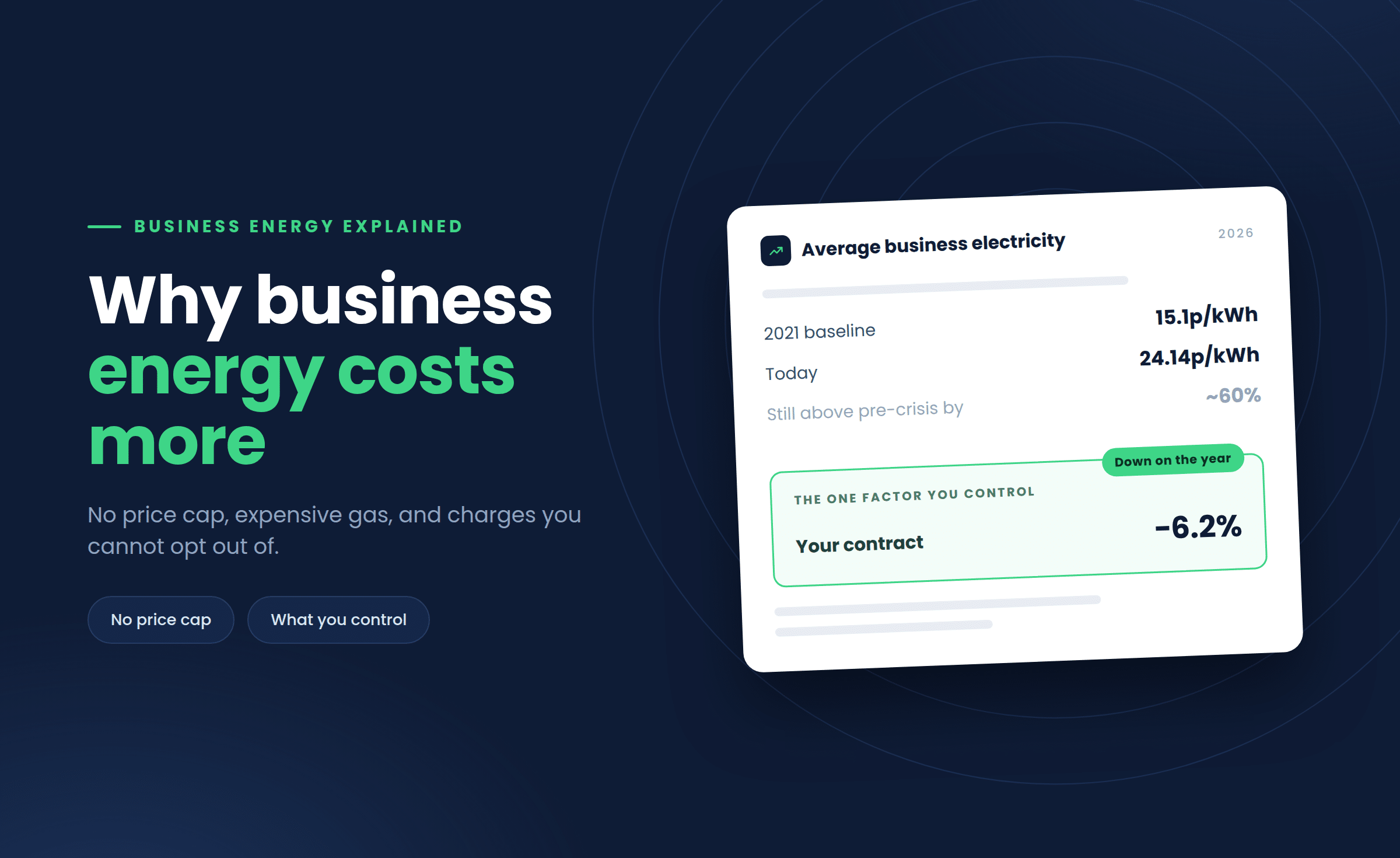
Business energy prices are high because business contracts carry no price cap, wholesale costs still sit well above pre-2021 levels, and network charges have climbed on top. It has eased lately, but from a much higher base.
If a renewal quote looks nothing like what you paid a few years ago, you are not imagining it. Average business electricity is still around 60% higher than in 2021, even after a recent fall, per government price data.
Much of the confusion comes from comparing business bills to the capped household ones in the news. Business bills work differently, and this guide walks through exactly why, and what you can do about it.
Why is there no price cap on business energy?
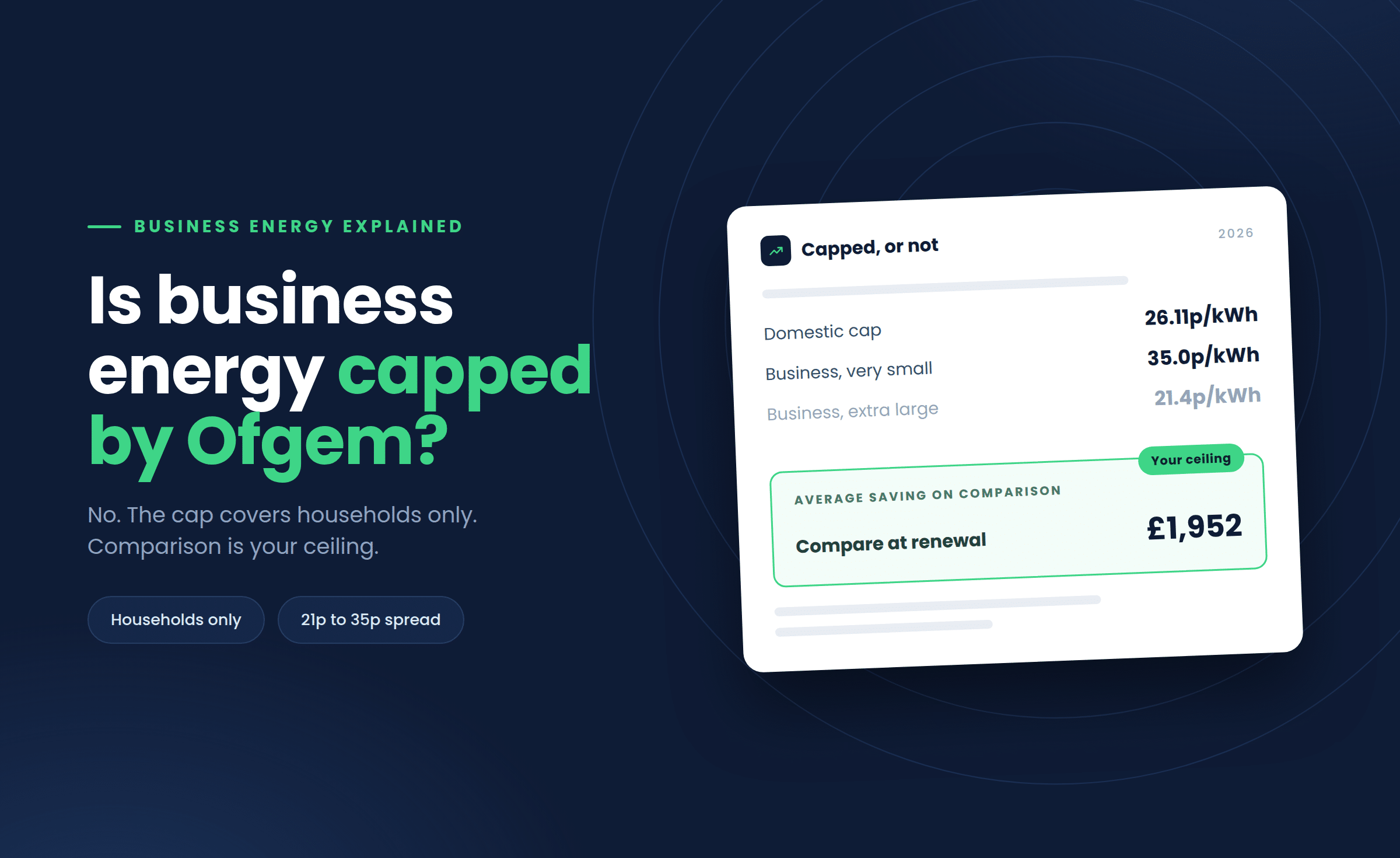
Ofgem’s price cap applies only to domestic energy. Business energy is priced through negotiated contracts, which is why business price rises can hit harder and faster than household ones.
The legal basis
The domestic cap comes from the Domestic Gas and Electricity (Tariff Cap) Act 2018, which made Ofgem set a default tariff ceiling for households. No equivalent cap was ever created for business, on the basis that firms can shop around and negotiate.
What this means for your business
That assumption only holds if you actually compare the market. A business that never switches has no cap to fall back on, and no floor either.
How much have business energy prices risen?
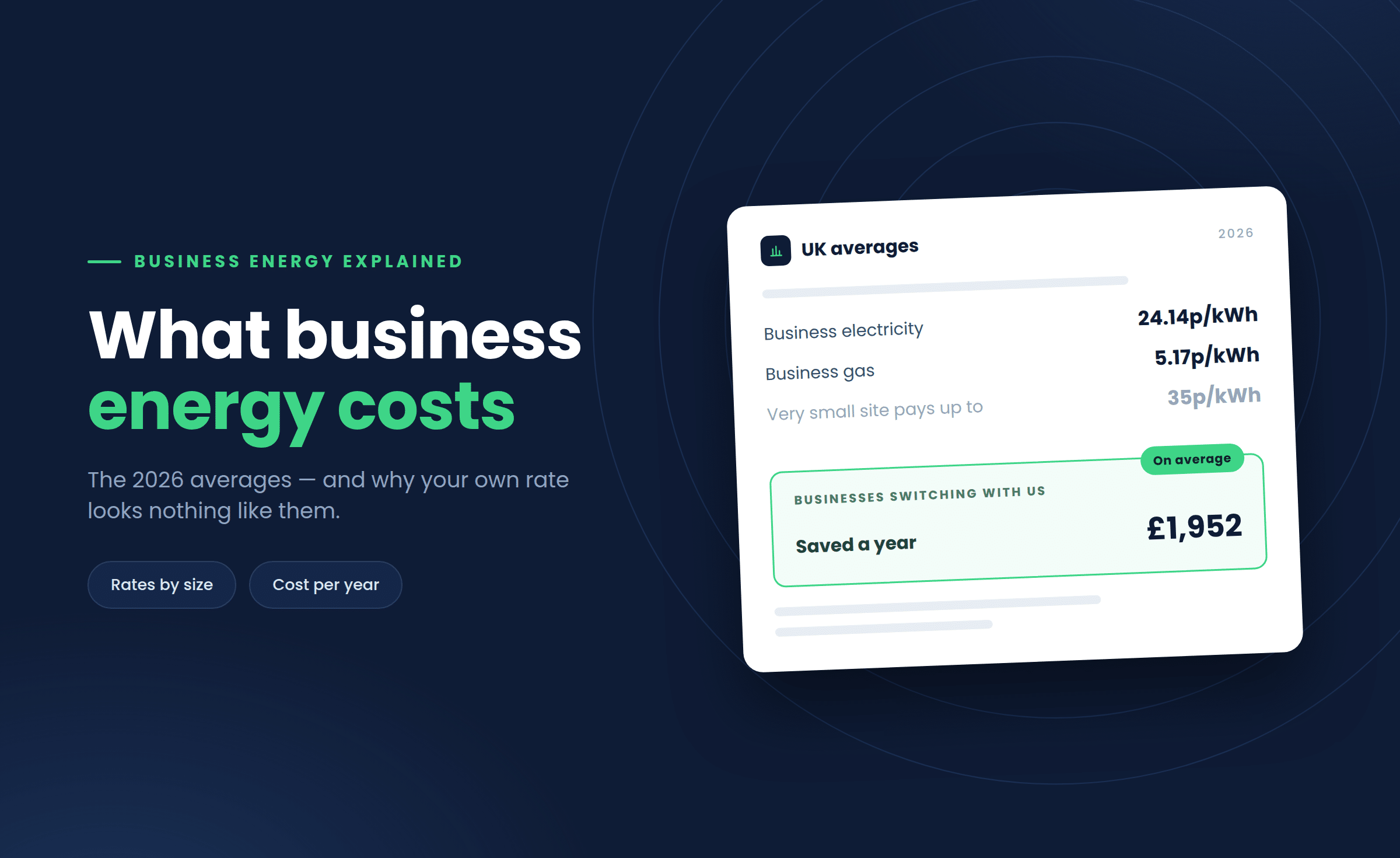
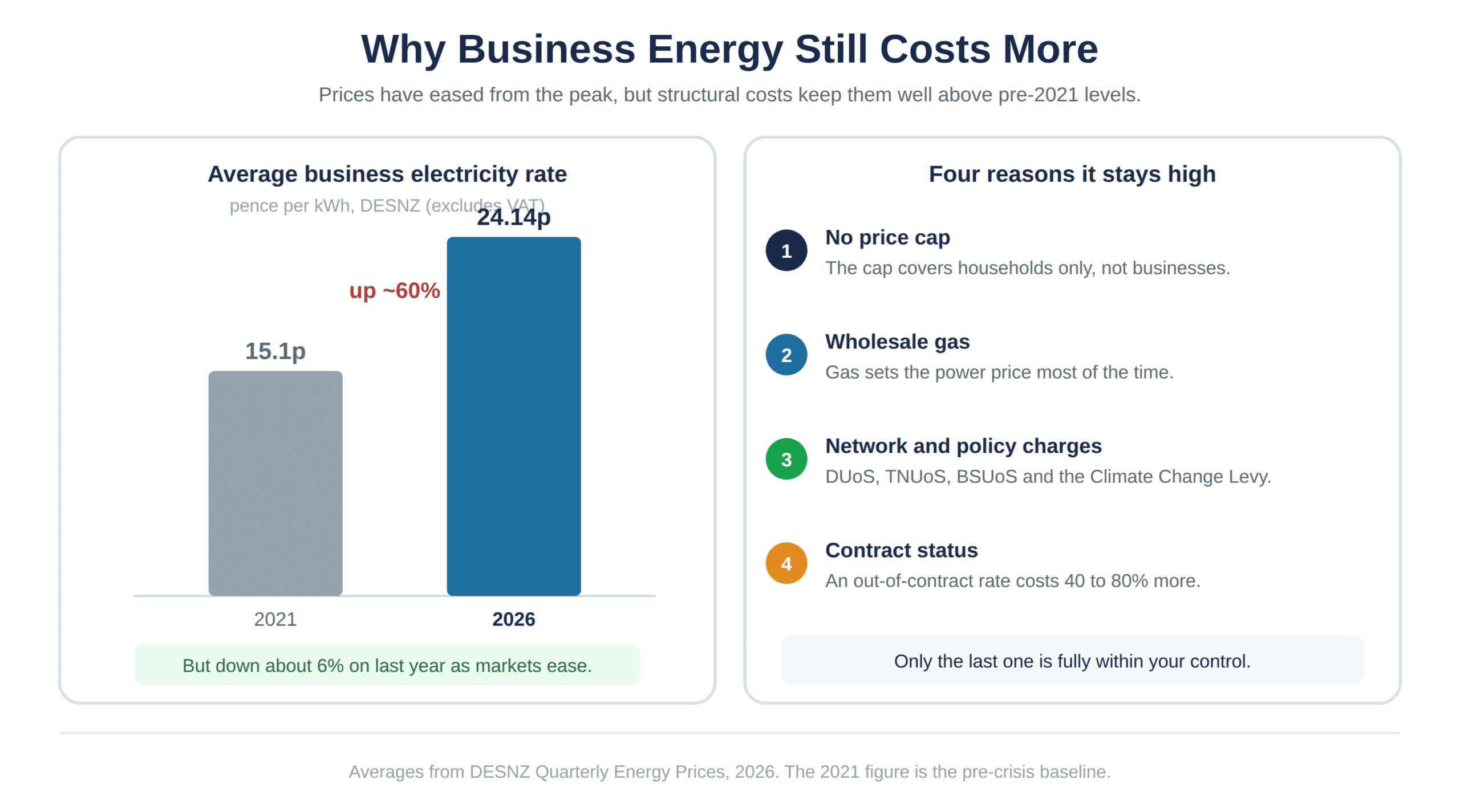
UK average business electricity is 24.14p per kWh in 2026, down 6.2% on the year but still around 60% above where it stood in 2021. Prices have eased from the peak, not returned to normal.
The five-year picture
The graphic and table below set the current market against that longer trend. The recent fall is real, but the starting point is far higher than most owners budget for.
| Market metric | 2026 figure |
|---|---|
| Average business electricity rate | 24.14p/kWh |
| Change year on year | Down 6.2% |
| Change versus 2021 | Up around 60% |
| Best 2-year fixed electricity, from | 26.2p/kWh |
| Best 2-year fixed gas, from | 7.9p/kWh |
| Out-of-contract premium | 40% to 80% higher |
| Average saving switching via USE | £1,952 a year |
| Typical switch transfer time | About 5 working days |
Size changes the picture
A very small business paying about 35p per kWh feels the squeeze far more than an extra large site on around 21p, even though both face the same market. Our guide to how much business energy costs breaks the rates down by size band.
What role does wholesale gas play in business energy prices?
Gas sets the price of UK electricity most of the time, so a wholesale gas spike drags electricity prices up with it. That is exactly what happened from 2021 onwards.
Why gas sets the price
Britain still generates a large share of its electricity from gas, even as that share falls. When gas is the last plant needed to meet demand, its cost sets the price for the whole market, so expensive gas feeds through to electricity contracts too.
How suppliers hedge their purchases
Suppliers buy wholesale energy months or years ahead, a practice Ofgem calls hedging. That is why a fixed quote reflects market conditions from when the supplier bought the energy, not today’s spot price.
Want to know what your business should actually be paying? Run a business energy comparison or compare live business electricity prices in 60 seconds, or call our UK team on 01242 32 31 31.
Do network and levy charges make business energy more expensive?
Yes. Distribution and transmission charges, balancing costs and the Climate Change Levy all sit on top of the wholesale rate and none are optional, so together they make up a large slice of your bill.
The non-commodity stack
These charges are added on top of the energy itself, whichever supplier you use. The main ones are below.
- DUoS: local distribution costs, set by your regional network operator.
- TNUoS and BSUoS: national transmission and balancing costs, passed through by your supplier.
- Climate Change Levy: a per-kWh HMRC tax, reducible with a Climate Change Agreement.
- Supplier margin: the commercial cost of managing risk and serving the account.
Why bills vary by region
Distribution and transmission charges vary by network area, so two firms with identical usage in different regions can see different bills. Operators such as UK Power Networks, SSEN and Northern Powergrid each set their own charges, and the Climate Change Levy is added on top by HMRC.
Are business energy prices likely to keep rising?
No one can promise a direction, but the 6.2% year-on-year fall shows prices can move down as well as up when wholesale markets ease. The market remains sensitive to gas supply and demand.
Current fixed-rate benchmarks
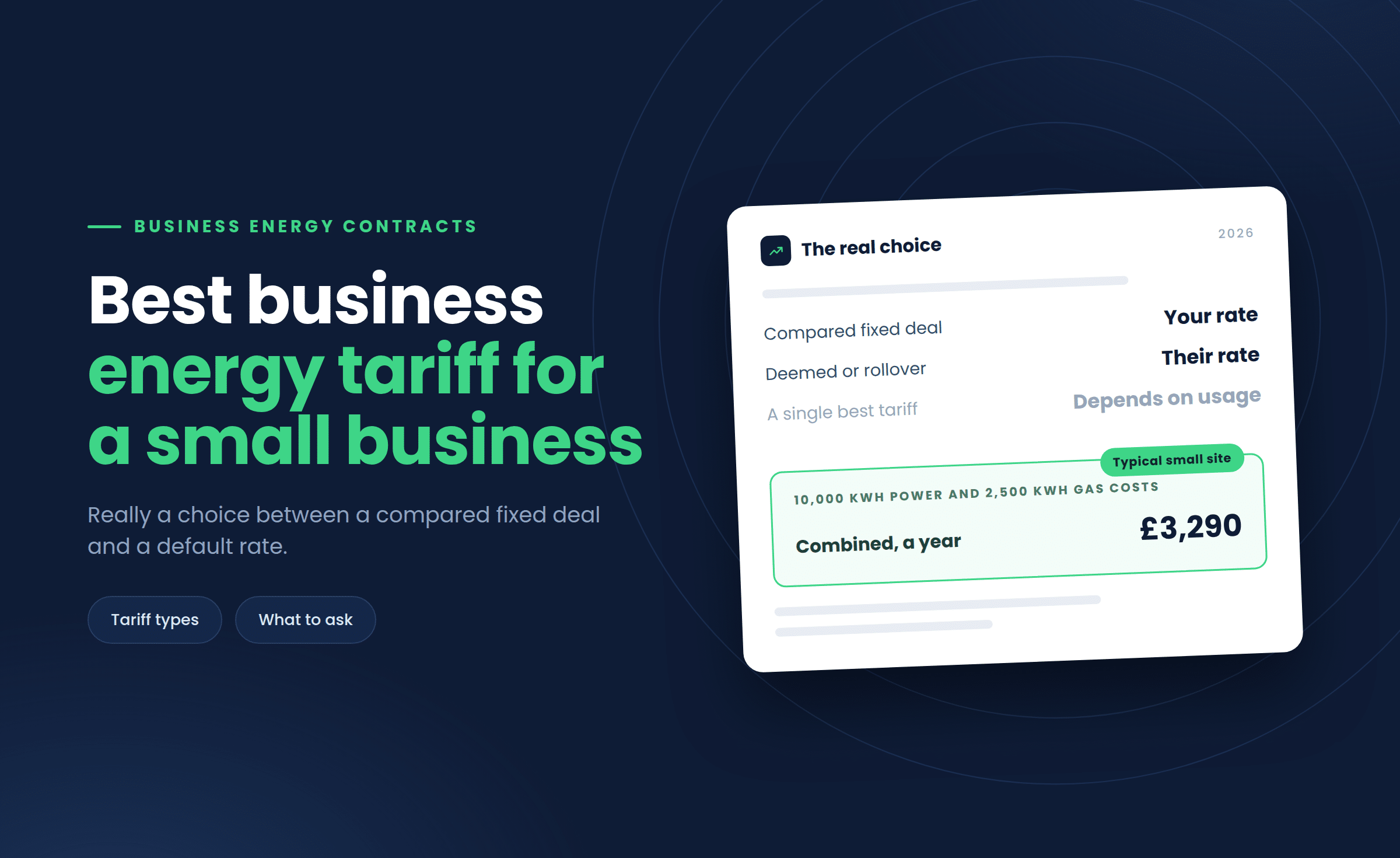
The best two-year fixed rates now start from around 26.2p per kWh for electricity and 7.9p for business gas, which shows where the competitive end of the market sits. The current Climate Change Levy rates are set separately by the government and apply on top.
Fixing versus waiting
A fixed deal trades the chance of future falls for certainty against future rises. If you are weighing a short fix against a longer one, our business energy price outlook looks at the market in more detail.
What can a business do about high energy prices?
The one factor fully in your control is your contract. Comparing the market and switching before your deal ends is the single biggest saving, worth an average of £1,952 a year with Utility Saving Expert.
Switch in good time
Start comparing three to six months before your renewal date, then agree a deal to start when your current one ends. The transfer completes in about five working days, so switching supplier is quicker than most owners expect, and it removes the risk of drifting onto an out-of-contract rate 40% to 80% higher than a negotiated one.
Other levers worth pulling
Check whether a Climate Change Agreement applies to your sector, and ask for quotes across the whole panel of business energy suppliers rather than one. Reviewing your energy procurement each year is where the saving is found.