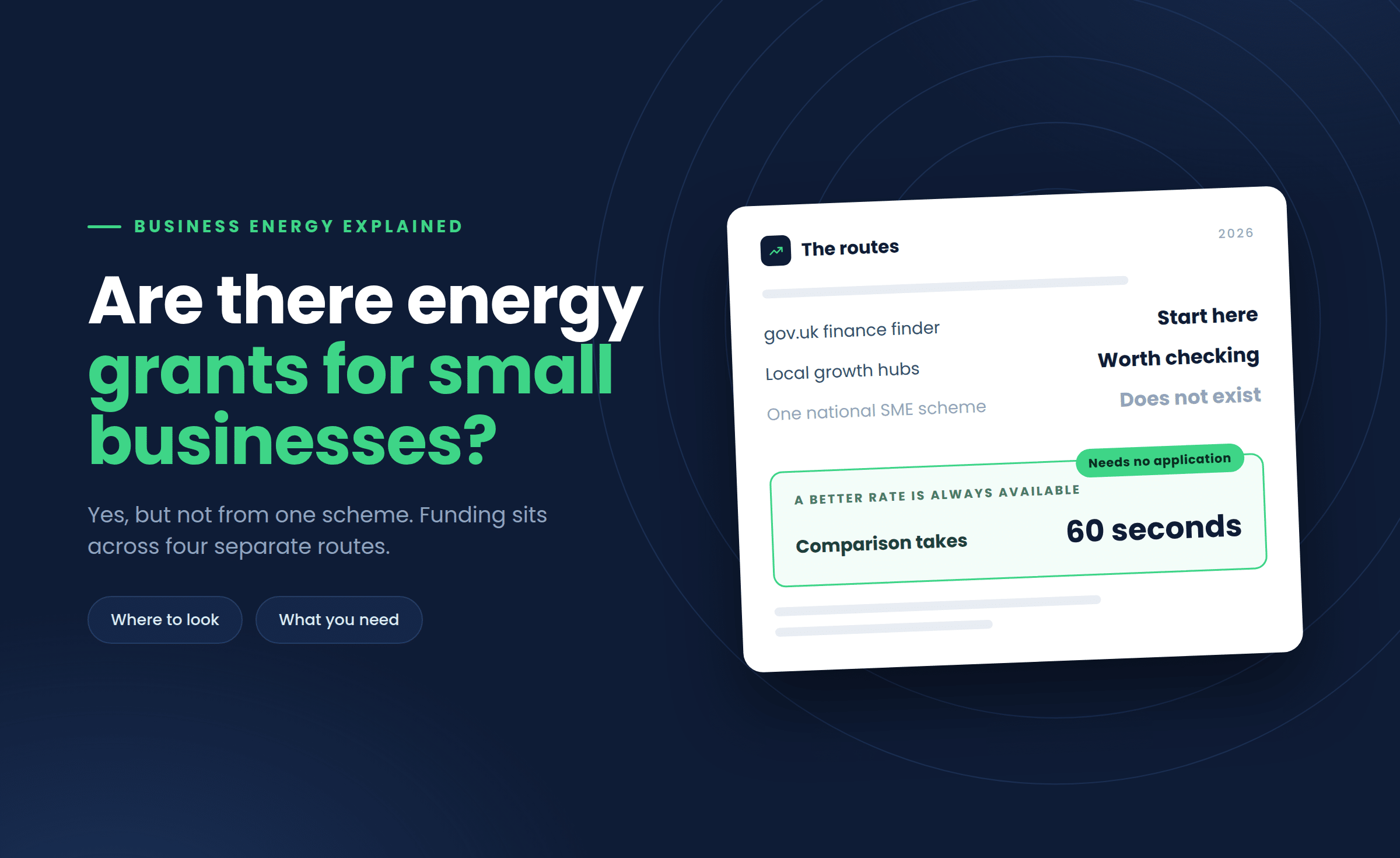

Business energy efficiency grants generally fall into four types: capital grants for specific equipment, interest-free or low-interest loans, business rates relief on qualifying green plant, and sector or region-specific decarbonisation funds. Availability changes constantly, so the gov.uk business finance support finder is the first stop, not a guess.
Search for energy grants for business and you will find pages listing schemes that closed months ago sitting alongside genuinely live funding, with no obvious way to tell them apart at a glance.
That is not laziness on the part of whoever wrote them. Government energy grants for business genuinely open, close and get replaced on a rolling basis, often tied to annual budgets or specific decarbonisation targets.
What does not change as often is the type of support on offer and where a business should go to check what is current. That is a far more useful thing to understand than any single scheme name.
What types of energy efficiency funding exist for UK businesses?
Most business energy efficiency grants fall into four broad categories: capital grants covering part of an equipment cost, interest-free or subsidised loans, business rates relief on qualifying plant, and targeted decarbonisation funds for specific sectors or regions.
Grants versus loans
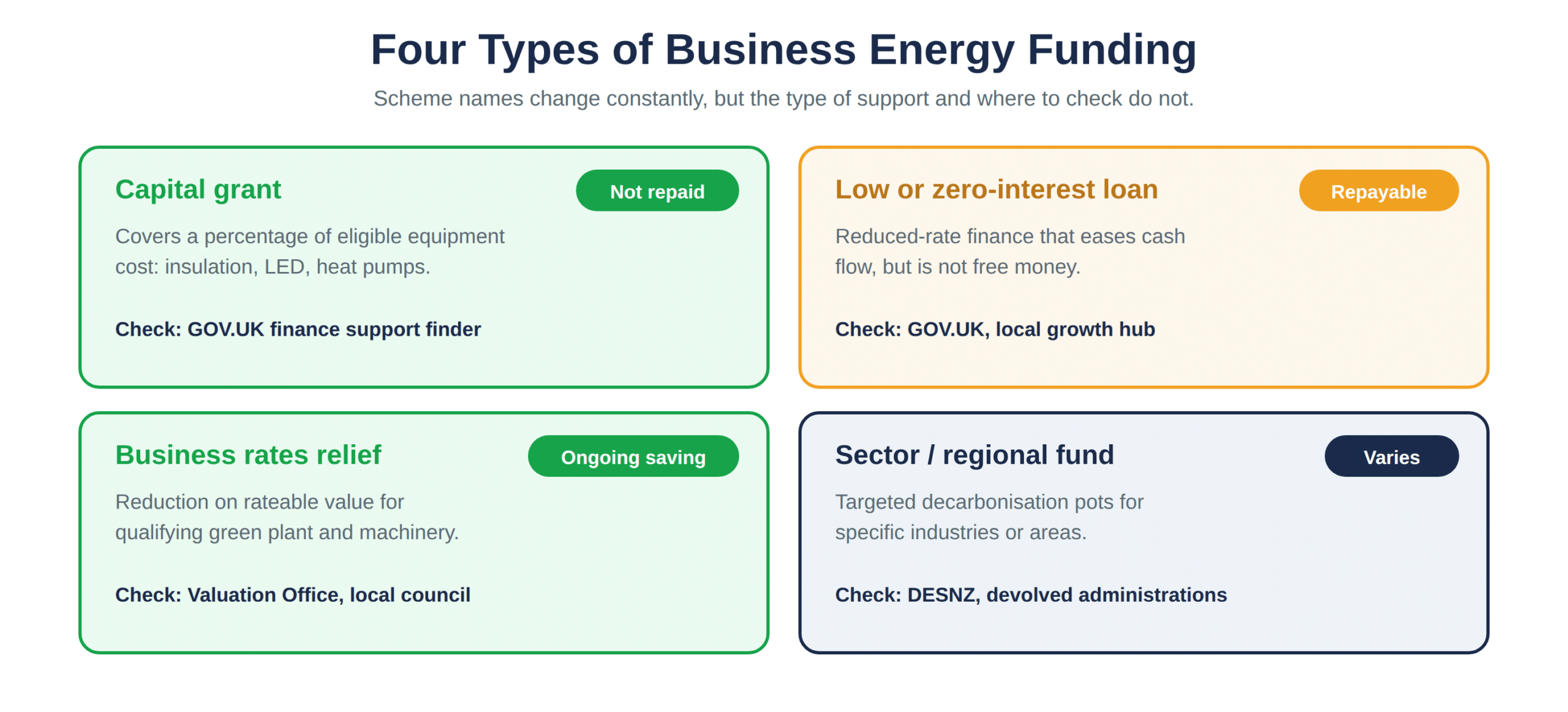
| Type of support | How it typically works | Where to check |
|---|---|---|
| Capital grant | Covers a percentage of eligible equipment cost | gov.uk finance support finder |
| Interest-free or low-interest loan | Repayable finance at a reduced rate | gov.uk, local growth hub |
| Business rates relief | Reduction on rateable value for qualifying green plant | Valuation Office Agency, council |
| Sector or regional decarbonisation fund | Targeted at specific industries or areas | DESNZ, devolved administrations |
Capital grants cover a percentage of a project such as insulation, LED lighting or a heat pump, not the whole bill. Notably, the Boiler Upgrade Scheme is not domestic-only: it also funds heat pumps in non-domestic buildings, which many businesses assume it excludes.
The exact percentage and cap move between schemes and rounds, so a figure quoted in an old article is rarely the one on offer today. Loans work differently again: you borrow at a reduced or zero rate, which helps cash flow but is not free money.
Where can a business find live grant schemes?
The gov.uk business finance support finder is the most reliable single source for current schemes, alongside local growth hubs, which often know about regional pots that national search tools miss entirely.
Quick list of places to check
- gov.uk finance finder: filtered by energy and sustainability.
- Your local growth hub: for regional and devolved funding pots.
- DESNZ guidance: the Department for Energy Security and Net Zero publishes active schemes.
- Trade bodies: sector associations and chambers of commerce flag member-only funding.
Growth hubs exist to connect local businesses with funding, and they are free to talk to. Note too that the Industrial Energy Transformation Fund is winding down, so check the gov.uk finance support finder for what has replaced it rather than chasing a closed scheme.
Do england, scotland and wales offer different support?
Yes. Energy efficiency support is partly devolved, so Scotland and Wales run their own schemes alongside anything UK-wide, and a business should check its own nation’s route rather than assuming one UK scheme covers everyone.
The devolved routes
In Scotland, support tends to run through nationally backed advisory and funding programmes alongside local authority schemes. In Wales, Business Wales is the central point for advice and funding referrals, and usually the fastest way to find what is open.
Scotland and Wales both lean more on interest-free or low-interest loans than on outright grants, so expect repayable finance rather than free money in many devolved programmes. That still helps a project stack up, but it changes the cash-flow maths.
Northern Ireland runs its own separate business support system too, generally accessed through Invest Northern Ireland, so businesses there should check that route specifically rather than assuming GB-wide schemes apply.
What can a business do while waiting on a grant decision?
Get quotes and a clear cost breakdown ready in advance, keep recent bills to hand, and start with the free or low-cost efficiency changes that do not depend on any grant approval at all.
Do not wait to start saving
Application windows can run for weeks or months, and demand often exceeds the funding pot. Our guide to energy-saving tips for small businesses is worth working through in parallel, since none of it depends on a grant and some of it strengthens a later application.
It is also sensible to check your current contract while you wait, because a business overpaying on its base rate is losing money regardless of any grant. Timing a business energy renewal well can save more than a small grant would.
Do grants affect tax or other business reliefs?
It depends on the scheme. Some grants count as taxable income while capital allowances on the underlying equipment can still apply, so this is genuinely a question for your accountant rather than a general assumption either way.
The capital allowances interaction
HMRC treats different grant structures differently, and getting this wrong on a return causes more hassle than it is worth. Some allowances, including the Annual Investment Allowance, can still apply even where a grant covered part of the cost, and separate reliefs like the Climate Change Levy may also be relevant.
A short conversation with your accountant before applying avoids a nasty surprise later. The interaction between a grant and any allowance needs checking case by case, not assuming either way.