
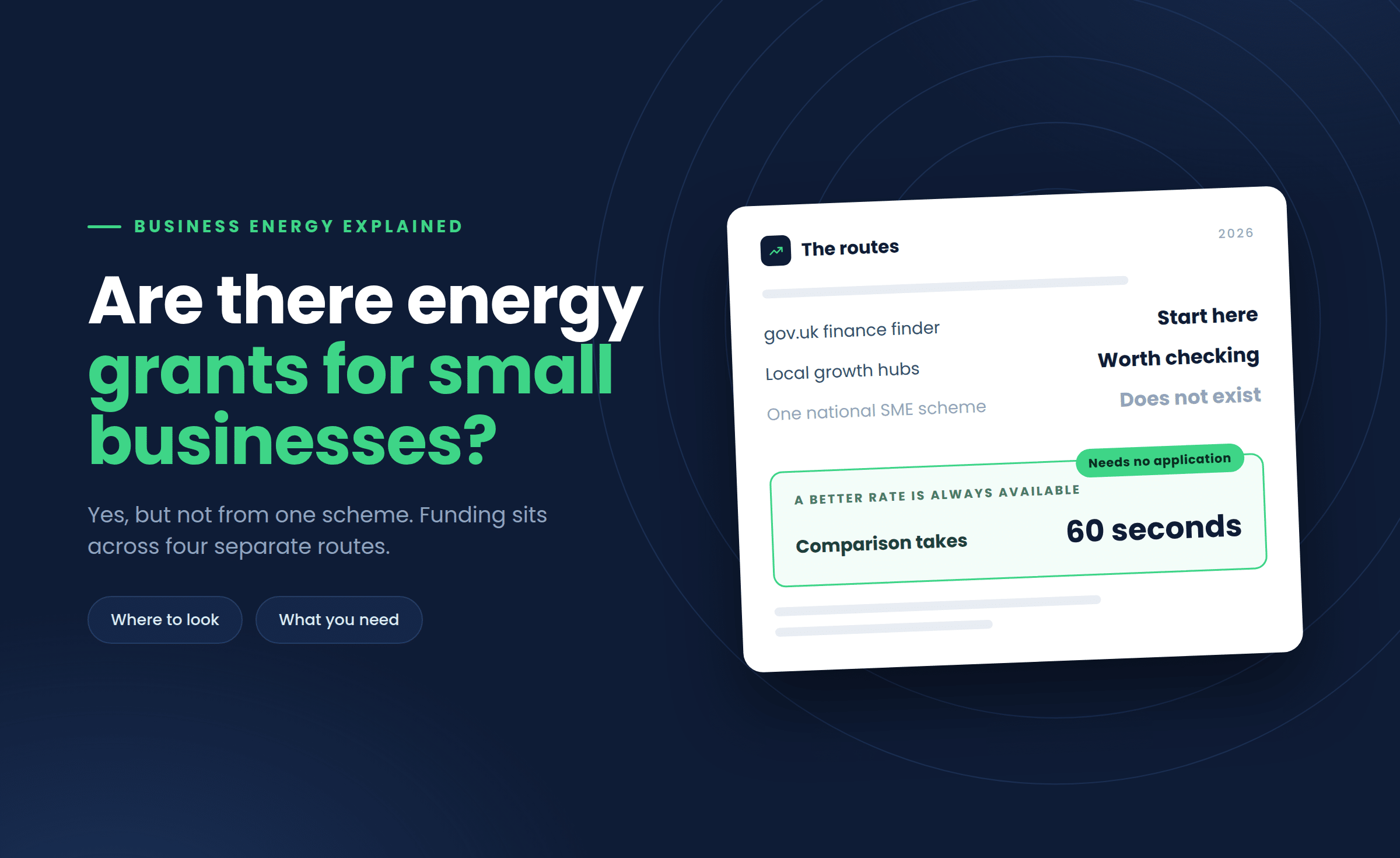
Yes, but not through one single scheme. SME energy grants in the UK are spread across the gov.uk business finance support finder, local growth hubs, devolved schemes in Scotland and Wales, and occasional sector-specific funds, so a small business usually needs to check several routes rather than one.
Small business energy grants is one of those searches that promises a tidy answer and delivers a scattered one. There is no single pot every small firm applies to.
That is frustrating if you expect one form on one website, but it also means there is more funding across the system than a single headline scheme would suggest.
Funding tends to be split by nation, sector and project type, which is exactly why the search feels harder than it should. Knowing where each type lives makes it much shorter.
Is there a single small business energy grant scheme?
No, there is no single, permanent small business energy grant that every UK company can apply to. Funding runs across multiple national, devolved and regional programmes that open and close on their own timetables.
The biggest misconception
Business owners search expecting a named scheme, do not find an obvious one, and conclude no support exists at all. In reality, SME grants tend to sit under broader efficiency, decarbonisation or small business programmes rather than a headline mentioning energy.
It is worth knowing there is no broad bill-support scheme any more either. The Energy Bill Discount Scheme, which capped unit rates during the crisis, ended in March 2024, so today’s support is about efficiency projects rather than the bill itself.
Which small businesses tend to qualify for support?
Eligibility usually depends on business size, sector and location rather than energy use alone, with many schemes targeting SMEs under a defined employee or turnover threshold, and some reserved for particular industries.
Funding route by business type
| Business type | Likely funding route | Who to check with |
|---|---|---|
| Micro business, under 10 staff | National SME schemes, growth hub grants | gov.uk, local growth hub |
| Manufacturing or industrial SME | Sector decarbonisation funds | Trade body, DESNZ guidance |
| Hospitality or retail SME | Regional and local authority schemes | Local council, growth hub |
| Business in Scotland or Wales | Devolved national schemes | Business Wales, Scottish agencies |
A micro business with under 10 staff often has access to different support than a 200-person company. Location matters more than most expect: a firm in a regeneration area can sometimes access funding unavailable a few miles away.
Sector counts too. Manufacturing and industrial firms have decarbonisation funds that hospitality or retail businesses cannot touch, while some local pots are open to any SME in the area regardless of what it does.
Where should a small business start looking?
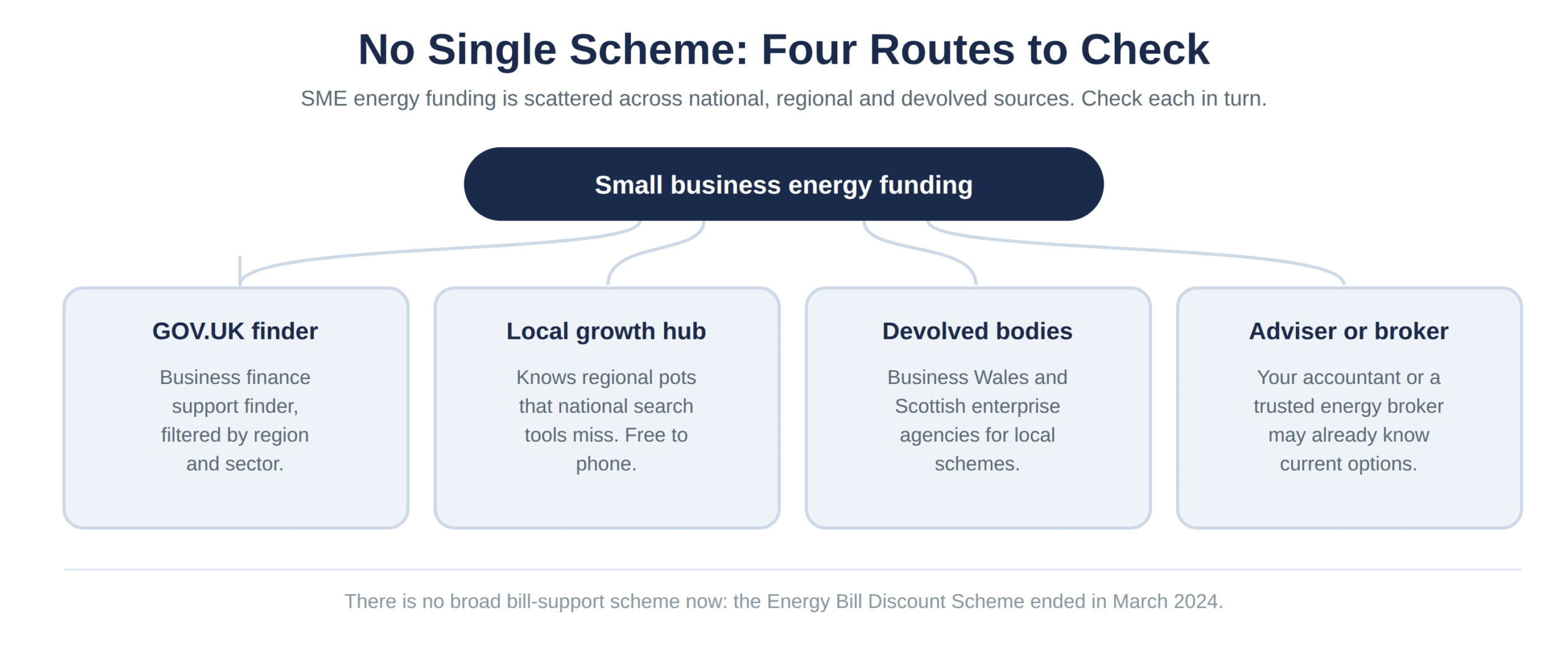
Start with the gov.uk business finance support finder, then call your local growth hub directly, since growth hubs often know about small, regionally funded grants that never appear in a national search.
Four sources worth checking
- gov.uk finder: filtered to your region and sector.
- Local growth hub: for regionally funded pots.
- Devolved agencies: Business Wales or a Scottish enterprise agency, if based there.
- Accountant or broker: who may already know current options.
A short phone call beats an hour of searching most of the time, and the gov.uk business finance support finder is the best national starting point. Our guide to business energy efficiency grants covers the broader funding categories in more depth.
If you are in Wales, Business Wales is the central point for advice and referrals, and in Scotland the Find Business Support service lists devolved schemes. Both surface funding that a UK-wide search will not.
What paperwork does a grant application usually need?
Most small business energy grant applications ask for recent energy bills, a supplier or installer quote for the proposed work, basic company details, and evidence that you meet the scheme’s size and sector criteria.
Documents worth having to hand
- Energy bills: the last 12 months, or at least a recent one showing annual usage.
- A written quote: from a supplier or installer for the proposed work.
- Company information: registration number, turnover and employee count.
- Trading history: evidence of it, if the scheme requires a minimum period.
Having this ready before you apply speeds things up considerably. If a broker or a letter of authority is involved anywhere in the process, make sure it is set up correctly before you submit anything.
Can a small business combine a grant with switching supplier?
Yes. Applying for an efficiency grant and comparing your energy contract are entirely separate processes, and doing both together usually produces a bigger overall saving than either one alone.
Two savings, not one
A grant reduces the cost of a specific project, whether that is insulation, lighting or new plant. Switching supplier reduces what you pay for every unit you use in the meantime, regardless of how the grant application goes.
Treating them as one decision is a common mistake. The grant may take months and might be refused, whereas a contract comparison can be done today and locks in a saving straight away.
Businesses that switch through Utility Saving Expert save an average of £1,952, and there is no reason that saving should wait on a grant decision. Compare a full panel of business energy suppliers while any application is in progress.