
The energy-saving tips that make the biggest difference for small businesses are cutting out-of-hours and standby consumption, servicing refrigeration and heating equipment properly, and comparing suppliers before a contract lapses onto a deemed rate. None of these need major capital, and most pay for themselves within months.
Every small business owner has typed some version of how do I cut my energy bill into a search bar over the last two years. The honest answer is a mix of things that cost nothing and things that need a bit of planning.
UK average business electricity currently sits at 24.14p/kWh, down 6.2% year on year, which sounds like relief. Rates are still well above where they sat five years ago, which is why cutting costs is now a real line item, not a nice-to-have.
This guide sorts practical tips by effort and cost, starting with changes you can make this week and working up to the investments worth planning for.
What quick, no-cost changes cut energy use fastest?
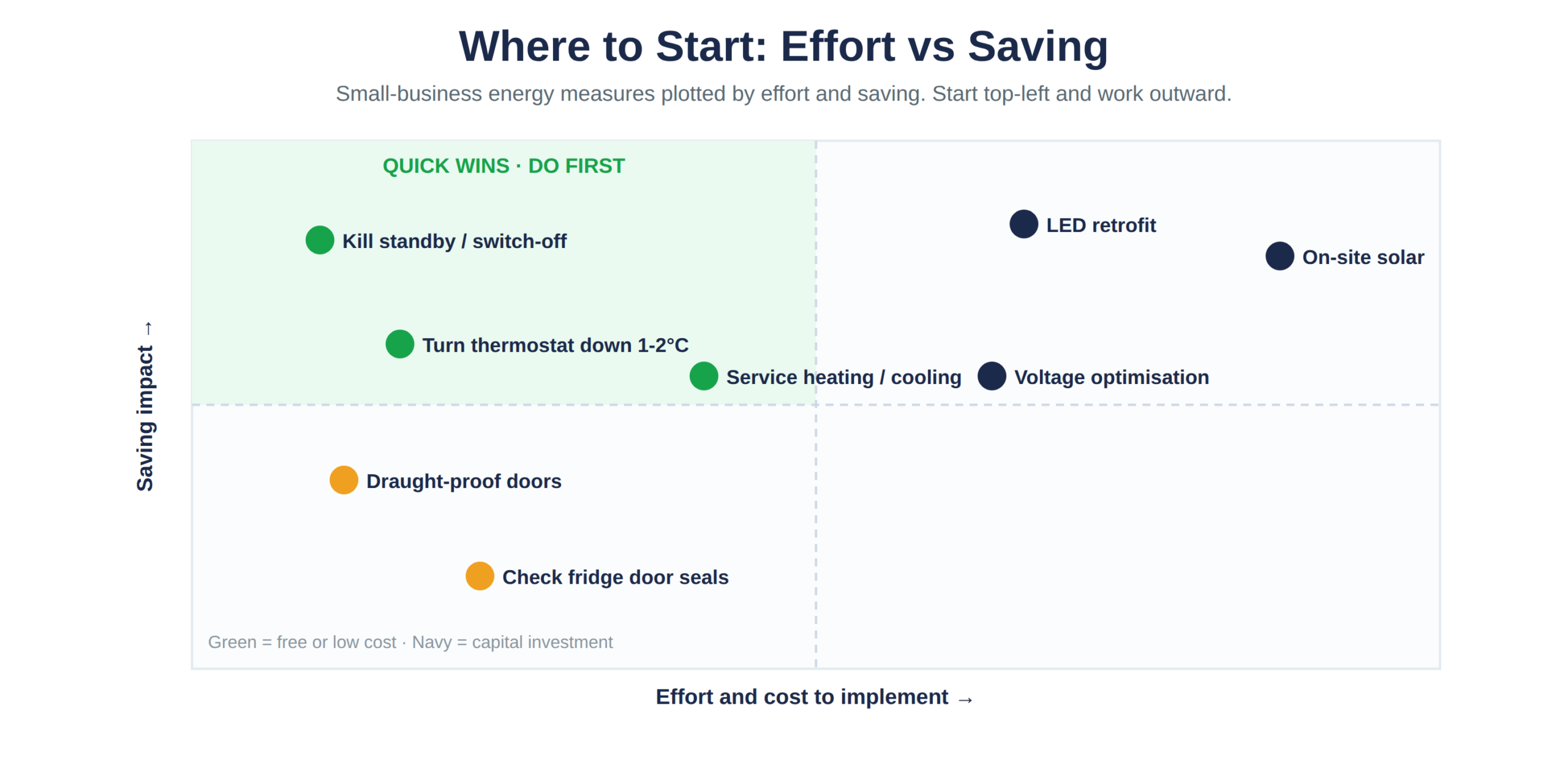
Turning equipment fully off rather than leaving it on standby, adjusting heating by a degree or two, and walking the premises after hours to see what is still running are the fastest wins, because they cost nothing and start saving straight away.
Simple habits that cost nothing
- Fit timer plugs: on non-critical equipment so it cannot be left running by accident.
- Drop the thermostat: by one or two degrees; most people will not notice, the meter will.
- Switch IT fully off: at night rather than leaving machines on sleep mode.
- Do an after-hours walk: once a month to catch anything left switched on.
A till system or run of monitors left on standby overnight adds up across a full year, even though each device barely registers alone. Our guide to how to read a business energy bill helps you spot that baseline load.
Which equipment wastes the most energy in a small business?
Older refrigeration, inefficient lighting and poorly maintained heating or cooling plant waste the most energy in a typical small business, usually because basic maintenance has slipped rather than because the equipment is faulty.
Saving impact by change
| Change | Typical saving impact | Cost to implement |
|---|---|---|
| LED lighting retrofit | Moderate to high | Low to medium |
| Fridge and freezer door seal check | Small but consistent | Low |
| Voltage optimisation unit | Moderate | Medium |
| Heating and cooling plant service | Moderate | Low |
| Smart heating timers and controls | Small to moderate | Low |
A commercial fridge with a worn door seal runs its compressor far harder than one sealing properly. A full LED retrofit is the other obvious target, and the Carbon Trust rates lighting among the fastest efficiency wins for retail and warehouse space.
Most businesses never check a fridge seal until the unit fails outright. A five-minute inspection of seals, filters and vents across your main appliances usually catches waste that has been building quietly for months.
How can heating and cooling costs come down without new kit?
Servicing the plant you already have, sealing draughts around doors and windows, and using thermostatic controls properly usually cut heating costs noticeably without buying any new equipment at all.
Draught-proofing and meter checks
A boiler or heat pump that has not been serviced in a while works harder than it should to hit the same temperature. That is wasted fuel or electricity for no extra comfort.
Draught-proofing external doors sounds basic, which is exactly why it gets skipped, yet a gap under a busy shop door undoes much of what the heating is trying to do. It is also worth checking whether you are on a half-hourly meter, since that data shows when demand actually spikes.
Is switching supplier a bigger win than efficiency measures?
Often yes, and it is faster to act on. A business sitting on an out-of-contract rate can be paying 40% to 80% more than a negotiated deal, and a switch typically completes in four to six weeks with no equipment changes needed.
Do both, not either-or
Businesses that switch through Utility Saving Expert save an average of £1,952, before any efficiency changes are considered. Comparing rates protects against overpaying, while avoiding an out-of-contract rate is often the single biggest saving available.
Efficiency measures reduce how much you use; a good contract reduces what you pay per unit.
What longer-term investments pay back fastest?
Voltage optimisation, a full LED overhaul and on-site solar tend to pay back fastest among the bigger investments, often within a few years rather than a decade, particularly for businesses with heavy daytime consumption.
Funding help for bigger projects
Solar suits a business open through daylight hours, since self-generated electricity is worth more used on site than exported. Some capital cost can be offset through business energy efficiency grants designed for smaller firms.
None of these bigger steps need to happen before the free changes, and the Energy Saving Trust has practical guidance for SMEs. Start with what costs nothing, then build the case for capital once you can see where the biggest waste sits.
Voltage optimisation suits sites where the incoming supply runs higher than equipment needs, trimming waste across every device at once. It is worth a quick feasibility check before assuming solar or lighting is the only route.