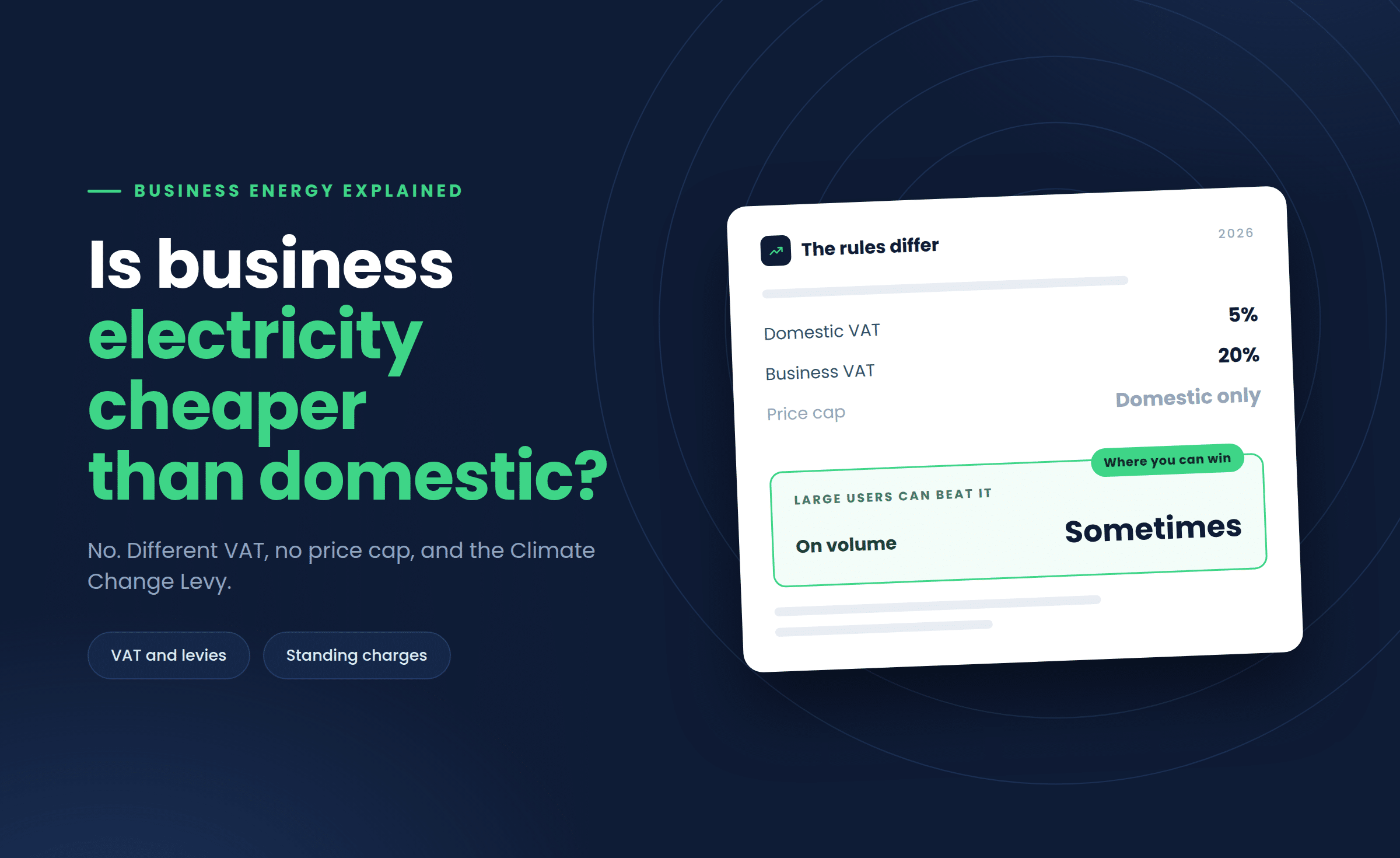

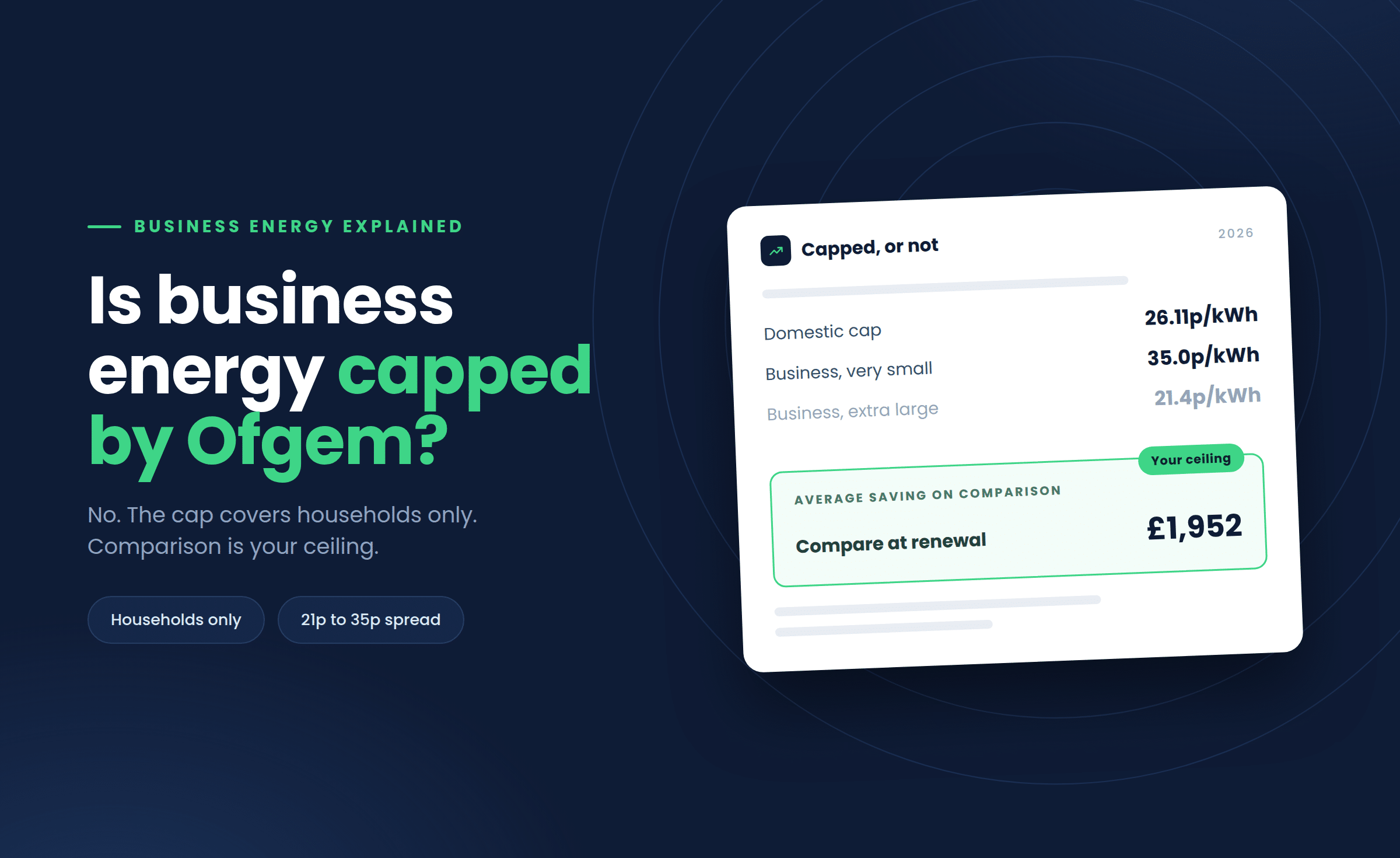
No. There is no business energy price cap in the UK, because Ofgem’s price cap protects domestic customers only, which is why commercial rates vary so widely from one business to the next.
It is an understandable question, given the media coverage of the household cap. If it protects families, surely something similar covers small businesses?
It does not, at least not in the way most people assume. Businesses are treated as commercial customers able to negotiate, so no ceiling on unit rates exists, though some targeted protections and conduct rules do apply.
What does the Ofgem price cap cover?
The Ofgem price cap sets a maximum unit rate and standing charge for domestic customers on a default tariff, reviewed roughly every three months. It applies to households, not businesses.
How the cap works
The cap exists because household energy is a basic service where customers have limited ability to negotiate. For the current period Ofgem’s cap sets domestic electricity at 26.11p per kWh, a ceiling suppliers cannot exceed on capped tariffs.
It caps the rate, not the bill
The cap does not fix your bill at a set figure, it limits the price per unit. A household using more energy still pays more overall, just within a capped unit price.
Why doesn’t the price cap apply to business energy?
A business price cap was never introduced because businesses are treated as commercial entities able to negotiate and switch supplier. The result is a market that relies on active comparison rather than a regulatory ceiling.
The regulatory logic
That is the thinking, even though in practice a sole trader or a five-person shop has nowhere near the bargaining power of a large corporate buyer. The rules treat all businesses as capable negotiators regardless.
What it means in practice
If you do not compare, nothing is capping what you pay. The table shows how business rates, drawn from government price data, compare with the capped domestic rate.
| Energy type | 2026 average rate | Price cap? |
|---|---|---|
| Business electricity | 24.14p/kWh (ex VAT) | No, set by contract |
| Business gas | 5.17p/kWh (ex VAT) | No, set by contract |
| Domestic electricity | 26.11p/kWh (capped, inc VAT) | Yes, reviewed quarterly |
What protections do businesses get instead?
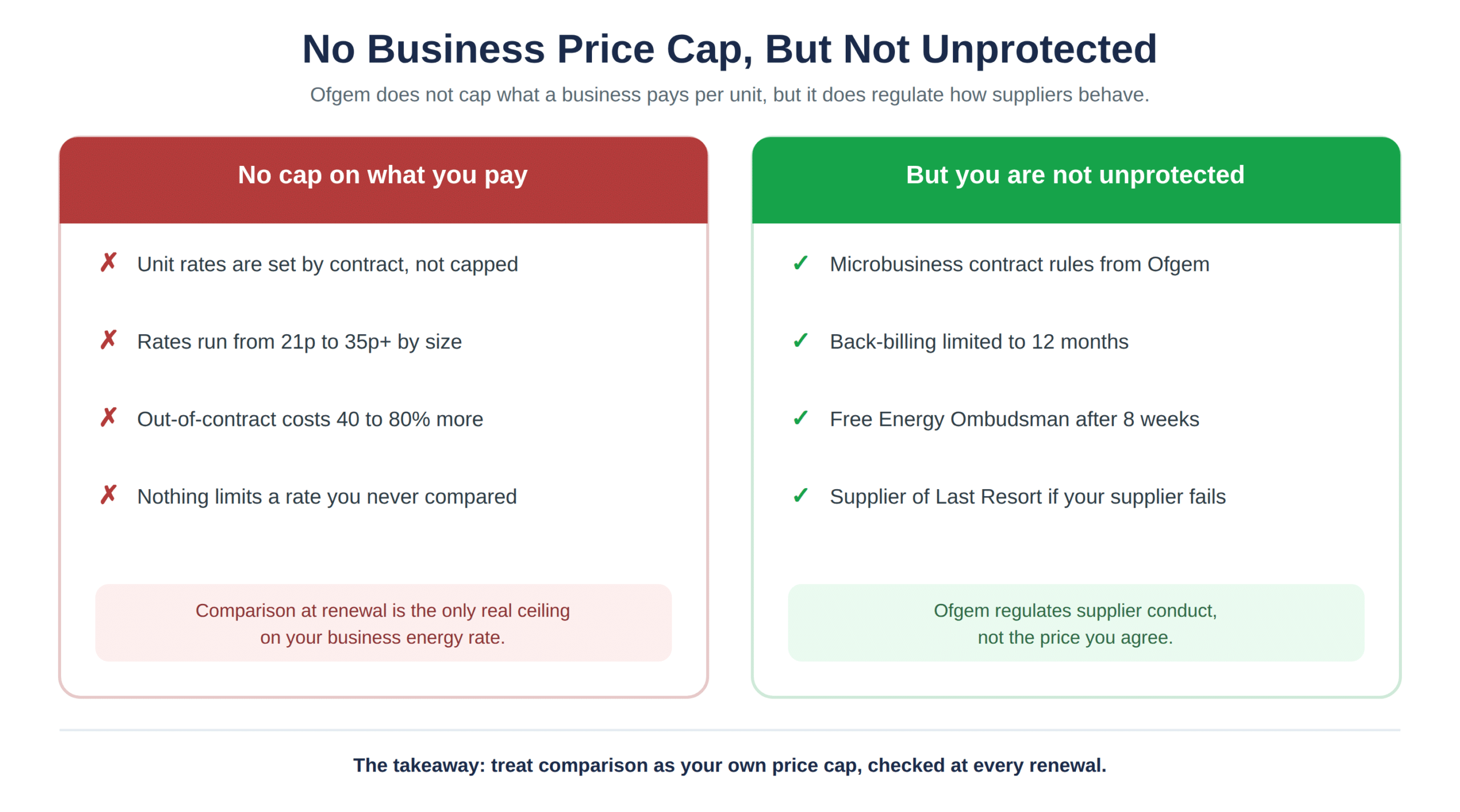
Businesses get regulation of conduct rather than price. Microbusinesses have specific contract protections, back-billing is limited, disputes can go to the Energy Ombudsman, and a failed supplier triggers a safety net.
The protections that do apply
The graphic below sets the missing price cap against the protections that genuinely exist. None of them caps the unit rate, but they are not nothing.
Microbusiness rules and complaints
These protections sit in Ofgem’s supplier licence conditions, not a price cap. A microbusiness, broadly one with under 10 staff and £2 million turnover or less, or using under 100,000 kWh of electricity a year, gets clearer contract terms, a rollover cap and the right to leave without notice, as Ofgem’s business guidance sets out.
Back-billing is limited to 12 months for supplier errors, and an unresolved complaint can go free to the Energy Ombudsman after eight weeks. It is regulation of how suppliers behave, not what they charge.
How much can business energy rates vary without a cap?
Quite a lot. Business electricity in 2026 ranges from around 35p per kWh for very small users down to 21p for the largest sites, a spread of roughly 14p per unit.
The range by size
Without a cap, unit rates reflect real differences in risk and cost to serve, alongside how well a business has negotiated. The table below shows the spread.
| Business size | Annual electricity use | Average rate (p/kWh) |
|---|---|---|
| Very small | 0 to 20 MWh | 35.0p |
| Small | 20 to 500 MWh | 28.8p |
| Medium | 2,000 to 20,000 MWh | 25.0p |
| Large | 20,000 to 70,000 MWh | 23.9p |
| Extra large | Over 150,000 MWh | 21.4p |
| UK average | All businesses | 24.14p |
Out-of-contract is the worst position
A business left on an out-of-contract or deemed rate, running 40% to 80% above a negotiated deal, is paying the full cost of having no protection. That gap is part of why business energy feels so expensive.
How can a business protect itself without a price cap?
Regular comparison is the closest thing a business gets to a price cap. Firms that switch through Utility Saving Expert save an average of £1,952 a year against an uncompared rate.
Compare at every renewal
Diarise your renewal date, start comparing two to three months ahead, and run a business energy comparison against the panel of more than 30 suppliers. If a broker manages your account, understand your letter of authority arrangements too.
Government crisis support such as the Energy Bill Discount Scheme has ended, so a review of that support confirms comparison is now the main lever. You can also check live business electricity and business gas rates in minutes.
If your supplier fails
A missing cap does not mean a missing safety net. If your supplier goes bust, Ofgem runs a Supplier of Last Resort process to keep you supplied, though you are moved onto a deemed rate until you agree new terms.
Our guide to failed energy companies covers what happens step by step, and what to check before signing whatever contract you are moved onto.