
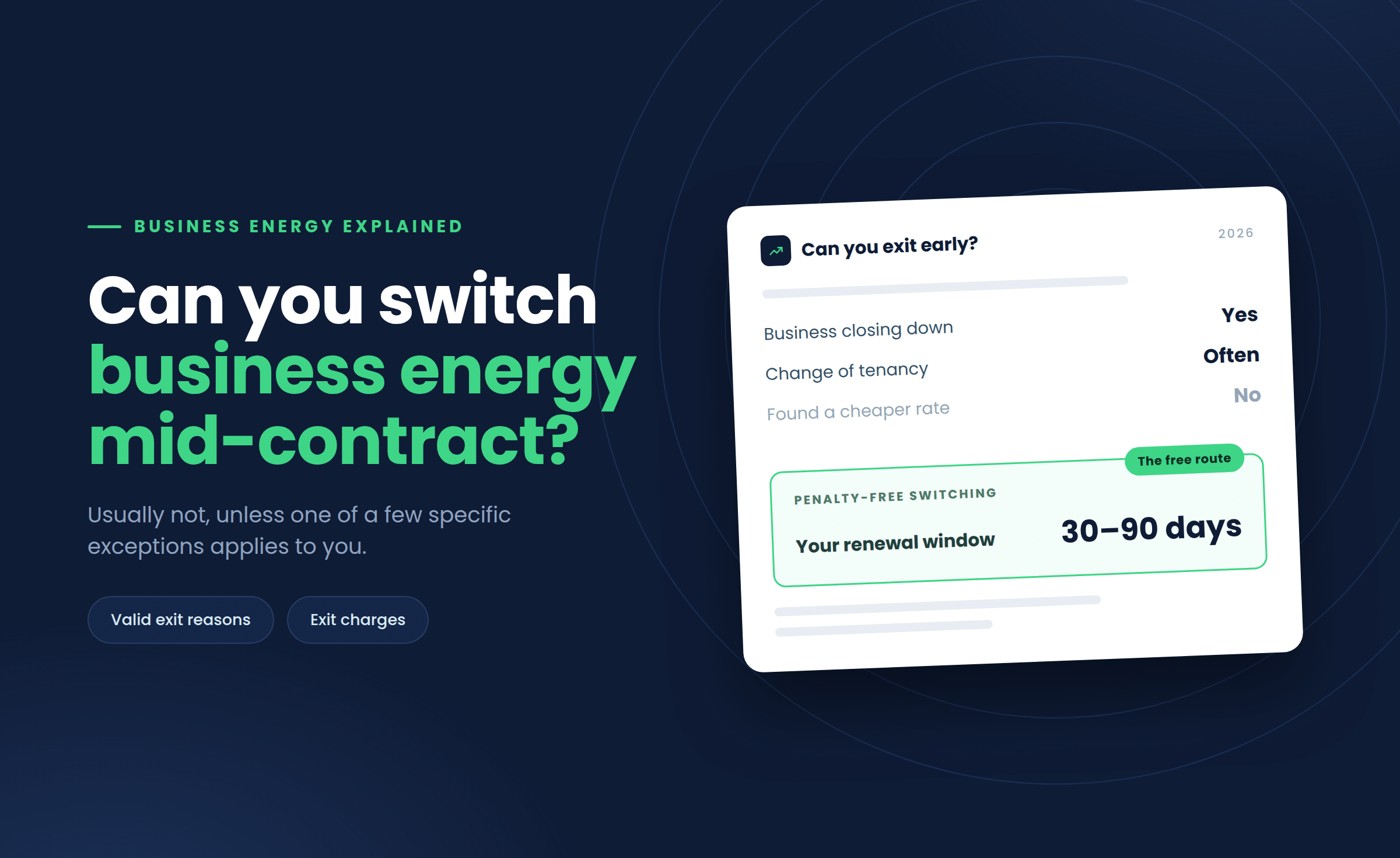
Generally, no. Business energy contracts are legally binding fixed terms, so you cannot switch mid-contract just because you have found a cheaper rate, though specific exceptions like business closure and change of tenancy do allow an early exit.
It is a fair question, especially watching rates move and wondering if you are stuck overpaying for another year. Business contracts work very differently from the flexibility most people expect from personal accounts.
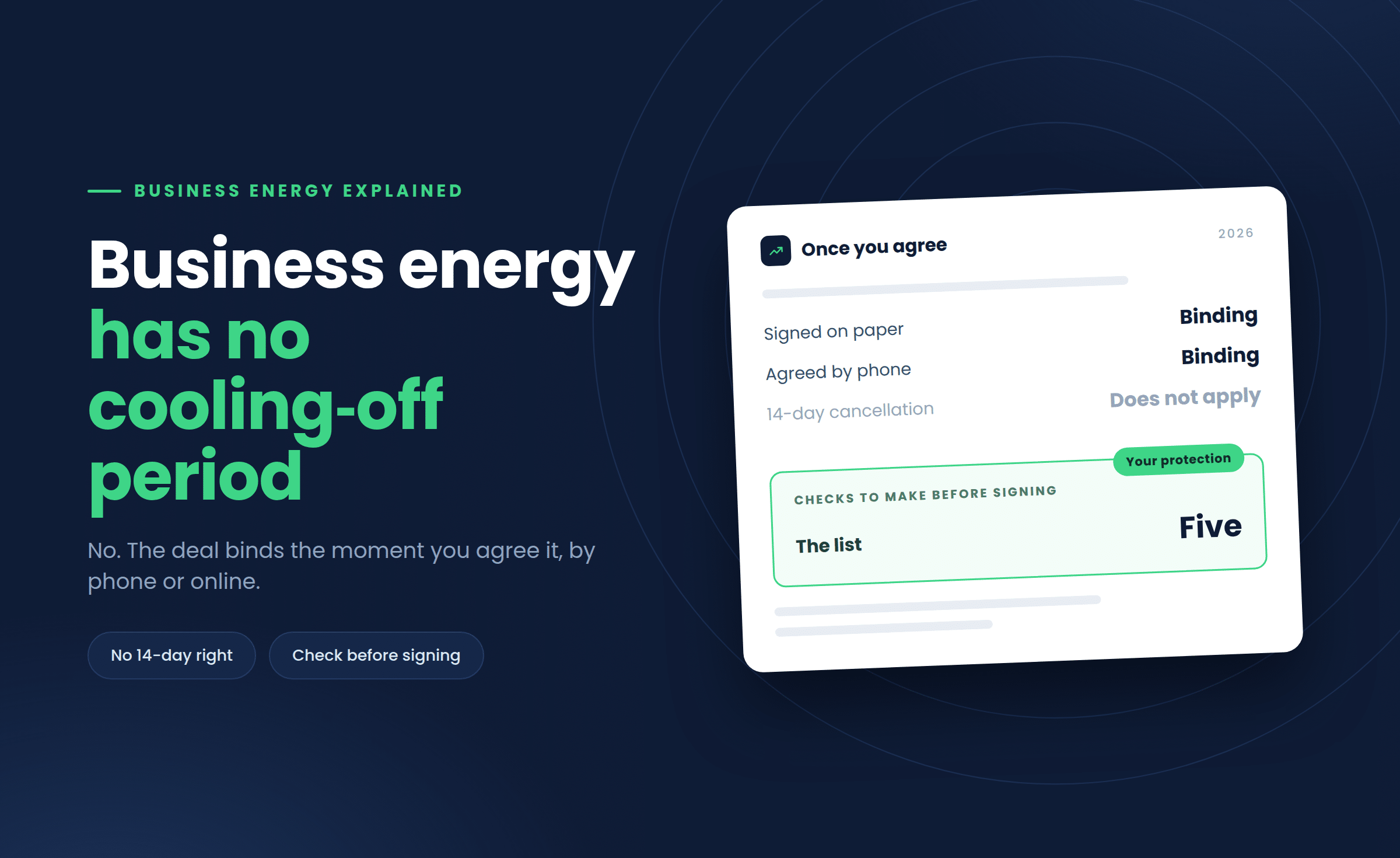
Unlike household energy, where you can switch at almost any time, a signed business contract is a binding commercial agreement with no statutory cooling-off period. That does not mean you have zero options, but the route out is narrower and needs handling correctly.
Why can’t you normally switch mid-contract?
A signed business contract commits both you and the supplier to fixed terms for a fixed period, and the supplier prices the rate partly on that commitment, so breaking it early undermines the basis the rate was set on.
The commercial logic behind it
Suppliers buy wholesale energy in advance to cover contracted customers, so an early exit leaves them exposed on volume already bought. That is the logic behind early termination charges, and our guide to business energy contracts covers the notice periods and renewal terms worth checking before you sign anything, which Ofgem’s business advice also sets out.
What are valid reasons to exit a business energy contract early?
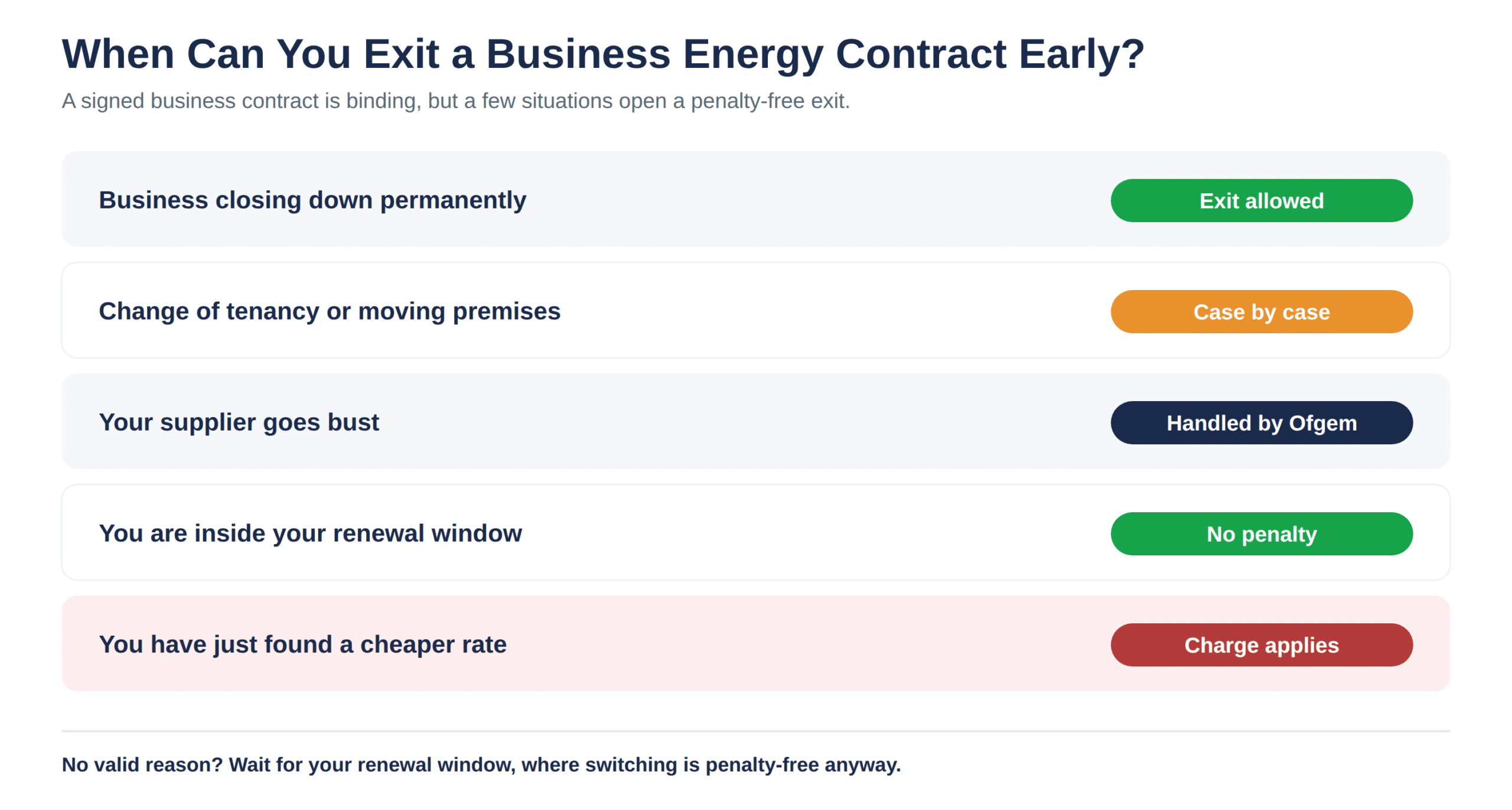
Business closure, change of tenancy, and supplier failure are the main recognised reasons to exit a business energy contract early without a full penalty, but simply finding a cheaper deal is not one of them.
| Reason | Allows early exit? | Notes |
|---|---|---|
| Business closing permanently | Yes | Evidence usually required, such as a Companies House filing |
| Change of tenancy or moving | Often | Contract may transfer to the new occupier instead |
| Supplier goes into administration | Handled by SoLR | Ofgem moves you automatically |
| Found a cheaper rate elsewhere | No | Standard early termination charges apply |
| Renewal window has opened | Yes | Standard, penalty-free switching applies |
Change of tenancy as an exit route
If you are vacating a premises before your contract ends, a change of tenancy sets out how liability usually passes to the new occupier rather than following you to your new site. Supplier failure is different again, handled through Ofgem’s Supplier of Last Resort process, as our guide to failed energy companies explains.
What happens if you switch without a valid reason?
Switching without a recognised exit reason usually triggers an early termination charge, calculated on your remaining contract value or a fixed penalty in your terms, and some suppliers also object to the switch itself.
The charge is designed to recover the wholesale cost the supplier already committed to on your behalf. It can be substantial on a longer remaining term.
An objection is not a permanent block. It simply pauses the switch until the reason, usually a balance or a mid-term move, is resolved with your current supplier.
What to check before deciding
- Read the clause: check your contract’s early termination terms before assuming any figure.
- Ask for the number: a broker or comparison provider can often confirm the likely charge, and our guide on how long a switch takes covers the process.
- Do the maths: sometimes the saving on a new rate still beats the exit charge over the remaining term.
Not sure where to start? Utility Saving Expert compares a panel of trusted business energy suppliers in 60 seconds if you would rather we did the legwork.
Can you switch during your renewal window even if the contract hasn’t ended?
Yes. Every fixed-term business contract has a renewal window, typically the final 30 to 90 days, during which you can switch penalty-free even though the contract is technically still running.
Mid-contract versus renewal window
This is not a mid-contract exit, it is the normal switching route, and our guide to business energy renewals explains how the window works. Timing it well, as our best time to switch guide shows, is the key to avoiding a deemed rate.
Confusion between mid-contract and renewal window causes a lot of unnecessary hesitation. If you are inside your renewal period, you are not breaking anything by comparing and switching.
What if your business has moved premises mid-contract?
Moving premises does not automatically end your contract, so depending on your supplier’s terms it may transfer with you, transfer to the new occupier of your old site, or require a formal change of tenancy.
Notify your supplier first
This is one of the most common genuine reasons a business needs to exit a contract early, and a change of tenancy is usually handled without the full termination charge if managed correctly through your supplier.
Notify your supplier before you move, not after. A late notification is far more likely to result in disputed charges on both the old and new premises.
Is it ever worth paying an early exit fee?
Sometimes, yes, particularly on a long remaining term with a wide gap between your current rate and the market, so run the numbers before dismissing an exit as too expensive.
Run the numbers first
With the UK average business electricity rate around 24.14p/kWh, from DESNZ data, and out-of-contract rates running 40% to 80% above a negotiated deal, a bad legacy contract can cost more over its remaining term than a calculated exit charge.
The maths is simple once you have the two numbers. Work out your saving over the months you have left, then compare it against the exit charge in your contract.
| Step | What to work out |
|---|---|
| 1. Annual saving | (current rate minus new rate) times your annual kWh |
| 2. Saving to term end | annual saving times the months left, divided by 12 |
| 3. Exit charge | the figure in your contract’s early termination clause |
| 4. Decision | exit only if the saving to term end beats the charge |
A quick comparison against current business electricity rates, weighed against the stated exit charge, usually gives you the answer in minutes, and our guide on switching to a cheaper plan walks through the next steps.