
Three-phase power is a heavier-duty electricity supply built from three alternating currents instead of one, and most businesses only need it once their equipment or floor space passes a certain load. A small office or shop usually runs fine on a standard single-phase supply.
If you have had an electrician mention going three-phase, or a landlord tell you the unit already has it, you are not alone in not quite knowing what that means for your bills or your options.
It comes up constantly during fit-outs, kitchen refurbishments and warehouse moves. Get the supply type wrong and you either pay for capacity you will never use, or you discover halfway through an installation that your new equipment will not run at all.
The good news is that working out which one you need is not complicated. It comes down to the equipment you are running, how much power it draws at once, and what your network operator can offer at your site.
What’s the difference between single-phase and three-phase power?
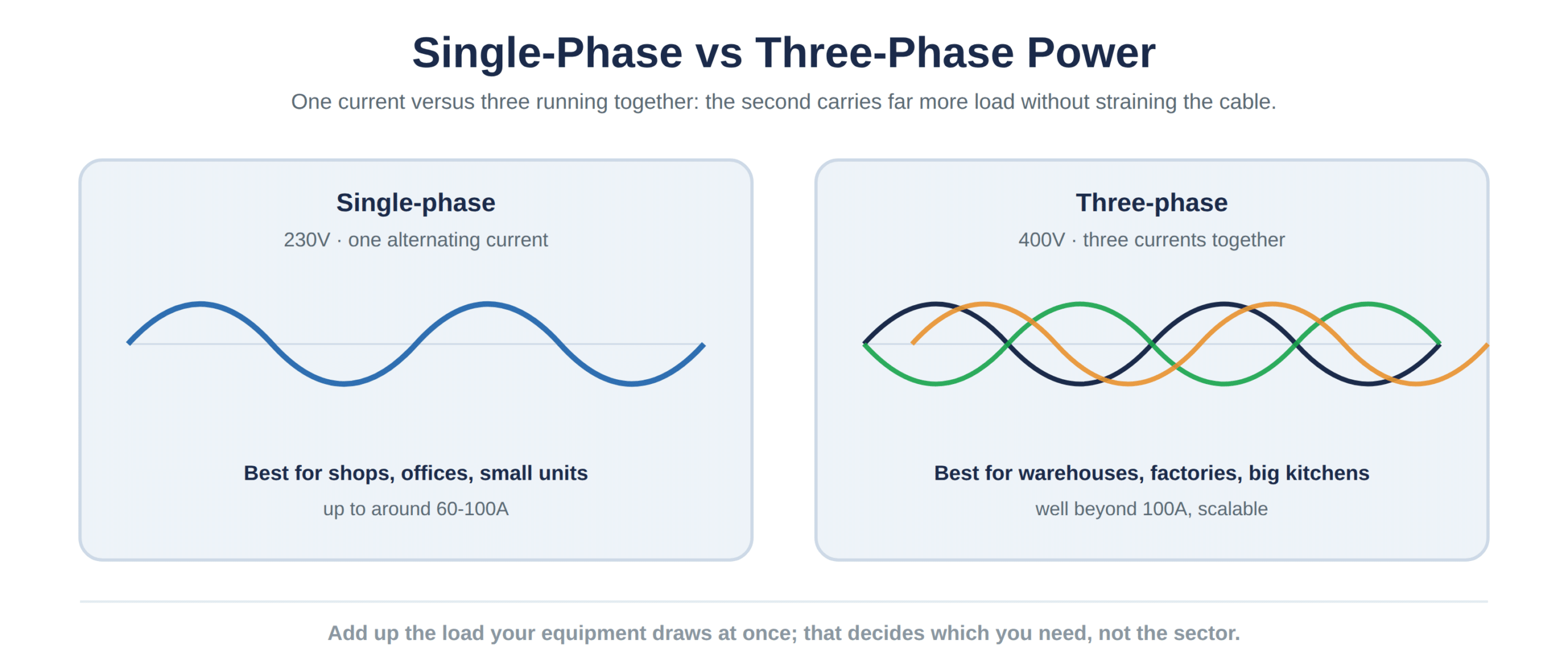
Single-phase power delivers one alternating current at 230V and suits most small premises, while three-phase power delivers three currents together at 400V and can carry far more load without overheating cables.
Capacity by supply type
| Feature | Single-phase | Three-phase |
|---|---|---|
| Standard voltage | 230V | 400V between phases |
| Typical capacity | Up to around 60-100A | Well beyond 100A, scalable |
| Common in | Shops, offices, small units | Warehouses, factories, larger kitchens |
| Motor performance | Runs small motors | Smoother start-up on larger motors |
| Upgrade route | N/A | Applied for via your local DNO |
Think of single-phase as one lane feeding your building and three-phase as three lanes in parallel. Each phase carries part of the load, which is why heavy machinery runs smoother on three-phase than the same kit forced onto a single-phase circuit.
Which businesses typically need a three-phase supply?
Businesses running heavy machinery, large-scale catering equipment, industrial refrigeration, lifts or multiple pieces of high-draw equipment at once usually need three-phase power to operate safely and efficiently.
It’s about load, not sector
A hairdresser with hood dryers is fine on single-phase. A commercial bakery running multiple ovens, proving cabinets and mixers at the same time almost certainly is not.
- Manufacturing and engineering: motors, compressors or CNC machinery.
- Large commercial kitchens: multiple high-draw appliances running together.
- Warehouses and logistics: lifts, conveyors or three-phase forklift chargers.
- Fleet EV charging: charging multiple vehicles at once typically needs three-phase.
The practical test is simple: add up the maximum load your equipment could draw at the same time, and check it against what a single-phase supply can safely handle.
How do you get a three-phase connection installed?
New three-phase connections and upgrades go through your local distribution network operator, not your energy supplier, and timescales depend entirely on how much reinforcement the local network needs.
What the process usually looks like
Your supplier bills you for the electricity, but the wires, substations and transformers belong to your DNO, whose connections team assesses whether the local network can take the extra load. Our guide to who your DNO is runs through the regional operators.
- Load assessment: your electrician specifies the kVA capacity you need.
- Application: goes to the DNO, sometimes submitted by the electrician for you.
- Quotation and works: the DNO prices any reinforcement, then schedules the connection.
A simple upgrade where capacity exists nearby can take weeks; a connection needing a new substation can run to several months, so start early. Our guide to a new business electricity connection covers the full timeline.
Does three-phase power change what you pay for business electricity?
Three-phase supplies often come with a higher standing charge because of the extra capacity, but the unit rate you pay per kWh is set by your contract and usage band, not by the number of phases.
No separate three-phase tariff
UK average business electricity in 2026 ranges from 35.02p/kWh for very small users down to 21.42p/kWh for extra large sites, with the average at 24.14p/kWh, from DESNZ data.
A three-phase site tends to sit further up that usage scale simply because it runs more equipment, which usually means a lower per-unit rate but a higher total bill. Your kVA capacity, half-hourly settlement status and supplier affect the final quote more than the phase count alone.
How do you know which supply your building already has?
Check your meter and consumer unit first: a three-phase installation has three incoming cables and a larger fuse and meter box compared to the single cable feeding a standard single-phase supply.
Confirm before you sign a lease
Your electrician or the meter operator can confirm this quickly, and it is worth checking before you sign a lease or plan a refit if the equipment you will run is anything beyond light office use.
If you are moving into an existing unit, ask the outgoing tenant or landlord directly, and cross-check against your meter point details using our guide to how to read a business energy bill. For larger new supplies, our energy procurement service can help plan capacity and price together.