
Warehouses cut energy costs fastest by replacing ageing high-bay lighting with LED and controls, and by tackling heat loss through a large, often poorly insulated shell rather than simply turning heaters up. Materials handling equipment charging is the third major cost most sites underestimate.
A warehouse is a strange building to heat and light. It is often a single, cavernous volume with a roof height of eight metres or more, built around storage racking rather than thermal efficiency.
That combination of huge volume, minimal insulation and high-mounted lighting is what pushes warehouse energy costs up. A logistics energy programme almost always finds the same two or three culprits.
Add a fleet of electric forklifts charging overnight, and a distribution site can carry a bigger bill than its footprint suggests. None of this is fixed by switching off a few lights at the end of the shift.
This guide covers where warehouse lighting and heating costs actually come from, and the changes that make a real difference without disrupting picking and dispatch.
What drives warehouse lighting costs?
High-bay fittings mounted above the racking typically run for the entire shift regardless of natural light, and older sodium or fluorescent fittings use far more energy than modern LED equivalents for the same light level.
Why aisle lighting is the quick win
Many warehouses run legacy fittings that take minutes to reach full brightness, so operators leave them on continuously between shifts. That habit alone locks in a high baseline cost.
Racking aisles are only occupied by a picker or forklift for a fraction of the day, yet many sites light every aisle at full output all shift. Motion sensing on aisles is one of the fastest wins available.
LED fittings also switch instantly, which removes the reason operators leave lights on between shifts. That behaviour change often saves as much as the wattage reduction itself.
Why is heating such a large cost in a warehouse?
Warehouses are heated for staff comfort and stock conditions, but the sheer volume of air, combined with loading bay doors opening throughout the day, means heat escapes constantly and has to be continuously replaced.
Low-cost fixes for heat loss
Every time a dock door opens for a delivery, warm air escapes and cold air rushes in. On a busy inbound day with dozens of vehicle movements, that is a lot of heat lost through openings meant to be open for minutes.
Destratification fans are a low-cost fix many warehouses still do not run. Without them the warmest air in the building sits uselessly near the roof while heaters work to warm the floor.
- Door management: PVC strip curtains or rapid-action doors to cut open time.
- Destratification fans: push warm air trapped at the roof back to floor level.
- Zonal heating: so office and welfare areas are not heated like bulk storage.
How much does MHE charging add to the bill?
Materials handling equipment, forklifts, pallet trucks and order pickers running on battery charge, draws a continuous and often overlooked load, particularly where equipment charges overnight across multiple bays at once.
Switching to lithium-ion batteries
Charging everything overnight during low demand can be efficient, but poorly maintained chargers and ageing lead-acid batteries waste a meaningful amount of that energy as heat.
Sites moving to lithium-ion batteries often see charging efficiency improve, alongside faster opportunity charging that reduces the number of spare batteries needed. Shifting charging to off-peak hours cuts the network-charge portion of the bill, which Ofgem sets through time-banded distribution charges.
What changes reduce warehouse energy costs?
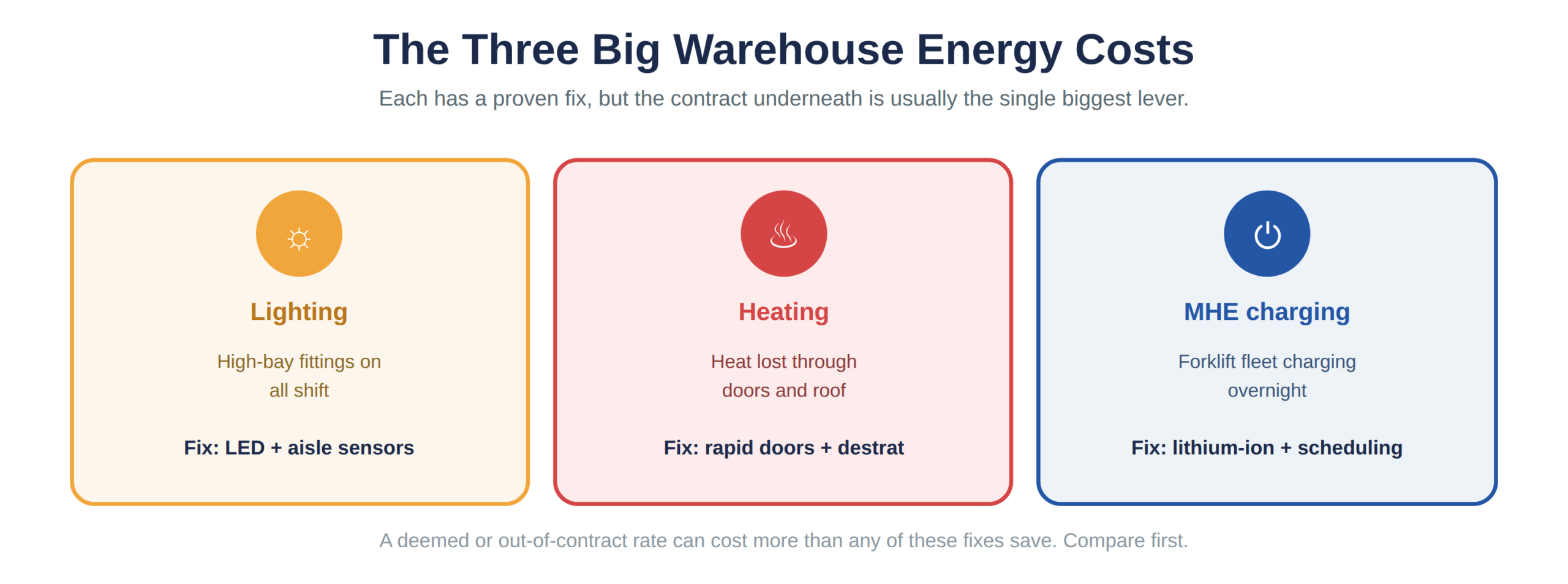
LED lighting with motion sensing in aisles, better control of loading bay heat loss, and a genuine contract review together deliver most of the achievable saving, and the contract review is usually the single biggest of the three.
Why the contract is the biggest lever
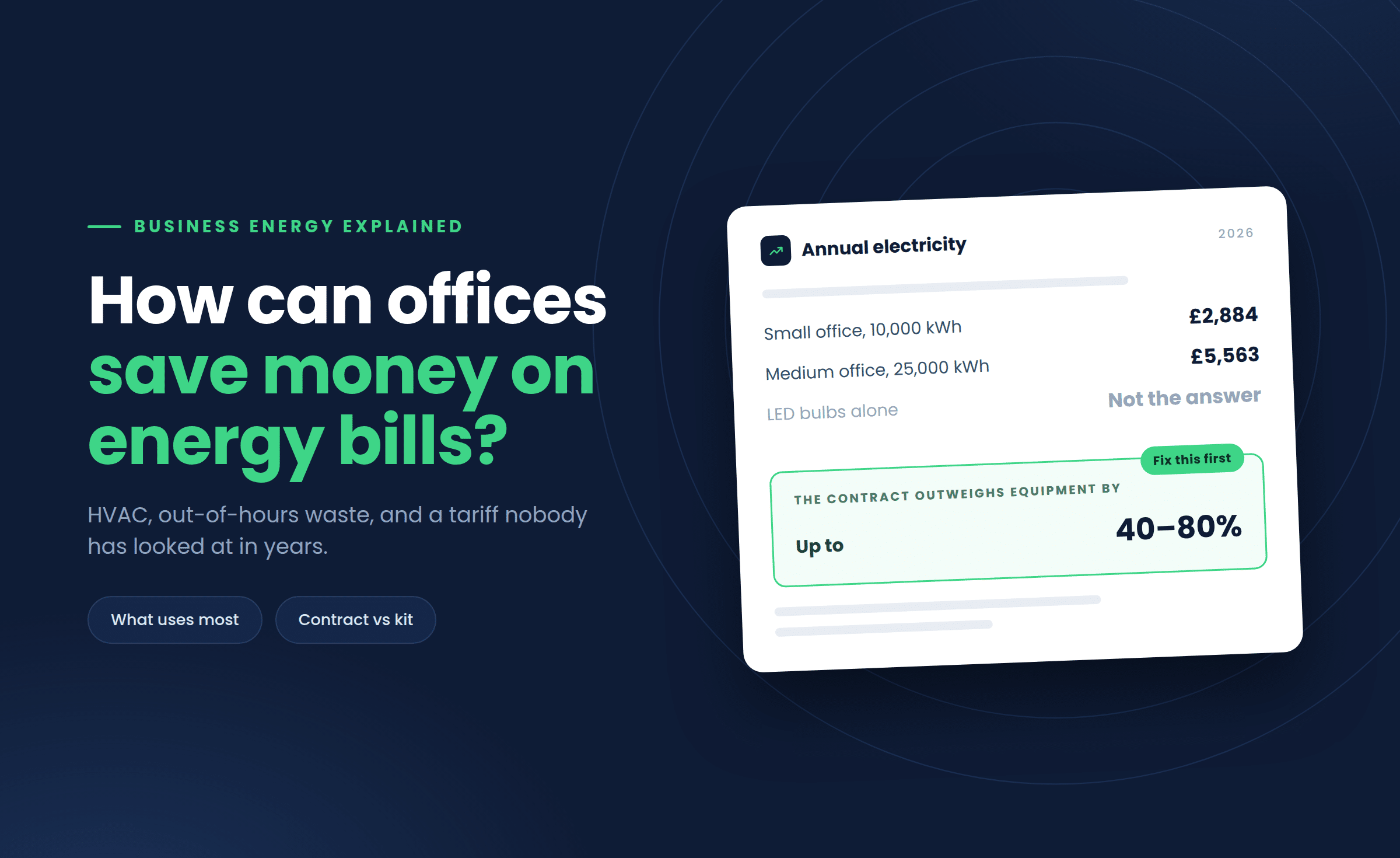
A warehouse on an out-of-contract or deemed rate can be paying 40% to 80% more than a negotiated deal, a gap often larger than any lighting retrofit. Comparing business electricity against current pricing is the first move.
| Cost driver | Typical fix | Effort |
|---|---|---|
| High-bay lighting | LED with aisle motion sensing | Medium |
| Loading bay heat loss | Rapid doors, strip curtains, destrat fans | Low to medium |
| MHE charging | Lithium-ion, scheduled charging | Medium |
| The energy contract | Compare and switch | Low |
Efficiency measures then compound the saving, and bodies like the Carbon Trust publish sector guidance. Our guide to reducing business energy consumption covers the wider operational fixes.
Does warehouse size change the energy contract you need?
Yes. Larger distribution sites move into higher usage bands with lower unit rates, but they also often qualify for half-hourly metering, which gives far more visibility into when energy is used across shift patterns.
Single-site versus group contracts
A three-shift site looks very different on a half-hourly profile to a single daytime shift with occasional overnight charging. That data shows exactly where the load sits.
Multi-site operators should review whether a single group contract beats separate depot agreements, and some warehouses qualify for reduced Climate Change Levy rates under Climate Change Agreements.