
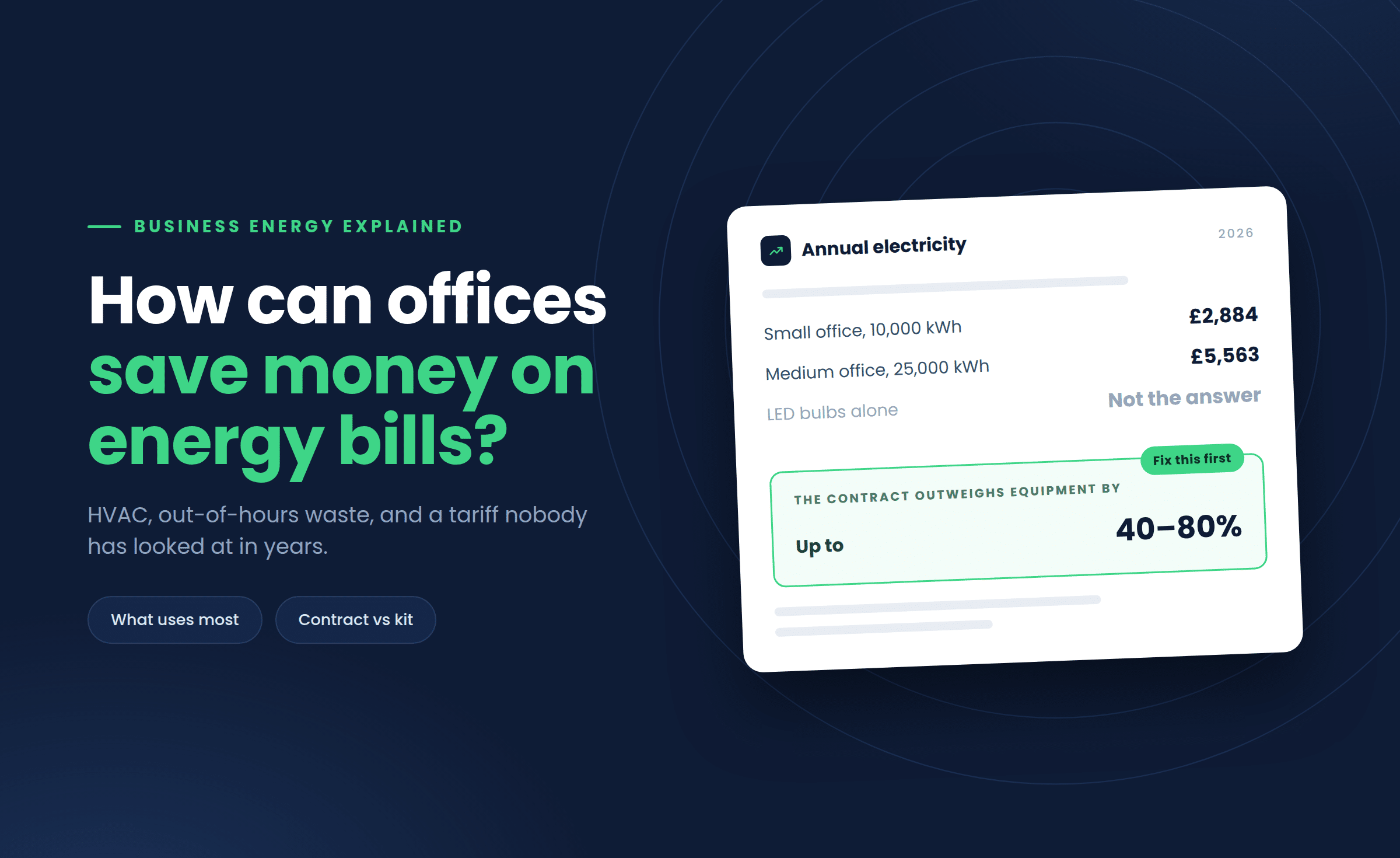
The fastest way for most offices to cut energy bills is to fix the contract first and the kit second: HVAC and out-of-hours IT and lighting waste usually cost more than any single piece of equipment, and a stale tariff can be quietly adding 40% to 80% on top.
Walk into most UK offices at 7am and the heating or air conditioning has often been running since before anyone arrived. Screens sit in standby overnight, server cupboards hum away regardless of who is in, and nobody owns the thermostat.
None of that shows up as a single dramatic cost. It shows up as a baseline that never quite drops, even over a bank holiday weekend when the office is empty.
Add a contract that rolled onto out-of-contract rates eighteen months ago and you have a bill that has grown worse without one bad decision. Offices are unusual because the biggest user, HVAC, is invisible, which is why reducing office energy starts with what you cannot see.
This guide covers what drives office energy costs, where the genuine savings sit, and how the contract compares with everything else you could spend money on.
What uses the most energy in an office?
Heating, ventilation and air conditioning typically account for the largest single share of an office bill, ahead of lighting, IT equipment and kitchen appliances combined.
Why the overnight baseload matters
HVAC runs almost continuously through the day and often for hours either side as it pre-heats or pre-cools the building. Lighting is the second big line, especially in older offices still running fluorescent tubes.
- HVAC: heating and cooling, usually the largest single load.
- Lighting: a bigger factor in older buildings without LED or daylight sensors.
- IT and comms rooms: a constant baseline draw, rarely switched off.
- Kitchen and welfare: kettles, dishwashers and water heaters, smaller but frequent.
The number worth checking is what your building draws between 8pm and 6am when nobody is there. A half-hourly meter shows this clearly: if the overnight baseline barely drops, something is running that should not be.
How much does a typical office spend on energy?
A small office using around 10,000 kWh of electricity a year pays close to £2,884 at current average rates, while a medium-sized office on 25,000 kWh sits closer to £5,563.
Current UK average rates
| Office size | Annual usage | Avg electricity rate |
|---|---|---|
| Very small | Under 20 MWh | Around 35p/kWh |
| Small | 10,000 kWh | Around 29p/kWh |
| Medium | 2,000-19,999 MWh | Around 25p/kWh |
Smaller users pay more per unit because standing charges spread across less consumption. These are Government-sourced averages including the Climate Change Levy and excluding VAT, so compare live business electricity against a recent bill for your exact figure.
Does switching supplier save more than upgrading equipment?
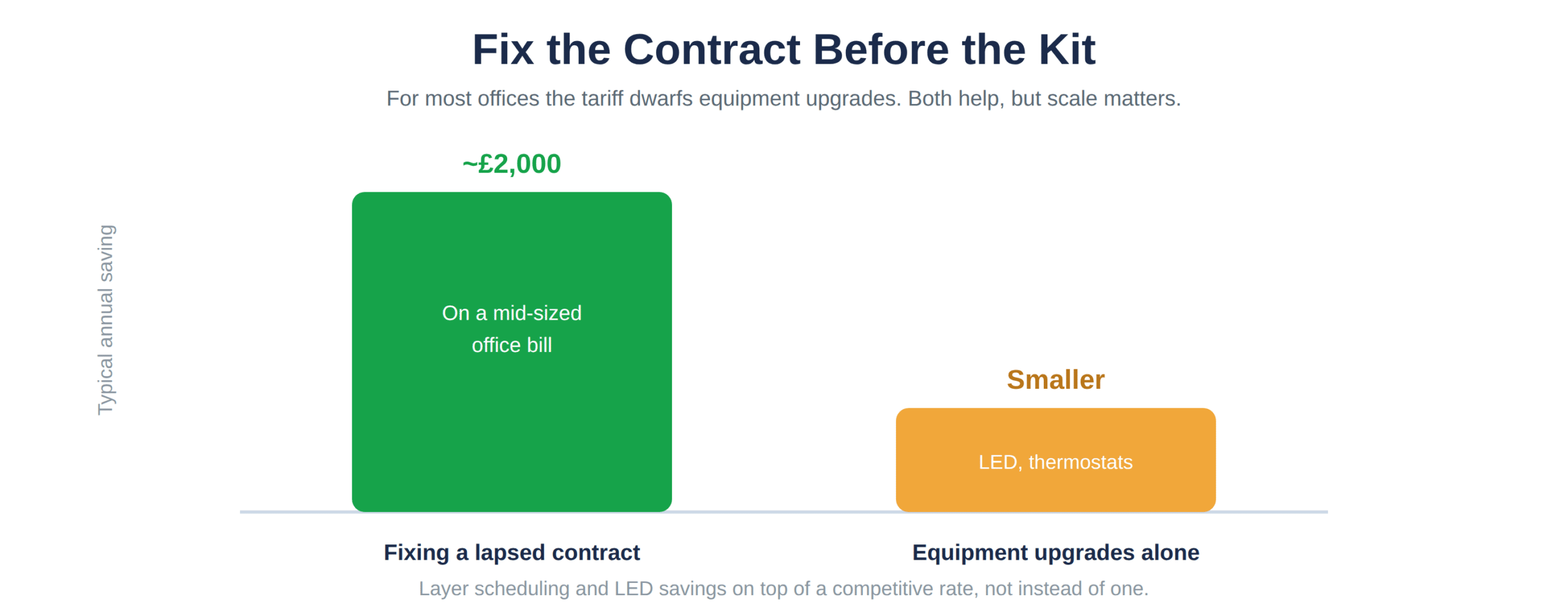
For most offices, yes: the contract itself is usually the single biggest lever, because an out-of-contract rate can run 40% to 80% above a freshly negotiated one, which dwarfs what LED bulbs or a smart thermostat alone will save.
Scale, not an argument against upgrades
An office spending £5,563 a year that has drifted onto default rates could be paying £2,000 or more above a negotiated 2026 contract, before a single bulb changes. Businesses switching through Utility Saving Expert save an average of £1,952 a year.
LED retrofits, better controls and behaviour change genuinely help, but they work on top of a competitive rate, not instead of one. Timing matters, so our guide to business energy renewals is worth reading two to three months before your contract ends.
What’s the easiest way to cut office energy without spending money?
Shutting down HVAC and lighting properly outside working hours, and switching comms room equipment to sleep or eco modes overnight, cuts consumption without any capital spend at all.
Free wins already built into your systems
Most building management systems include scheduling functions nobody has configured properly. Left on factory defaults, they heat and cool the building far more generously than occupancy needs.
- Match HVAC to occupancy: not the widest possible working hours.
- Kill unused zones: turn off lighting in meeting rooms not in daily use.
- Sleep the desktops: automatic sleep after a short idle period.
- Review comms cooling: many rooms are set colder than the kit needs.
- Name an owner: so settings do not drift back over time.
How does hybrid and part-time office use change the numbers?
Hybrid working has left many offices heating, cooling and lighting a full floor for a fraction of the desks in use, so the biggest opportunity is often matching building zones to real occupancy rather than treating every day like a full house.
Zoning and meter data
If an office runs at 60% occupancy on Tuesday and 20% on Friday, running full HVAC on both wastes money on the quiet day. Zoning suits larger offices, while smaller ones can consolidate desk bookings onto fewer floors, and profile classes explain how smaller sites are billed.
Larger offices above 100kW maximum demand sit on half-hourly meters that record consumption in 30-minute blocks. The Carbon Trust publishes guidance on using that data, and Ofgem sets the network charges that make off-peak use cheaper.