
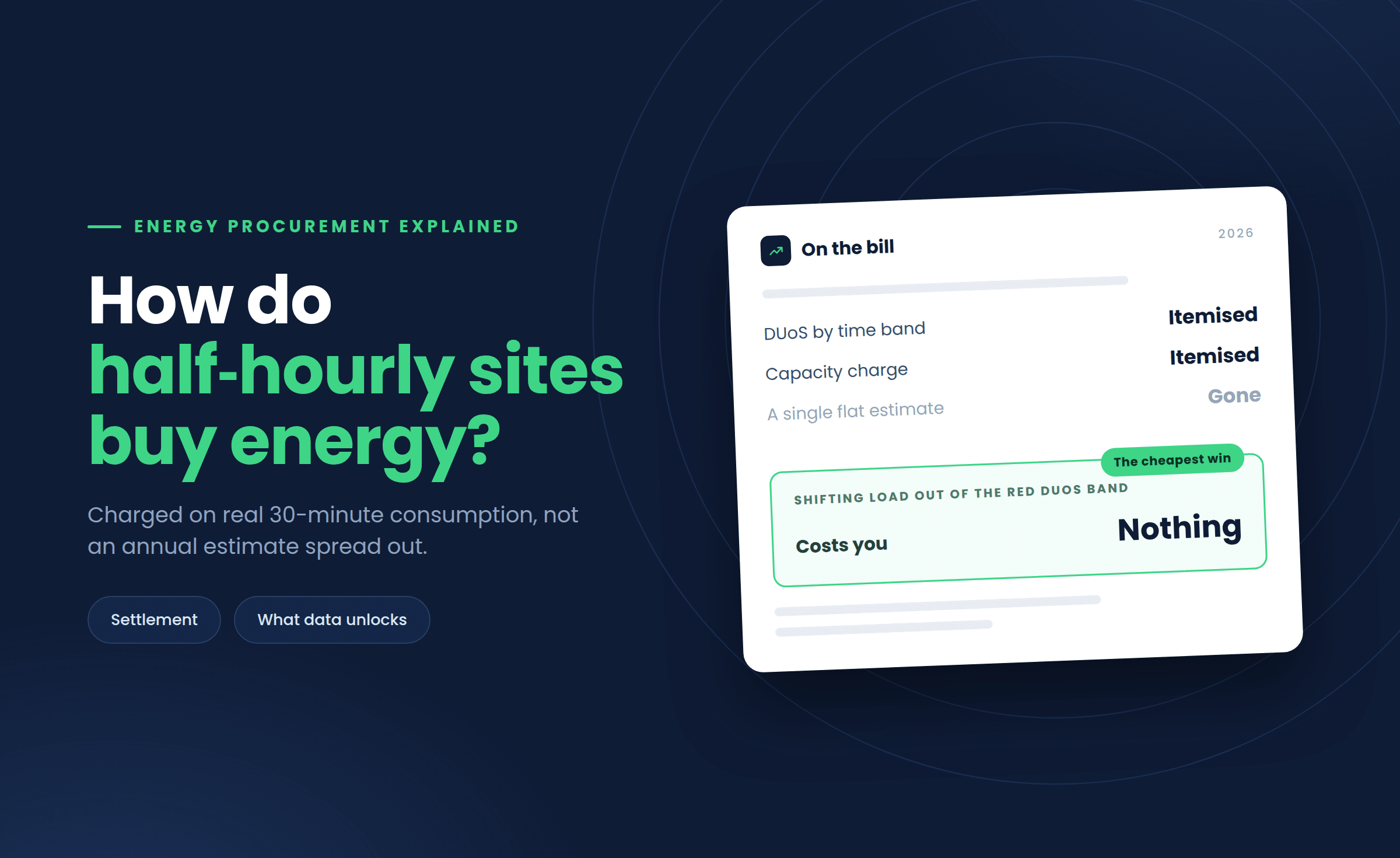
Half-hourly sites buy energy against actual metered consumption recorded in 48 half-hour periods a day, rather than an estimated annual quantity, which exposes the exact shape of demand and opens up procurement options a standard meter cannot access.
Most smaller businesses never think about when during the day their electricity is used. Their meter is read periodically, an estimated annual figure is applied, and the bill lands regardless of whether demand was flat or spiky.
A half-hourly contract runs on a different basis. Every half-hour of usage is recorded and settled individually, which is why it opens doors that standard meters cannot reach in energy procurement.
That granularity is exactly why half-hourly buying looks so different from a standard small business switch.
This guide covers what makes a site half-hourly, how settlement works, and how that data changes the procurement conversation.
What makes a site half-hourly in the first place?
A site typically becomes half-hourly metered once its maximum demand exceeds 100kW, though some businesses opt in voluntarily below that threshold to access better market visibility and procurement flexibility.
Mandatory, voluntary and the MHHS rollout
Our guide to half-hourly meters explains the technology, while sites below the threshold sit in profile classes instead, categorised into standard consumption bands.
The market-wide half-hourly settlement programme is gradually extending half-hourly settlement to smaller meters too, so the data advantages described here will reach more businesses over time.
- Mandatory: above roughly 100kW maximum demand for most sites.
- Voluntary: opt-in available below that threshold for the data.
- Meter: must be capable of half-hourly recording.
How does half-hourly settlement change how you’re charged?
Half-hourly settlement means your supplier is charged, and charges you, based on actual metered consumption in each 30-minute period, rather than an annual estimate spread evenly or by generic profile across the year.
Why accuracy cuts both ways
This sits within the Balancing and Settlement Code, administered by Elexon, which reconciles what was actually generated and consumed across the GB market at half-hourly granularity.
The practical effect is that demand spikes and troughs are visible and priced accurately, rather than smoothed out by an estimate that might flatter or penalise your actual usage pattern.
For a business with a spiky profile that is a mixed blessing. It removes any hidden cross-subsidy from an averaged estimate, so the bill reflects exactly how and when you use power.
What extra costs show up on a half-hourly bill?
Half-hourly bills typically itemise DUoS charges by time band, capacity charges based on your agreed or actual maximum demand, and a clearer breakdown of BSUoS and TNUoS than a standard profiled bill usually shows.
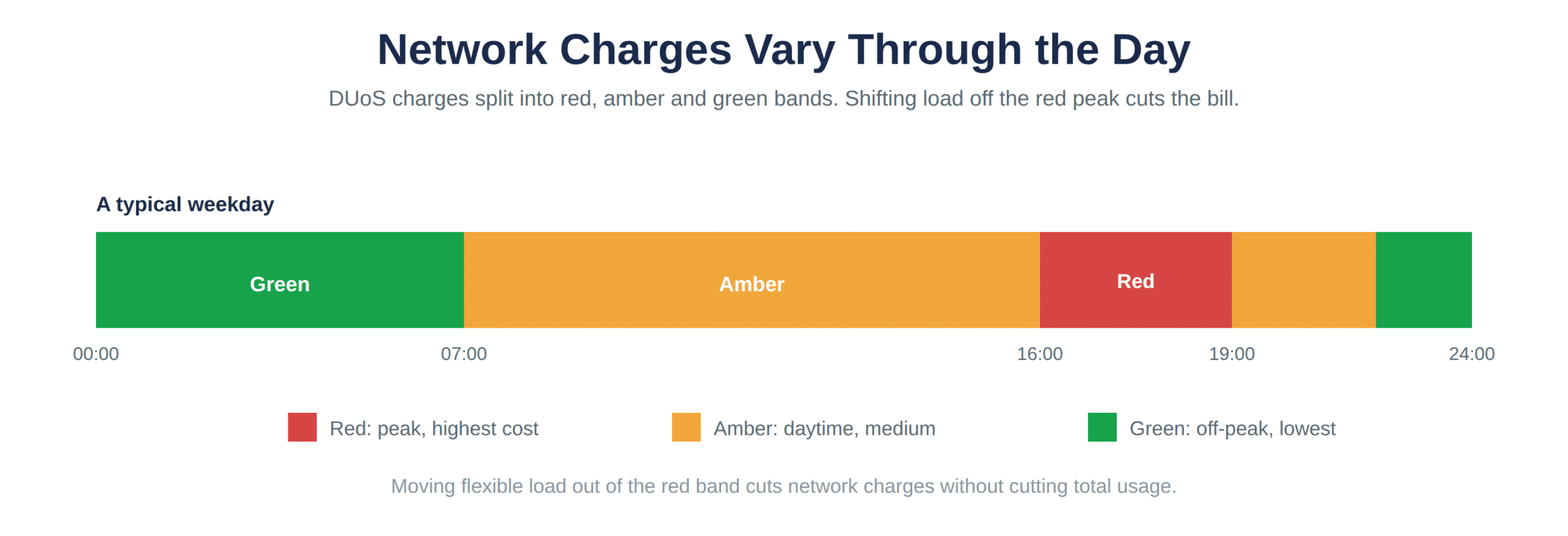
DUoS charges by time of day
DUoS rates split into red, amber and green bands, with red (typically weekday early evening) considerably higher than green overnight rates. A business running load in red band hours pays noticeably more for that portion.
That is exactly the kind of detail a standard profiled bill would never surface, and it is the first place a half-hourly site should look for savings.
| DUoS band | Typical timing | Relative cost |
|---|---|---|
| Red | Weekday early evening peak | Highest |
| Amber | Daytime working hours | Medium |
| Green | Overnight and weekends | Lowest |
How does half-hourly data change your procurement options?
Half-hourly data gives suppliers and brokers a precise view of your consumption shape, which supports flexible or tranche-based purchasing, more accurate pricing, and demand-shifting strategies non-half-hourly sites cannot access.
Better pricing for a favourable profile
Our guide to flexible energy procurement relies on exactly this data, since a flexible or basket strategy needs an accurate demand profile to price and manage properly.
Suppliers can also price a half-hourly site more competitively where the profile is favourable, such as consumption weighted towards off-peak, something an estimated profile-class bill would never reflect in the quoted rate.
What role do Elexon and NESO play in half-hourly settlement?
Elexon administers the Balancing and Settlement Code that governs how half-hourly consumption and generation are reconciled, while NESO manages real-time grid balancing, funded through BSUoS charges passed to suppliers and businesses.
Why this affects your bill
These two bodies sit behind almost every half-hourly bill’s non-commodity lines, even though most businesses never interact with either directly. NESO balancing costs, in particular, can move for reasons entirely separate from your own consumption.
Understanding their role matters mainly for context. It explains why non-commodity costs on a half-hourly bill can shift without any change in your usage or supplier choice.
It is also why a like-for-like comparison of two half-hourly quotes has to separate the commodity rate from the pass-through charges. A headline unit rate alone can hide where the real cost sits.
How do you use half-hourly data to cut costs?
Half-hourly data lets a business identify which periods of consumption cost the most, whether red band DUoS timing or high-demand periods driving capacity charges, and adjust operations or purchasing to reduce exposure.
Shifting flexible load off peak
Shifting flexible load, such as batch production, cold storage cycling or EV charging, away from red band peak hours can meaningfully reduce the network charge portion without cutting overall consumption. A kWh primer helps whoever reviews the data internally.
If your business already has half-hourly meters and is not using the data actively, there is likely value being left on the table at renewal and in day-to-day operations alike.