
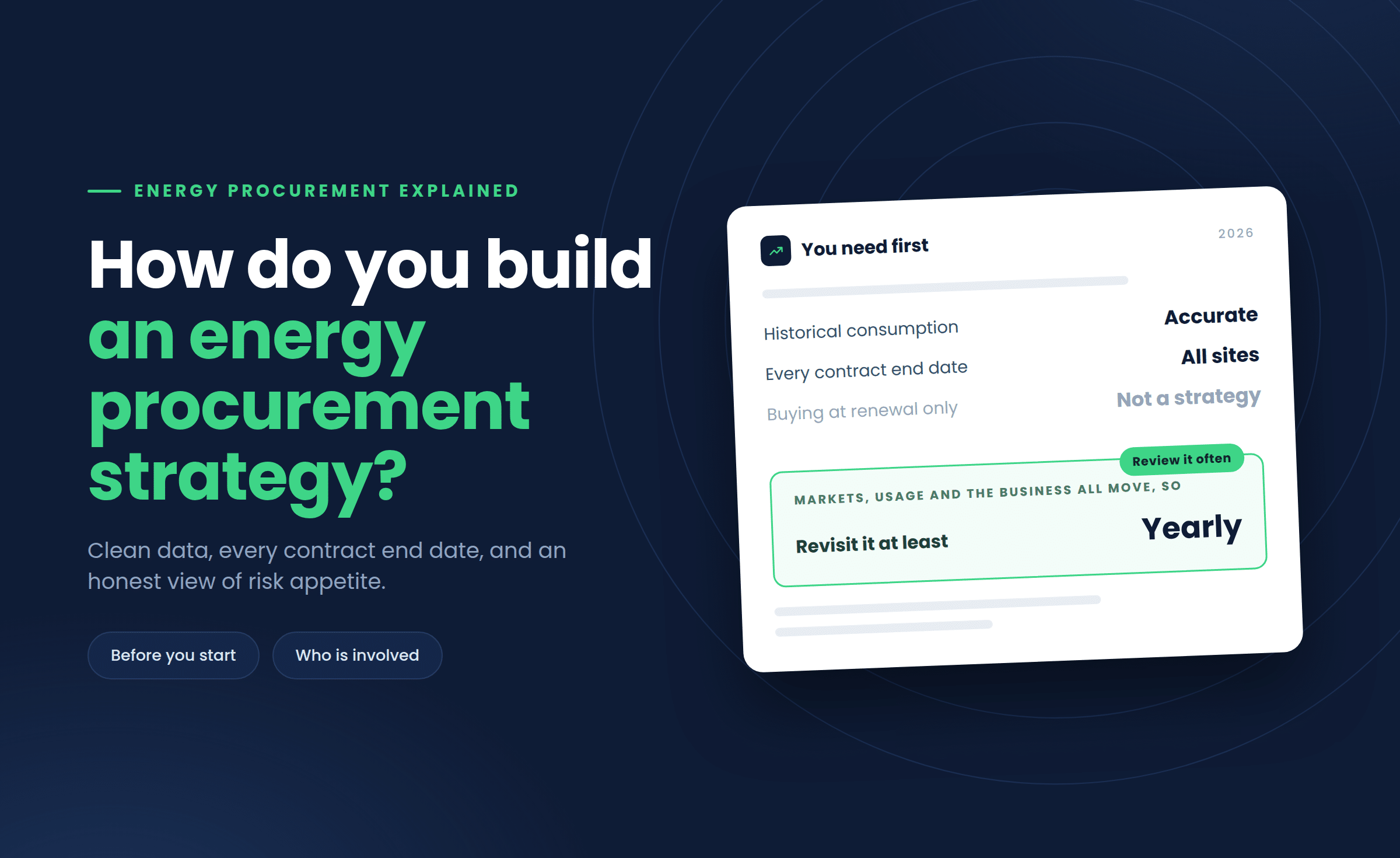
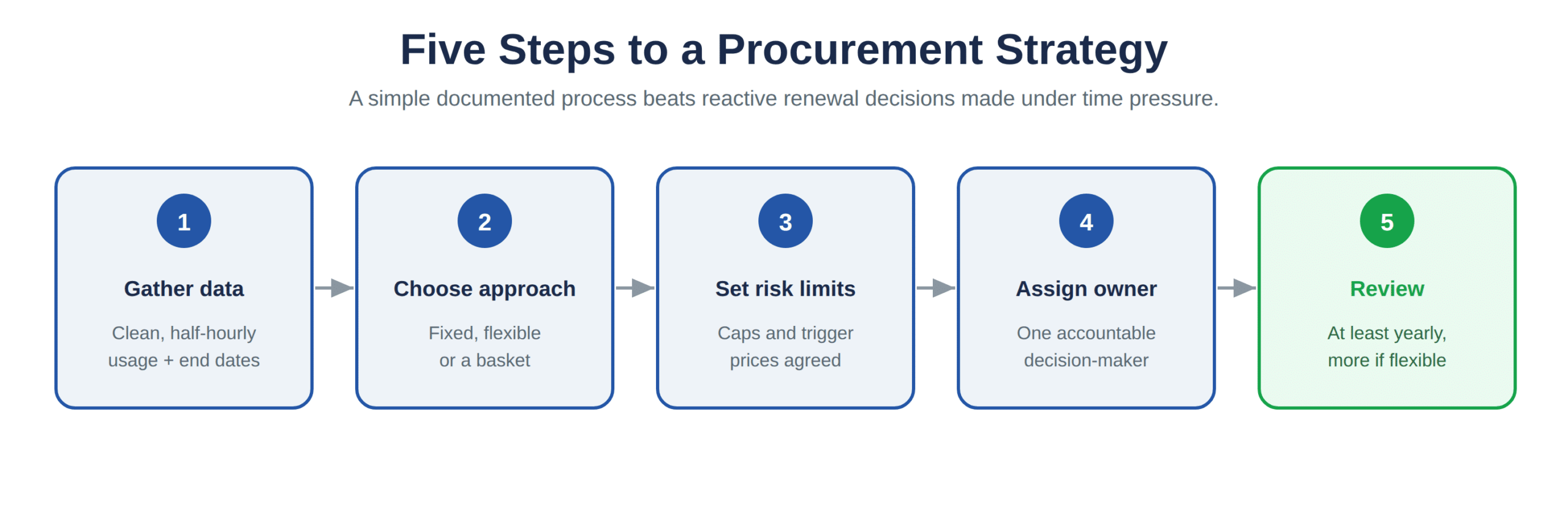
Building an energy procurement strategy starts with clean consumption data, then works through choosing a buying approach, setting risk limits, deciding who is accountable, and reviewing performance regularly rather than only at renewal.
For many businesses, strategy is a generous word for what happens with energy buying: someone gets a renewal notice, gathers a few quotes, and picks whichever number looks lowest.
That is not wrong exactly, just incomplete once the numbers get large enough that timing and structure start to matter as much as the headline rate.
A strategy formalises decisions previously made ad hoc: how much risk the business will carry, who signs off, and how performance is measured. It turns energy procurement into a repeatable function.
This guide walks through the practical steps of building that strategy, from data through to ongoing review.
What information do you need before setting a strategy?
You need accurate historical consumption data, ideally half-hourly where available, current contract end dates across every site, and a clear view of the business’s tolerance for price uncertainty.
Data checklist before you build
Consumption data reveals whether demand is steady, seasonal or concentrated in particular hours. Our guide to reading a business energy bill is the fastest route to the figures you need.
- Historical usage: 12 to 24 months per site or meter.
- Contract end dates: and any early termination terms.
- Meter types: including which sites are half-hourly.
- Budget tolerance: how much price movement the business can absorb.
How do you decide between fixed, flexible or a basket approach?
The choice usually comes down to volume and risk appetite: smaller or single-site businesses tend towards fixed contracts, larger half-hourly users often use flexible tranche buying, and many mid-sized operators settle on a basket blending both.
How a basket approach works
A basket fixes a portion of volume to protect against the worst case while leaving the rest open to flexible buying. Our guide to flexible energy procurement covers the tranche mechanics if your data points that way.
| Approach | Typical fit |
|---|---|
| Fixed | Smaller or single-site, planning-led |
| Flexible / tranche | Large half-hourly users with resource |
| Basket (fix + flex) | Mid-sized, wanting some protection and upside |
How do you build procurement risk management into the plan?
Risk management means setting clear limits before you buy: a maximum share of volume left unbought as the contract approaches, defined trigger points for locking in rates, and named individuals accountable for each decision.
Protecting whoever makes the call
Without these limits agreed in advance, a flexible or basket strategy can drift into inaction, with nobody willing to commit while waiting for a better rate that may never arrive.
- Cap the exposure: a maximum percentage of volume left unbought at any point.
- Set trigger prices: that automatically lock in a tranche once reached.
- Name an owner: a single accountable person, even if a broker executes.
Who should be involved in setting the strategy?
A finance director or facilities manager typically owns the strategy, but input from operations, whoever manages supplier relationships, and any external broker should feed into the final decisions.
Why finance must be in the room
Finance needs to understand how a flexible strategy could move actual spend against the annual forecast. Read our guide to business energy brokers before appointing a TPI, since their remuneration can influence how actively they manage timing.
Written risk parameters also protect whoever makes the buying decisions, since a documented process is far easier to defend to a finance director than a judgement call made under pressure near contract end.
Operations should be in the conversation too. A planned change of hours or a new production line shifts the usage profile the whole strategy is built on, so the people who know that first need a route to flag it.
How often should a procurement strategy be reviewed?
At least annually, and more often for businesses on flexible contracts, since market conditions, consumption patterns and business growth can all shift the right approach faster than a single annual check catches.
Triggers for an out-of-cycle review
Adding or losing a site, a change in operating hours, or new energy-intensive equipment are all reasons to revisit outside the normal cycle. Our guide to business energy renewals covers the renewal timeline that sits alongside a strategic review.
Grid balancing costs also move over time. NESO manages GB balancing, and the associated charges feed into the non-commodity costs a full strategy should account for.
What happens to a business without any strategy at all?
Without a strategy, businesses buy reactively at renewal, often close to a contract’s end date, missing favourable market windows and risking a drift onto expensive out-of-contract rates if a renewal is delayed or overlooked.
Why the risk multiplies across sites
Out-of-contract rates run 40% to 80% above a negotiated deal, exactly what a documented strategy prevents. Ofgem rules protect against some of the worst outcomes, but the timeline discipline is on the business.
For a multi-site business the risk multiplies: without coordination, different sites can end up on wildly different rates simply because each was dealt with in isolation, whenever its renewal happened to fall.
A strategy does not need to be complicated to be worthwhile. Even a simple documented approach covering data, risk limits and review timing beats reactive renewals, and the discipline of the process matters more than the buying approach chosen.