
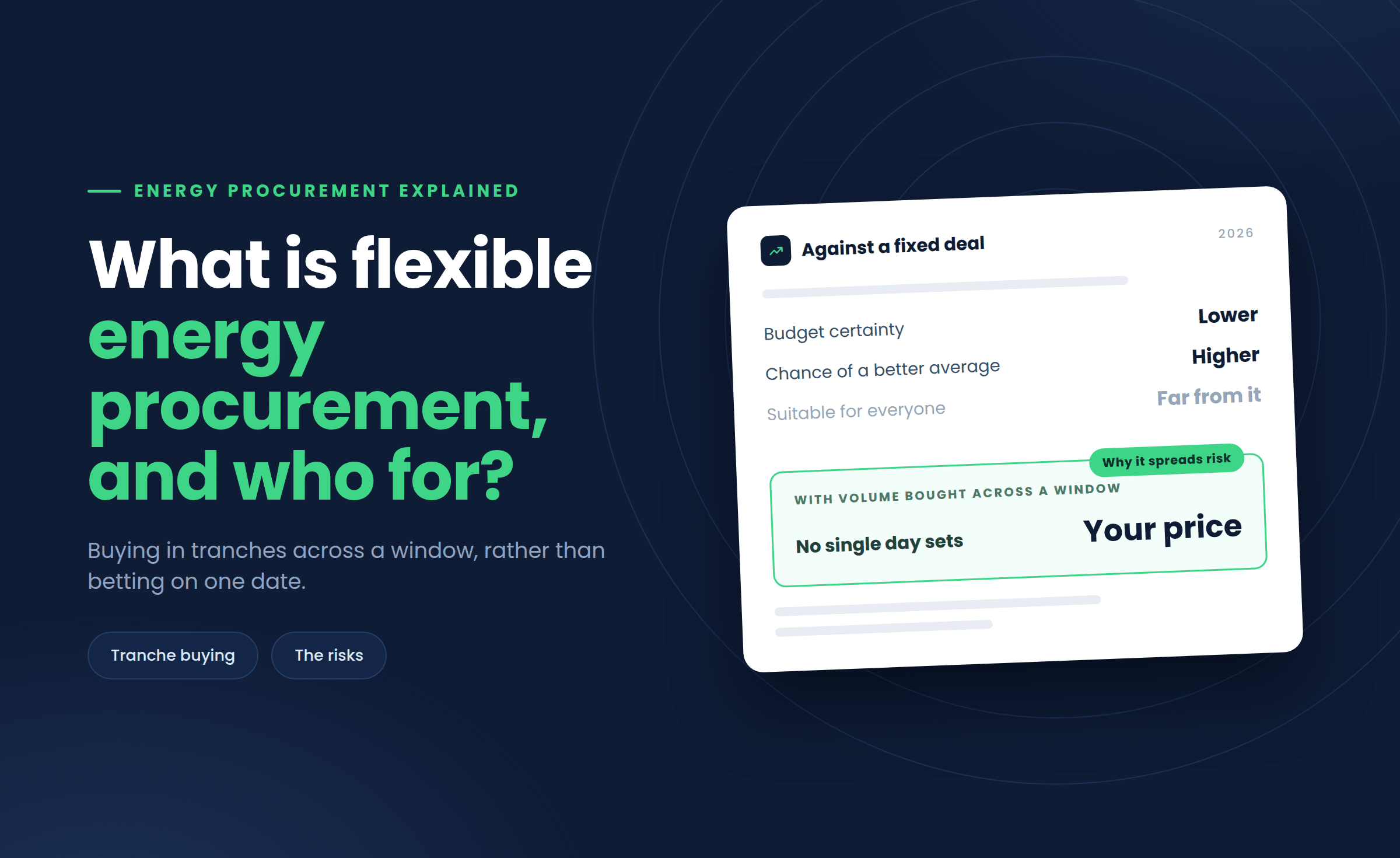
Flexible energy procurement lets a business buy its electricity or gas in stages, or tranches, over time instead of locking in one rate for the whole contract. It suits larger, half-hourly metered businesses with the risk appetite and resource to manage an actively bought contract.
A fixed contract has one obvious appeal: certainty. You know your rate for the next one, two or three years, and budgeting gets a lot simpler as a result.
That certainty comes at a price, because a fixed rate is set at a single point in time. Buy at the wrong moment and you are locked into that decision for the whole term.
Flexible purchasing takes a different view: rather than betting everything on one date, a business buys across multiple tranches, smoothing the risk of any single bad-timing decision. It is one branch of energy procurement.
This guide covers how tranche buying works, who it genuinely suits, and what a business gives up in exchange for the flexibility it gains.
How does tranche buying spread risk?
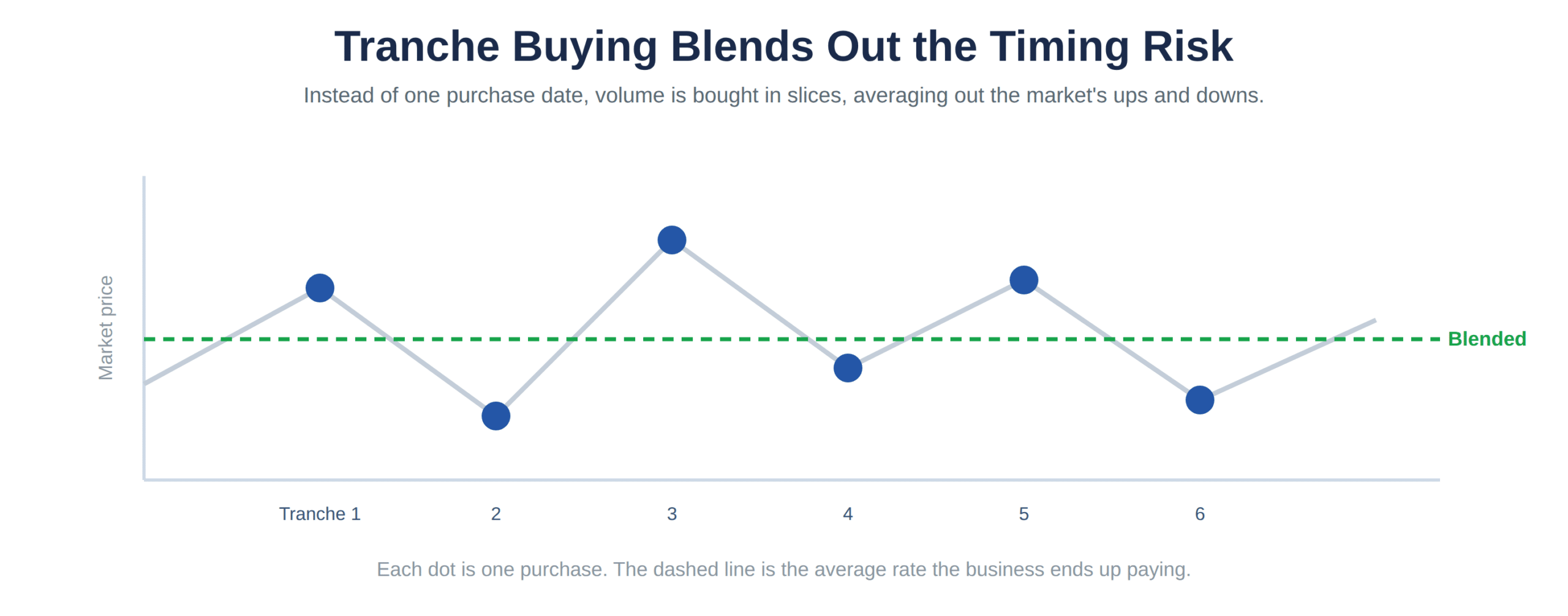
Tranche buying means purchasing a portion of your total forecast usage at several points across a buying window, rather than one lump purchase, so no single market movement determines your whole contract price.
Splitting volume into tranches
If a business buys 20% of its annual volume every few months, a spike on any one purchase date affects only that slice, not the entire contract. The blended rate settles between the market’s highs and lows.
- Split the volume: into tranches bought at different times.
- Lock each portion: each tranche fixes that slice’s rate independently.
- Blend the result: the final rate is the average across all tranches bought.
What’s the difference between flexible and fixed procurement?
A fixed contract sets one rate for the whole term at a single purchase point, while flexible procurement builds the final rate from several purchases over time, trading budget certainty for the chance of a better average price.
Which trade-off suits you
| Fixed contract | Flexible procurement | |
|---|---|---|
| Price certainty | High | Lower until final tranche |
| Timing risk | One purchase date | Spread across the window |
| Resource needed | Low | Active management |
| Best for | Smaller or planning-led | Large, half-hourly users |
Fixed suits a business that values knowing its exact cost above all, or one without the resource to manage a hands-on process. Flexible suits a business comfortable with some price uncertainty.
The point of flexible buying is not to beat the market on every purchase. It is to avoid the worst outcome of a single badly timed fixed deal signed on a spike.
Which businesses are large enough to buy flexibly?
Flexible procurement generally suits businesses with half-hourly meters, substantial annual consumption, and either an in-house energy manager or a broker able to make and time the tranche purchases.
Sectors most likely to qualify
This rules out most smaller businesses, where the admin of managing multiple purchases outweighs the pricing benefit. Medium to large users tracked as half-hourly for settlement are the natural fit.
Businesses in the Energy Intensive User Group, or already reporting under ESOS or SECR, often have both the scale and the internal discipline that flexible buying rewards.
How is a flexible energy budget managed day to day?
Managing a flexible contract means tracking wholesale market movement, deciding when to place each tranche, and monitoring the running blended rate against budget forecasts through the buying window.
Setting risk parameters
Most businesses set risk parameters upfront, such as a maximum share of volume left unbought as the term approaches, to avoid a last-minute purchase at a poor rate. Our guide to building an energy procurement strategy covers how these get set.
The wholesale market itself is settled through arrangements Elexon administers, which is why flexible contracts almost always apply to half-hourly settled sites rather than smaller meters.
What are the risks of buying energy flexibly?
The main risk is that the market moves against you during the buying window, and without a budget cap or risk limit in place, a business can end up paying more overall than it would have on a fixed rate.
Why inaction is the hidden danger
Flexible buying demands more attention. A business without the resource to monitor the market can drift into inaction, effectively buying its remaining volume at whatever rate is available near contract end.
That is why flexible procurement usually runs through a broker or dedicated energy manager rather than being left to whoever handles the energy bill alongside other duties.
Who manages flexible purchasing on a business’s behalf?
A Third Party Intermediary, or broker, typically manages flexible purchasing, executing tranche purchases against agreed risk parameters and reporting back on the running blended rate.
Broker or in-house
Our guide to business energy brokers covers how remuneration works, worth checking carefully for flexible contracts since fee structures vary more than on a simple fixed deal. Ofgem oversees how intermediaries must treat business customers.
Larger businesses sometimes build this capability in-house, employing a dedicated energy manager who works directly with wholesale market data rather than through an intermediary.
Either way, the reporting is what makes it work. A monthly view of the running blended rate against budget keeps the finance team informed and stops any tranche decision being made in the dark.