
Energy procurement is the process of buying gas and electricity for a business in a structured, planned way rather than accepting whatever renewal price a supplier offers. Larger and multi-site businesses generally need it; smaller businesses usually get most of the benefit from a straight comparison at renewal.
Most small businesses treat their energy contract like a phone contract: it renews, the price changes, and someone eventually shops around. That works reasonably well when the bill is a few thousand pounds a year.
It breaks down once a business spends tens or hundreds of thousands annually across one large site or several smaller ones, where timing, risk and contract structure genuinely move the final cost.
Procurement brings discipline to that decision, treating energy as a managed cost line rather than an annual admin task. It sits behind our wider energy procurement service.
This guide covers what procurement services do, how they differ from a standard switch, and how to judge whether your business has reached the size where it matters.
How does business energy procurement work?
Procurement means analysing consumption data, choosing a purchasing approach such as a fixed contract or flexible tranche buying, timing the market entry, and managing the contract through its life rather than just at renewal.
What the process involves
For a smaller business on a single meter, that is simple: compare quotes, pick a supplier, sign a fixed deal, as our guide to switching business energy sets out. Larger users add half-hourly data and a market view.
- Consumption analysis: understanding usage patterns across the site or portfolio.
- Purchasing strategy: fixed, flexible, or a basket blending the two.
- Market timing: choosing when to buy, not just what to buy.
- Ongoing management: monitoring the contract and market through its term.
What’s the difference between commodity and non-commodity costs?
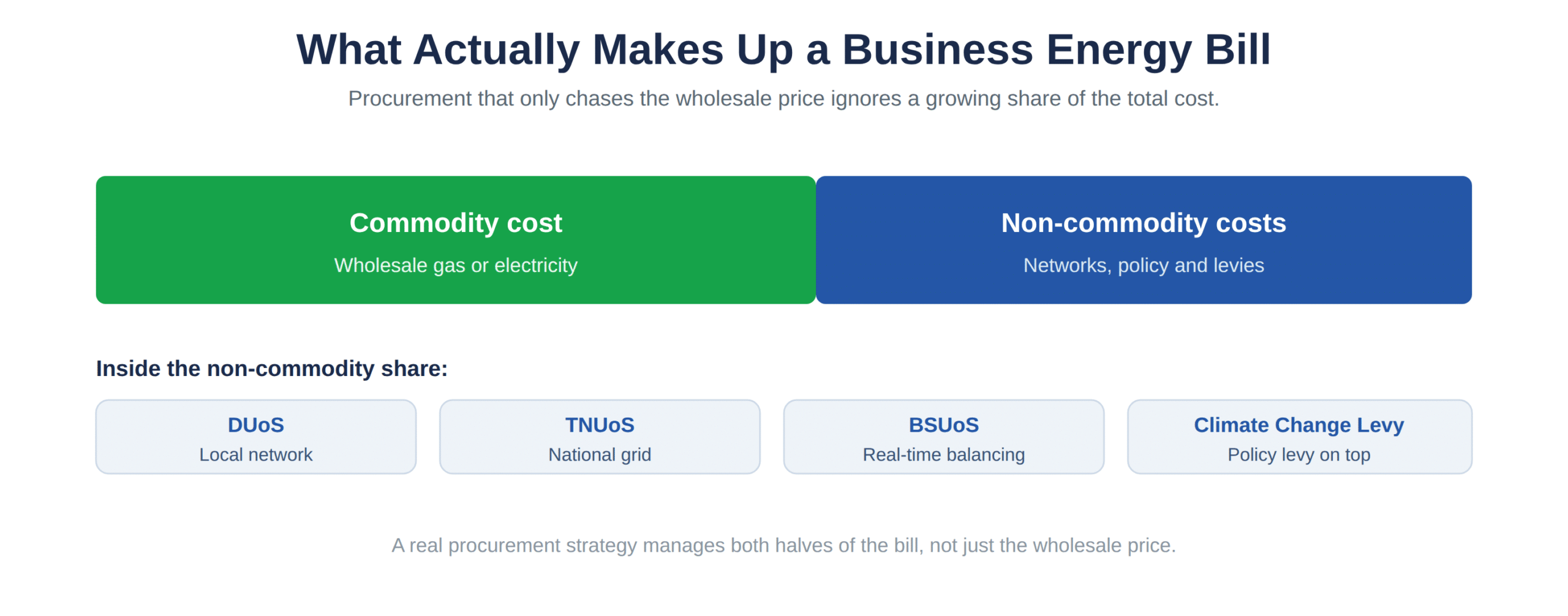
Commodity cost is the wholesale price of the gas or electricity itself, while non-commodity costs cover network charges, policy costs and levies such as DUoS, TNUoS, BSUoS and the Climate Change Levy, which now make up a substantial share of any large bill.
What the non-commodity charges cover
DUoS covers the local network, TNUoS the national transmission grid, and BSUoS funds real-time balancing. The Climate Change Levy sits on top, and our guide to non-commodity costs breaks each one down.
A strategy that only focuses on the commodity price is missing a growing share of the actual bill. On a large account the non-commodity element can rival the wholesale cost, and Elexon administers the settlement code that governs how half-hourly sites are charged.
Which businesses genuinely need a procurement strategy?
Half-hourly metered sites, businesses spending well into six figures annually, and multi-site operators with several meters all tend to benefit meaningfully from a proper procurement approach.
Signs your business has outgrown a simple switch
A single small shop paying a few thousand pounds a year gets most of the value from comparing carefully at renewal, which our guide to business energy renewals covers. Scale changes the calculation.
- Half-hourly meters: at one or more of your sites.
- Six-figure spend: combined annual energy cost or higher.
- Multiple sites: three or more separate meters to manage.
- Tracked as a budget line: not just treated as an overhead.
| Approach | Best fit |
|---|---|
| Compare at renewal | Single small site, modest spend |
| Fixed contract via broker | Mid-sized single or few sites |
| Flexible / tranche buying | Half-hourly, six-figure spend |
| Managed portfolio procurement | Multi-site, large or volatile demand |
What do energy procurement services typically include?
They generally cover consumption analysis, contract strategy design, market access to multiple suppliers, ongoing risk monitoring, and contract or portfolio administration, delivered in-house or through a broker.
Beyond the pure buying
Larger providers add budget forecasting and market intelligence, giving finance teams a view of likely cost movement ahead of renewal. Some extend into sustainability reporting, since ESOS and SECR increasingly sit alongside the procurement strategy side of the job.
The common thread is turning energy from a reactive annual scramble into a planned function with visibility over cost and risk months ahead.
For a finance team, that visibility is often worth as much as the saving itself. Knowing the likely cost range before renewal makes budgeting far less of a guessing game.
What role does a broker or TPI play in procurement?
A Third Party Intermediary, commonly called a broker, negotiates with suppliers on a business’s behalf, provides access across a wider supplier panel, and manages the timing and administration of the buying process.
Fees and the letter of authority
Our guide to business energy brokers explains how fees and remuneration work, worth understanding before appointing one. A letter of authority is usually required before a broker can act with suppliers on your behalf.
Not every remuneration model is transparent by default, so ask directly how a broker is paid before signing. Ofgem has tightened the rules on how intermediaries must treat business customers, and a good broker will explain its fees without hesitation.
How much difference can procurement make to a large bill?
For a large user, the gap between an unmanaged renewal and a well-timed, well-structured approach can run into a meaningful percentage of the total bill, particularly during volatile market periods.
Why drifting out of contract costs so much
Out-of-contract rates sit 40% to 80% above a negotiated deal in many cases, exactly the outcome active procurement prevents across a portfolio. Businesses switching through Utility Saving Expert save an average of £1,952, and that grows once multiplied across several sites.
Scale alone already changes the rate available, with the largest usage bands securing lower unit prices. Timing and structure on top of that can widen or narrow the gap further.