
Managing energy across multiple sites works best under a single contract or coordinated strategy covering every meter, with aligned renewal dates, consistent supplier relationships, and one accountable owner rather than each site handling its own contract.
A retail chain, a care home group, or a hospitality business with several venues all hit the same problem: each site has its own meter, its own contract, and often its own renewal date, disconnected from the others.
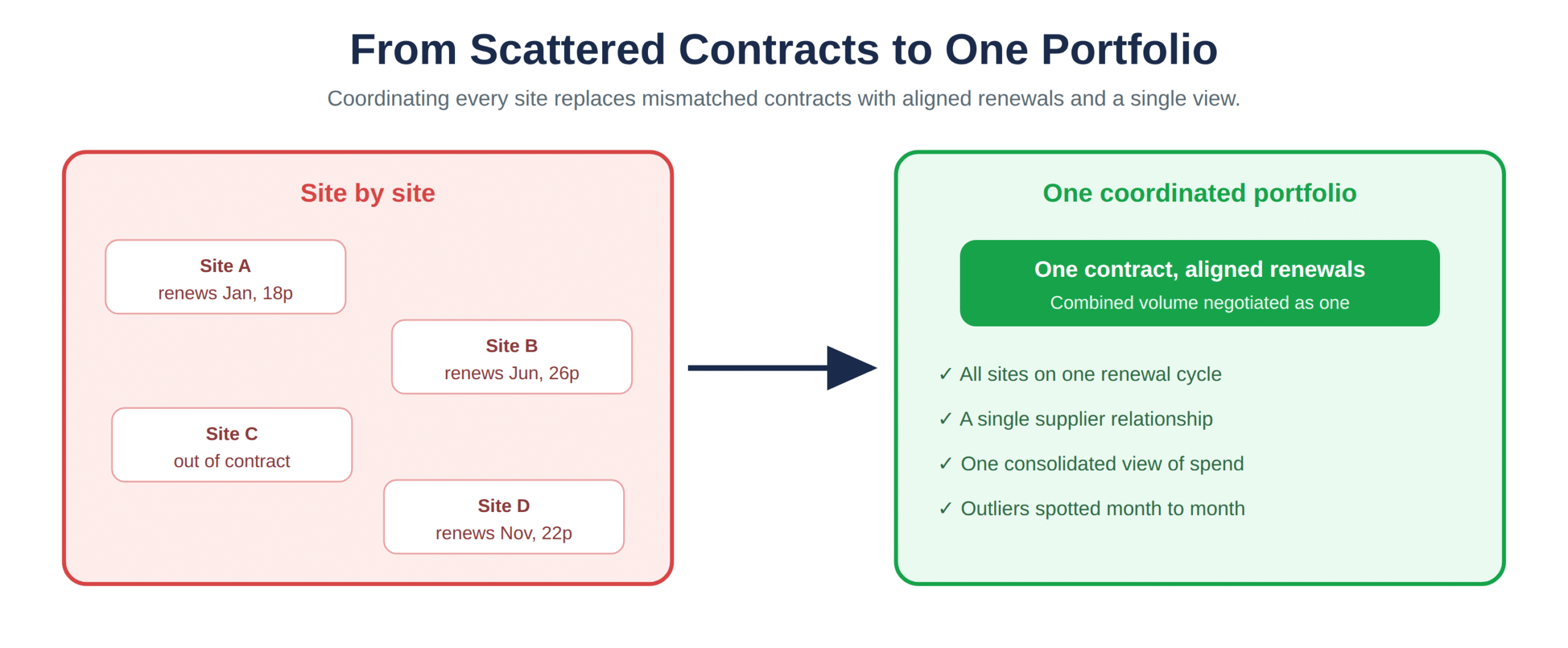
Left unmanaged, that drifts into chaos. Different sites end up on wildly different rates, some roll onto expensive out-of-contract terms, and nobody has a single view of what the portfolio actually spends.
Portfolio energy management brings that back under control, treating every site as part of one coordinated exercise. It is where energy procurement earns its keep for a growing estate.
This guide covers what changes when you manage energy at portfolio level, and the practical steps that keep a multi-site estate from drifting apart.
What’s different about buying energy for a multi-site portfolio?
Buying at portfolio level means negotiating rates across combined volume rather than site by site, which usually gets a better rate than any single site could achieve alone, alongside far simpler administration.
What portfolio buying gives you
Combined volume gives real negotiating weight with suppliers, particularly once the portfolio spans several hundred thousand pounds of annual spend. The trade-off is coordination effort upfront.
- Combined volume: usually beats site-by-site negotiation.
- One relationship: a single supplier simplifies billing and account management.
- Consolidated reporting: one clear view of total portfolio spend.
| Element | Site-by-site | Coordinated portfolio |
|---|---|---|
| Negotiating power | Each site alone | Combined volume |
| Renewal dates | Scattered | Aligned |
| Supplier contacts | Many | One relationship |
| Spend visibility | Fragmented | Single view |
Should every site sit on the same contract and renewal date?
Aligning renewal dates is usually worth the short-term disruption of a few mismatched contract lengths, since it lets a business negotiate the whole estate at once rather than piecemeal throughout the year.
Common reasons portfolios drift out of line
Businesses growing by acquisition often inherit a messy spread of end dates. Bringing them into alignment, even over one or two cycles, pays off later, and our guide to business energy contracts covers the terms to check first.
- Acquisitions: sites bought at different times with different contracts.
- Local renewals: site managers historically handling their own.
- No central record: of contract end dates across the estate.
How do you manage sites with different meter types?
A typical portfolio includes a mix of standard, half-hourly and smart meters, and a good multi-site contract accommodates all three under one supplier relationship without forcing every site onto identical terms.
Flagship and satellite sites together
Larger flagship sites are more likely to sit above the half-hourly threshold, while smaller satellites stay on standard profiled metering. Sharing our half-hourly meters and kWh guides with site managers helps them understand their local billing.
Both meter types can still be managed under one coordinated strategy. The contract simply prices and settles each according to its metering, behind a single relationship.
What role does a broker or TPI play in portfolio management?
A broker manages the day-to-day administration of a multi-site portfolio, coordinating renewal timing, consolidating billing queries, and negotiating combined-volume rates on the business’s behalf.
One letter of authority, not many
Our guide to business energy brokers explains the remuneration models, which matter more at portfolio scale since fees across many sites add up. A single letter of authority covering the whole portfolio simplifies the relationship considerably.
Ask how the broker is paid across the estate before appointing them. At portfolio scale a small difference in the fee model becomes a large difference in cost, and Ofgem has tightened the rules on how intermediaries must treat business customers.
A good broker also keeps a live record of every site’s contract end date. That single register is often the most valuable thing they provide, because it stops any site quietly slipping out of contract.
How do you track and benchmark performance across sites?
Tracking portfolio performance means comparing consumption and cost per site against comparable benchmarks, whether similar sites in your own estate or sector averages, to spot outliers that need investigating.
Spotting an outlier site
A site using noticeably more energy per square foot than a comparable location is worth a closer look. Sometimes it is a genuine operational difference, sometimes a fault or inefficiency worth fixing.
Regular reporting, ideally monthly rather than only at renewal, keeps these outliers visible before they become an expensive surprise. A site running well above a comparable location stands out fast when the whole estate sits on one dashboard.
- Compare like with like: cost and consumption per site against similar sites.
- Flag increases: investigate rather than assuming seasonal variation.
- Review monthly: not only at each site’s renewal date.
What happens when sites are added or sold mid-contract?
Adding a new site is usually a simple supplement to the existing agreement, while disposing of a site typically needs a formal change of tenancy or contract novation process.
Build the flexibility in early
Our guide to change of tenancy covers what happens to an energy contract when a site changes hands, whether you are buying a new location or exiting one.
Building this flexibility into the original contract saves a stressful scramble later. Brokers routinely manage portfolios spanning several network operator regions, coordinating the different regional charges each site falls under.