


Manufacturers reduce energy costs most effectively by fixing compressed air leaks, upgrading motors and drives, and reviewing process heat schedules, three areas that quietly waste energy on almost every factory floor. It is less about switching things off than running existing plant properly.
Factory energy costs rarely come down to one culprit. They are spread across process plant, compressed air systems, motors, drives and the building services wrapped around all of it.
That spread is why manufacturing energy audits so often turn up savings nobody was looking for. A compressed air leak hissing behind a machine guard can run up a bigger annual bill than an entire office wing.
Larger manufacturers also carry obligations smaller businesses do not, from the UK Emissions Trading Scheme to reporting under SECR. Those sit alongside the basic job of controlling usage, and a solid energy procurement approach ties them together.
This guide covers where manufacturing energy actually goes, the fixes that consistently pay off, and where the contract still does more than any single piece of kit.
Where does a factory’s energy go?
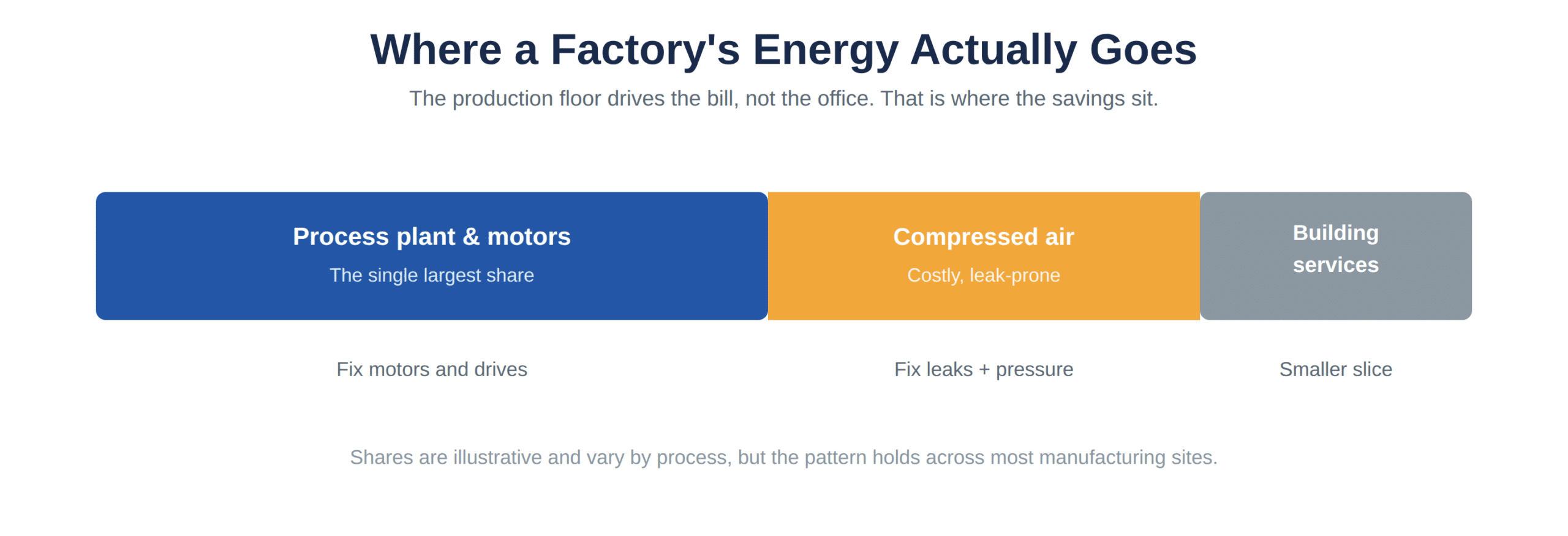
Process plant, motors and compressed air together typically account for the largest share of manufacturing energy costs, with building services like lighting and heating usually a smaller slice than most site managers expect.
Why the production floor dominates
That balance surprises people who assume the office and welfare areas drive the bill. In most manufacturing sites they do not, the production floor does.
It means the biggest savings sit in how the plant runs, not in the building around it. Getting the process side right is where a real programme starts.
| Measure | What it tackles | Effort |
|---|---|---|
| Compressed air leak survey | Wasted generated air | Low |
| Variable speed drives | Motors running flat out | Medium |
| Process heat scheduling | Plant left hot between batches | Low to medium |
| Contract review | Every unit you buy | Low |
Why is compressed air such a hidden cost?
Compressed air is one of the most expensive forms of energy a factory generates, and a large share of that air is typically lost to leaks before it ever reaches the tool or process it is meant to power.
Finding and fixing the leaks
A leak is invisible and often inaudible over factory noise. A system can run for months with a dozen small leaks nobody has noticed, quietly inflating the compressor’s runtime.
- Ultrasonic surveys: pick up leaks impossible to hear over normal factory noise.
- Prompt repairs: fix leaks as found rather than batching into an annual window.
- Review pressure: many factories run compressors higher than any tool needs.
Generation efficiency matters too. An older fixed-speed compressor running well below full load for much of the day is a common, costly setup that a variable speed drive compressor avoids.
Can motors and drives cut industrial energy costs?
Yes. Fitting variable speed drives to motors that currently run at fixed speed, even when the process only needs partial output, is one of the most consistently effective measures available to manufacturers.
Efficiency at replacement time
Pumps, fans and conveyors are frequently sized for peak demand and then run flat out regardless of load. A variable speed drive lets the motor match its output to what the process genuinely needs at that moment.
Motor efficiency ratings matter at replacement time too. When an older motor fails, fitting a higher-efficiency equivalent rather than a like-for-like unit locks in a saving for the rest of that motor’s life.
Does process heat scheduling make a real difference?
Reviewing when and how process heat is generated, rather than assuming it must run continuously, often reveals capacity that can be scheduled around actual production demand instead of running on regardless.
Ramp-downs and waste heat recovery
Ovens, kilns and heat treatment plant are frequently left at temperature between batches out of habit. A scheduled ramp-down between runs costs nothing in output but saves meaningfully, as our guide to reducing business energy consumption explores.
Waste heat recovery is worth a look too, particularly where a process already generates heat that is currently vented rather than reused for space heating or pre-heating process water. The Carbon Trust publishes sector guidance on recovering it cost-effectively.
What obligations apply to larger energy-intensive manufacturers?
Larger manufacturers may fall under the UK Emissions Trading Scheme, Climate Change Agreements, and reporting requirements like SECR or ESOS, each carrying its own compliance timeline separate from routine energy management.
CCAs and the british industry supercharger
Climate Change Agreements are worth checking, since qualifying sites access a reduced Climate Change Levy rate in exchange for hitting efficiency targets. The British Industry Supercharger also reduces network charges for energy-intensive industries.
It is worth checking whether your sector and usage level qualify. Membership bodies like the Energy Intensive User Group track how these schemes apply across industry.
Where does the energy contract fit into all this?
The contract itself is usually the single biggest lever a manufacturer has, ahead of any efficiency project, since a site on an out-of-contract or deemed rate can pay 40% to 80% more than a negotiated deal on every unit.
Matching the contract to production
Larger manufacturers with high, variable usage often benefit from a flexible or half-hourly settled contract that reflects genuine demand across shifts, rather than a flat rate designed for a simpler business.
Our guide to energy procurement covers how industrial users structure a contract around fluctuating production, and half-hourly data shows exactly where the load sits shift by shift.