
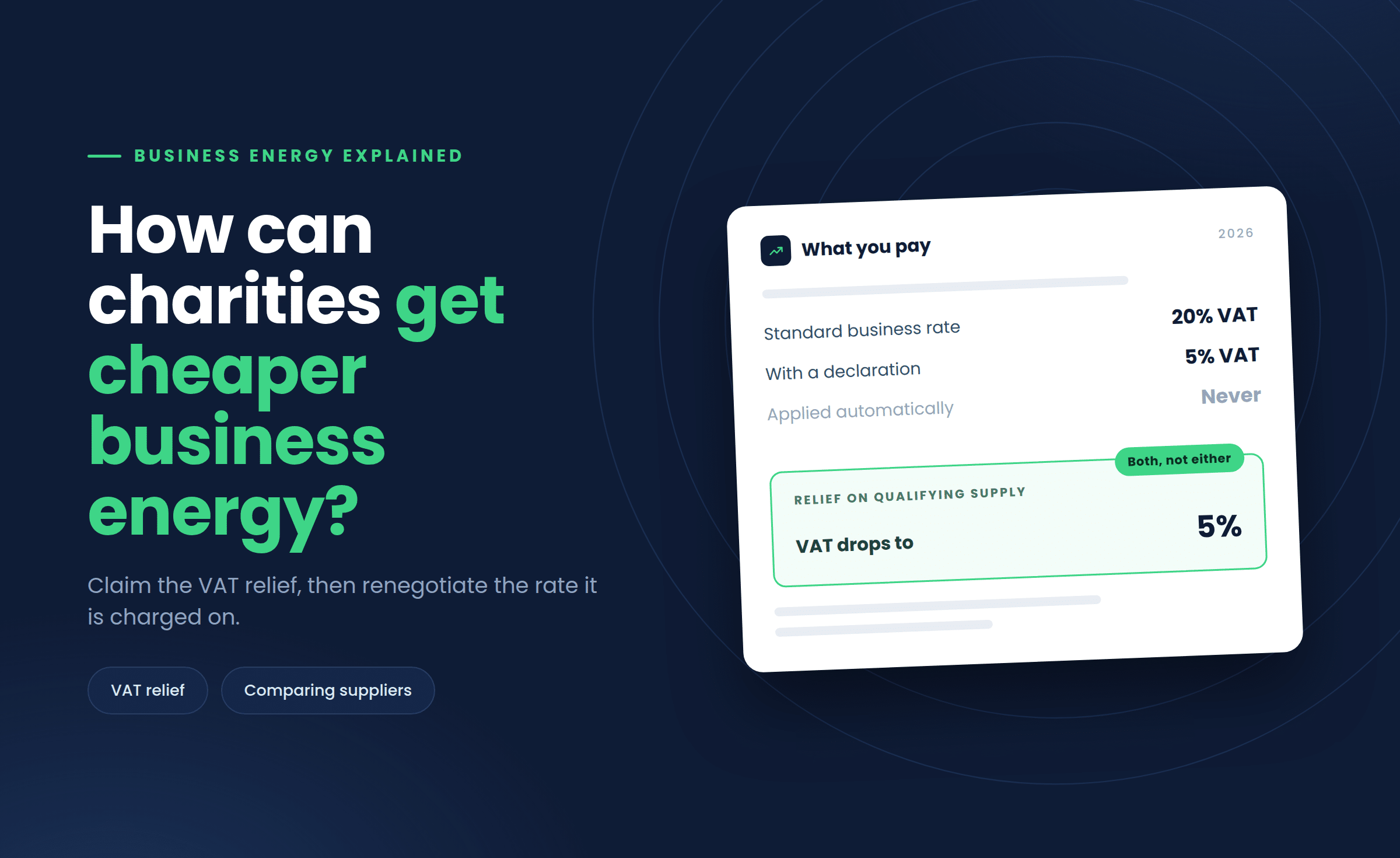
Charities lose money on energy in two ways, and most only fix one: an uncompetitive rate inherited years ago and never renegotiated. The second is quieter, unclaimed VAT relief that has been sitting on the table the whole time.
A charity running a community centre, a shop or a small office looks like any other small business to most suppliers by default. Nobody applies charitable VAT treatment automatically, so you have to know it exists and ask for it.
Charity energy suppliers are not a separate category either. It is the same panel of UK suppliers everyone else compares against, just with reliefs that apply once eligibility is declared, as our sectors we cover hub sets out.
This guide covers what charities can actually claim, how charity energy rates compare with standard business rates, and where to focus limited time and budget for the biggest impact.
What VAT relief can charities claim on energy bills?
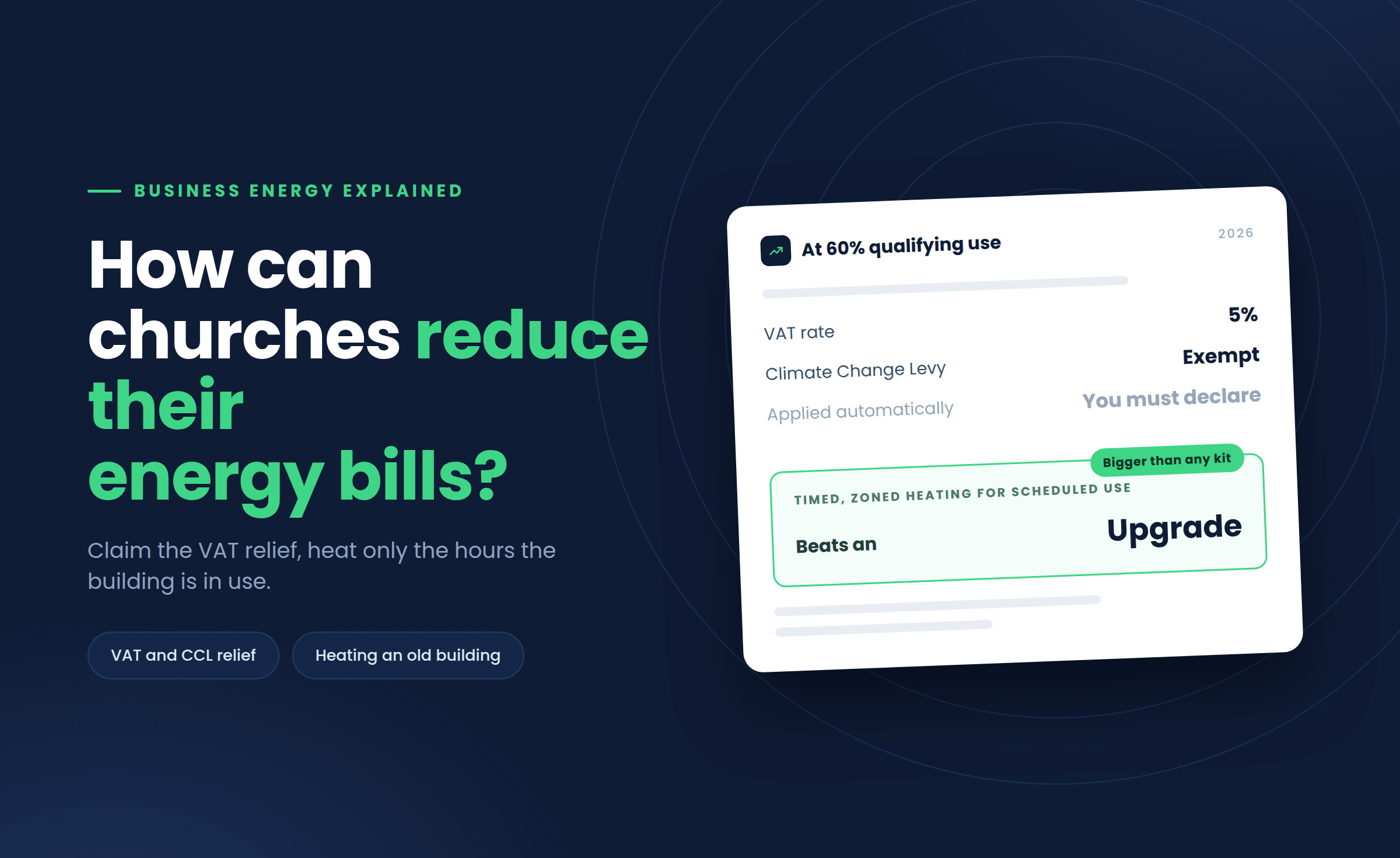
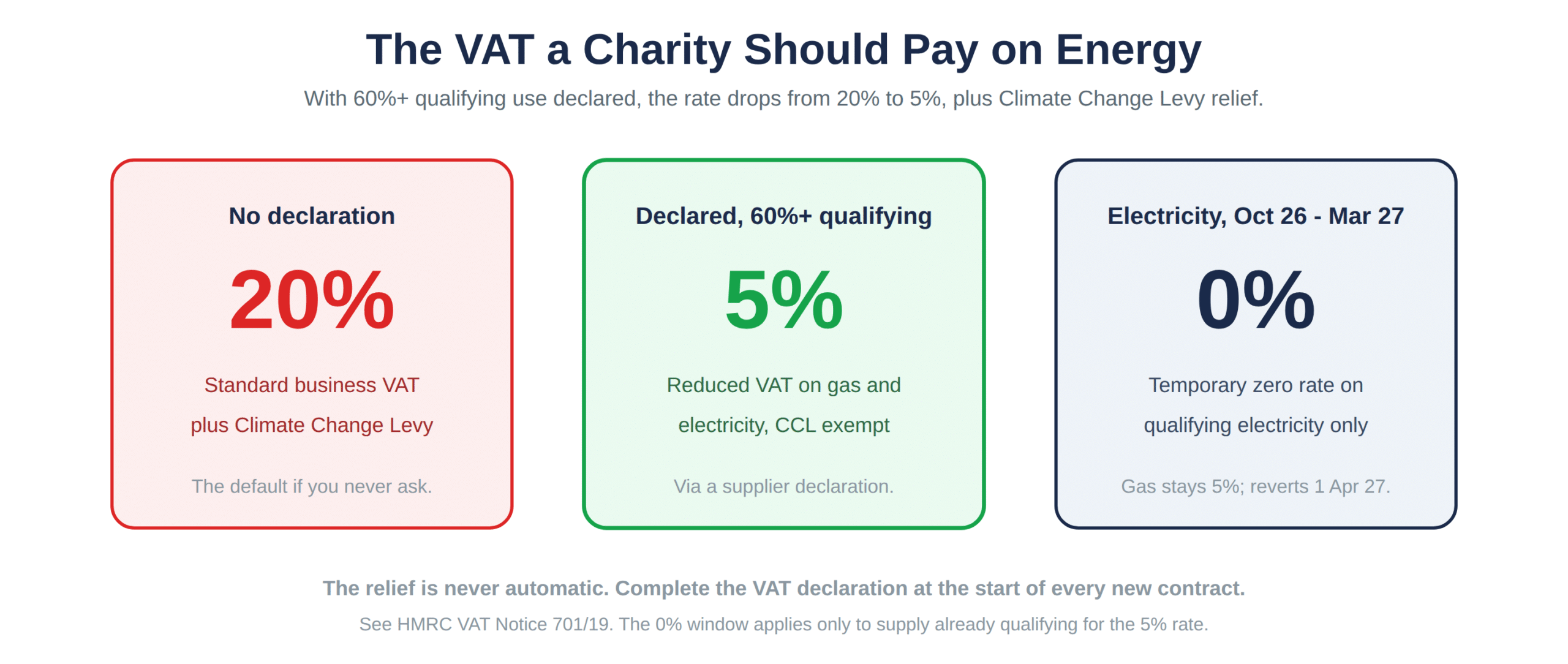
Charities can claim the reduced 5% VAT rate, instead of the standard 20%, where 60% or more of the energy supplied is used for non-business or qualifying charitable purposes, alongside exemption from the Climate Change Levy on the same supply.
The declaration you must complete
This relief is set out in HMRC VAT Notice 701/19 and applies regardless of supplier. It is not automatic: a charity completes a short declaration confirming the percentage of qualifying use.
- Confirm the split: what percentage of energy use is non-business or charitable.
- Complete the form: the supplier’s VAT declaration at the start of every contract.
- Check both reliefs: VAT relief and CCL exemption, not just one.
- Re-confirm on switching: the declaration does not automatically transfer.
There is also a temporary boost from 1 October 2026 to 31 March 2027, when VAT on qualifying electricity drops to 0% rather than 5%, using the same test. Gas stays at 5% for qualifying use, and the 0% rate is due to revert on 1 April 2027 unless extended.
Are charity energy rates any different from standard business rates?
The underlying unit rates charities pay are the same market rates any small or micro business sees, priced by usage band rather than charitable status, but the VAT and CCL relief on top can make the effective cost meaningfully lower.
A worked example for a small charity
| Usage band | 2026 average electricity rate | Standard VAT | Reduced VAT (60%+ qualifying) |
|---|---|---|---|
| Very small (0-20 MWh) | 35.02p/kWh | Full rate + 20% | Full rate + 5%, CCL exempt |
| Small (20-499 MWh) | 28.76p/kWh | Full rate + 20% | Full rate + 5%, CCL exempt |
| UK average, all businesses | 24.14p/kWh | Full rate + 20% | Full rate + 5%, CCL exempt |
A charity using 10,000 kWh a year sits in the very small band, and the difference between 20% and a correctly applied 5% is worth calculating properly. Our guide to VAT on business energy bills covers the test, and comparing business electricity against a recent bill confirms your figure.
What other protections do charities get as energy customers?
Many charities also qualify as microbusinesses under the Retail Energy Code, based on employee numbers or low annual consumption rather than charitable status, which brings extra protections around contract clarity and back-billing limits.
Microbusiness status and the ombudsman
Microbusiness status typically applies to organisations with fewer than 10 employees or under a set annual threshold. Our guide to micro business energy explains the criteria and the protections that follow.
- Retail Energy Code: microbusiness protections if eligible by size or usage.
- Ombudsman access: the Energy Ombudsman for complaints a supplier will not resolve.
- Back-billing limits: standard caps on charges for metering errors.
How should a charity compare energy suppliers?
The comparison process for a charity is the same as any small business: gather a recent bill, confirm your usage and meter details, and compare against a panel of suppliers rather than accepting an automatic renewal offer.
Timing the switch around your financial year
Trustees managing energy alongside dozens of other duties often cannot run this every year, which is why so many charities land on out-of-contract rates 40% to 80% above a negotiated deal. A letter of authority lets a comparison service manage the switch for a mostly volunteer-run organisation.
Switching through Utility Saving Expert compares a panel of 30-plus trusted UK suppliers, with an average saving around £1,952 a year. Charities working to a Charity Commission year-end sometimes align a switch to budgeting, but that should not delay comparing a panel of suppliers if the contract is due to renew sooner.
What energy-saving steps make sense for a charity with a limited budget?
Behavioural and scheduling changes, like adjusting heating timers and switching off unused areas of a building, deliver the fastest results for charities without capital to spend on equipment upgrades.
Zero-cost changes first
A charity shop, community hall or drop-in centre often has irregular opening hours that do not match a heating or lighting schedule set years ago. Reviewing when the building is genuinely occupied and adjusting timers costs nothing.
- Match schedules: heating and lighting to actual opening hours, not historic defaults.
- Check fridge settings: charity shop units often run colder than necessary.
- Ask your landlord: if you rent, about responsibility for building fabric improvements.
- Seek grants: charity-sector energy efficiency funding where it exists locally.