
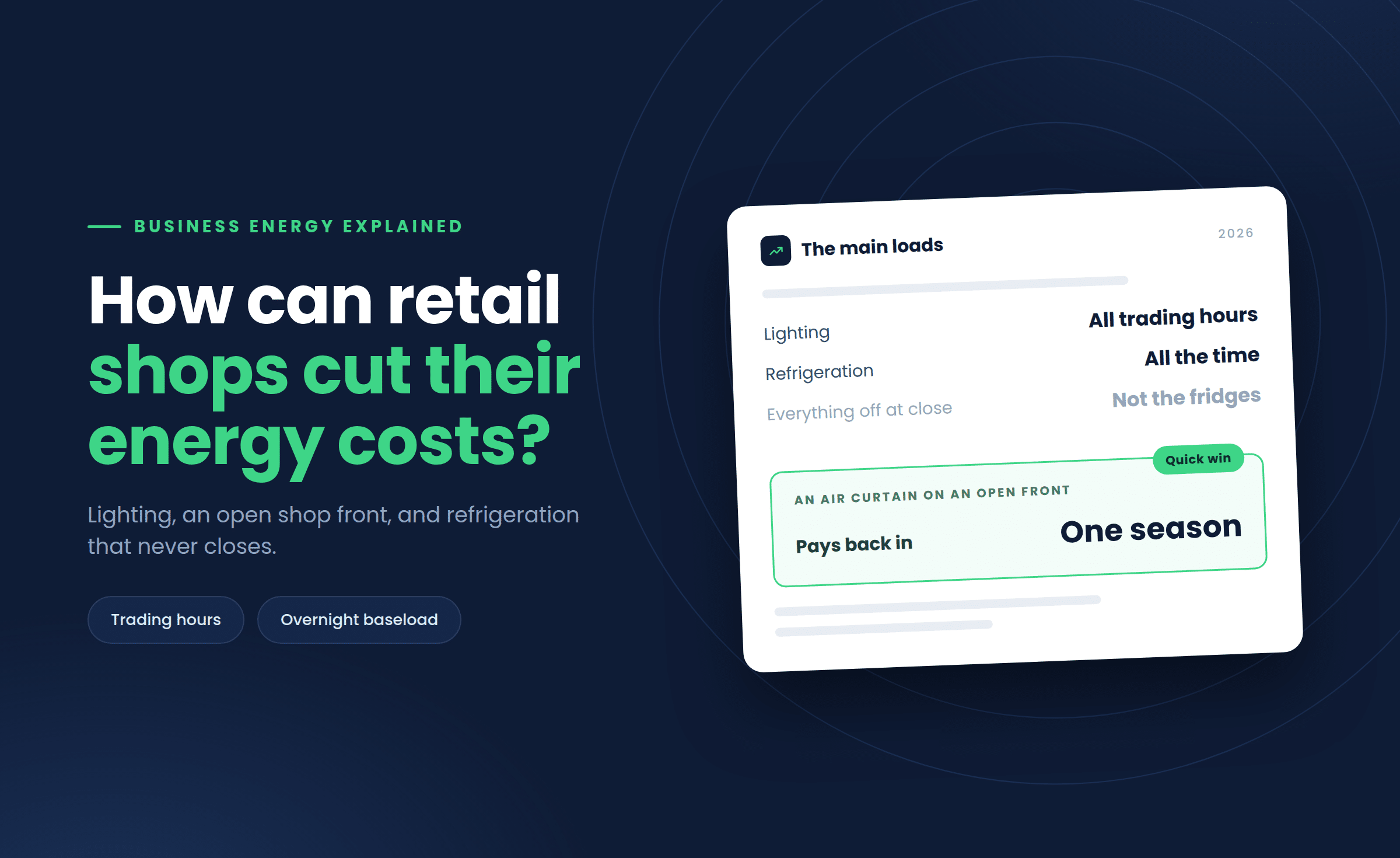
Retail shops cut energy costs mainly by tackling lighting and heat loss around the shop front, since these run for the entire time the doors are open and often beyond it. For stores with chilled or frozen stock, refrigeration is usually the single biggest and least visible cost on the bill.
A shop’s bill mixes things you can see, the lights, the till, the changing-room heating, and things you cannot, the chiller cabinet humming in the corner and the alarm that never sleeps. Retail energy costs get judged on the visible half and lost on the invisible one.
The British Retail Consortium has flagged energy as one of the fastest-rising cost pressures on the high street, and store-level data shows the same pattern: lighting, heating and refrigeration dominate, not the till points.
Shop bills are also unusually sensitive to opening hours and footfall, because a store that opens its doors to the street loses heat every time a customer walks in. Our retail sector guidance covers the pattern across store types.
What drives a retail store’s energy bill?
Lighting and heating or cooling the sales floor together make up the largest share of most retail energy costs, with refrigeration a close second for any store selling chilled, frozen or ambient food.
The visible and invisible costs
Retail lighting is often left at full brightness for the entire trading day, including window displays lit well past closing. Our guide to how to read a business energy bill shows how to see where your own usage concentrates.
| Cost area | Typical share | Detail |
|---|---|---|
| Lighting (floor and windows) | High | Often at full output the whole trading day plus display hours |
| Heating and cooling the floor | High | Constant heat loss through an open shop front during trading |
| Refrigeration (food retail) | High where present | Runs 24 hours a day regardless of footfall |
| Tills, security and back office | Lower | Small individually, but continuous even when closed |
Why do open shop doors cost so much in heat loss?
An open shop door lets heated or cooled air escape continuously, forcing the HVAC system to keep replacing it, which is why heating a sales floor with the door propped open costs noticeably more than heating the same space closed.
Fixes that keep the door open
It is a genuine trade-off. An open door invites footfall in, but it also means the shop is effectively heating the pavement outside.
Air curtains fitted above the entrance are one of the more effective fixes, creating a barrier of moving air that reduces heat exchange without shutting the door. Draught lobbies achieve something similar where the layout allows.
Where the heating runs on gas, the effect shows up on the business gas bill rather than electricity, so a shop with an all-day open door should watch both fuels through the colder months.
Does refrigeration change the picture for food retailers?
Yes. Convenience stores, bakeries and any retailer running open chiller cabinets or freezers see refrigeration become their single largest continuous energy cost, running around the clock whether the shop is busy or empty.
Maintenance checks that cut fridge costs
Open-fronted chillers lose cold air constantly, which is why retailers increasingly fit night blinds or glass doors, both cutting compressor load. The Carbon Trust rates door retrofits among the strongest retail refrigeration measures.
Regular defrosting and door seal checks matter here too. A perished seal on a freezer door is an invisible drain that keeps running until someone notices the frost build-up.
How can a retail store save energy without hurting the shopping experience?
A store can save energy customers will not notice by switching to LED lighting, fitting sensors in stockrooms and changing rooms, and setting heating and cooling on a timer that matches trading hours rather than running continuously.
Changes customers never see
- LED retrofits: for sales floor and window lighting, a fraction of the energy of older fittings.
- Occupancy sensors: in stockrooms, changing rooms and toilets used only briefly.
- Trading-hour controls: on heating and cooling, with a setback for early deliveries.
- Night blinds: on open refrigeration outside trading hours where layout allows.
None of these change what a customer sees or feels while shopping. For more no-cost ideas, see our energy-saving tips for small businesses.
They just stop the shop paying for energy nobody is using. A window display lit past midnight draws footfall for a few evening hours but bills for all of them, so timers on signage are an easy early win.
What happens to energy use outside trading hours?
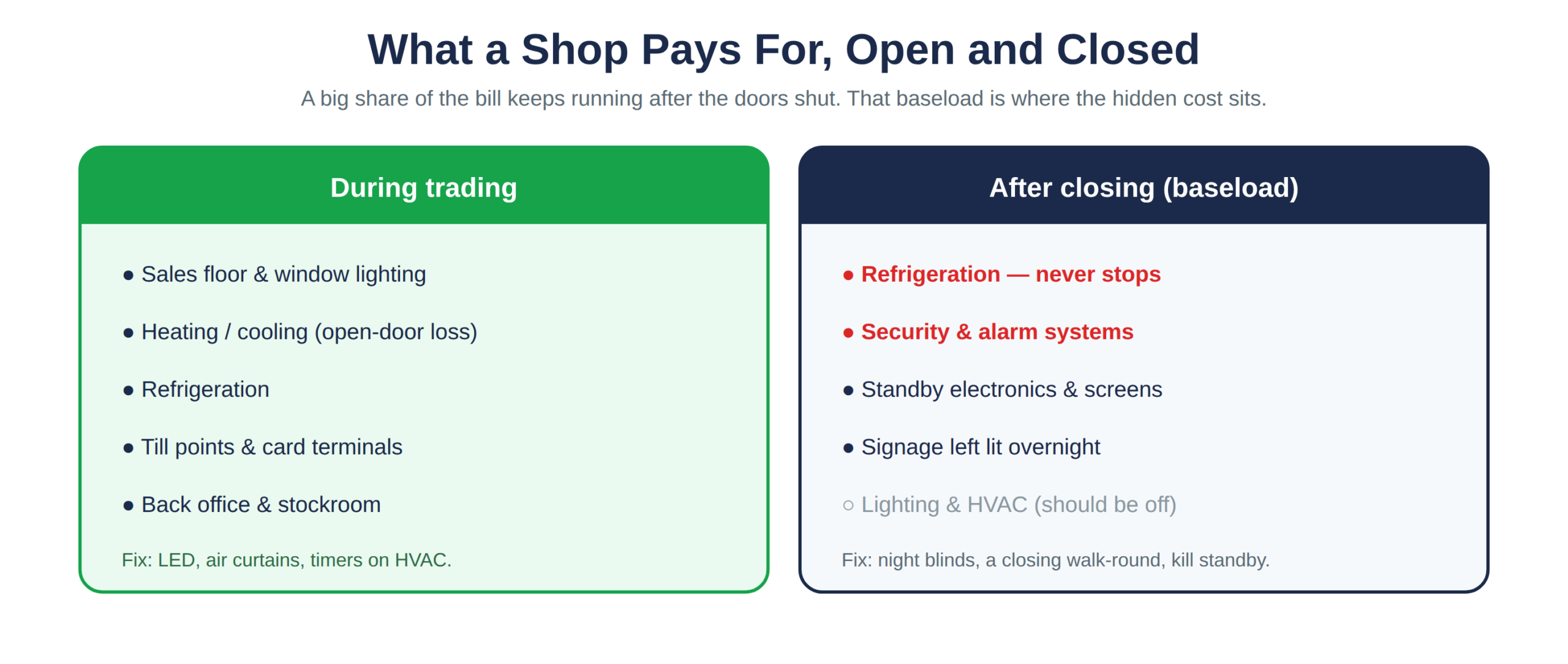
Refrigeration, security systems, alarm panels and standby electronics all keep drawing power after the shop shuts, which means overnight and Sunday closure baseload can be a meaningful share of a retail energy bill.
Comparing baseload across sites
Walk the store after closing at least once and note what is still on. Till screens, back-office computers and printers left on standby are common and easy to fix.
For multi-site retailers, comparing baseload across branches often reveals one or two stores running well above the norm. An out-of-contract rate can run 40% to 80% above a negotiated deal, so our guide to business energy contracts is worth reading before renewal.