
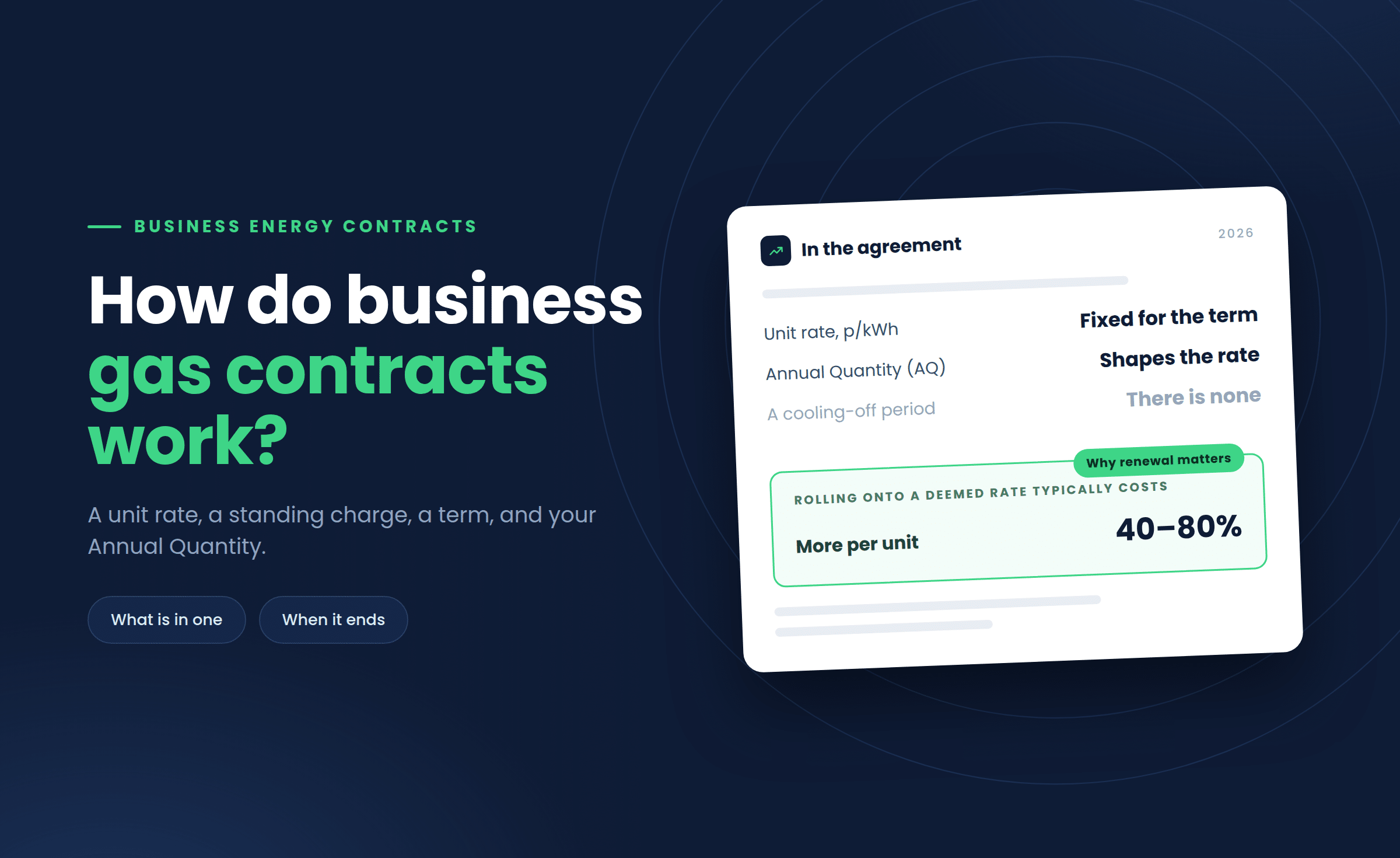
A business gas contract is a fixed-term agreement, usually one to three years, that locks in a unit rate and standing charge with a supplier. Unlike household tariffs, there is no statutory cooling-off period once you have signed, and the price is fixed for the whole term regardless of what happens to wholesale gas prices.
Business owners moving from a domestic mindset are often caught out by this. At home you can switch tariff whenever you like and cancel within 14 days if you change your mind.
Business contracts do not work that way. They are commercial agreements between two companies, and once signed they are binding for the agreed term.
That rigidity cuts both ways: it protects you from mid-term price rises, but it also locks you in if a cheaper deal appears later. Consider this business gas contract explained from the ground up.
What’s written into a commercial gas agreement?
A commercial gas agreement sets out your unit rate in pence per kWh, a daily standing charge, your contract length, and the renewal or notice terms. It also references your Annual Quantity (AQ), the supplier’s estimate of how much gas you will use over the year.
The core contract elements
Get the AQ badly wrong and your rate can be mispriced, so check it against your actual last 12 months of usage rather than accepting the supplier’s estimate blind.
| Contract element | What it means |
|---|---|
| Unit rate (p/kWh) | The price charged for each unit of gas you actually consume |
| Standing charge (p/day) | A fixed daily fee for meter and network costs, charged regardless of usage |
| Contract length | Usually 1, 2 or 3 years, fixed for the whole term |
| Annual Quantity (AQ) | The supplier’s estimate of your yearly consumption, used to set your rate |
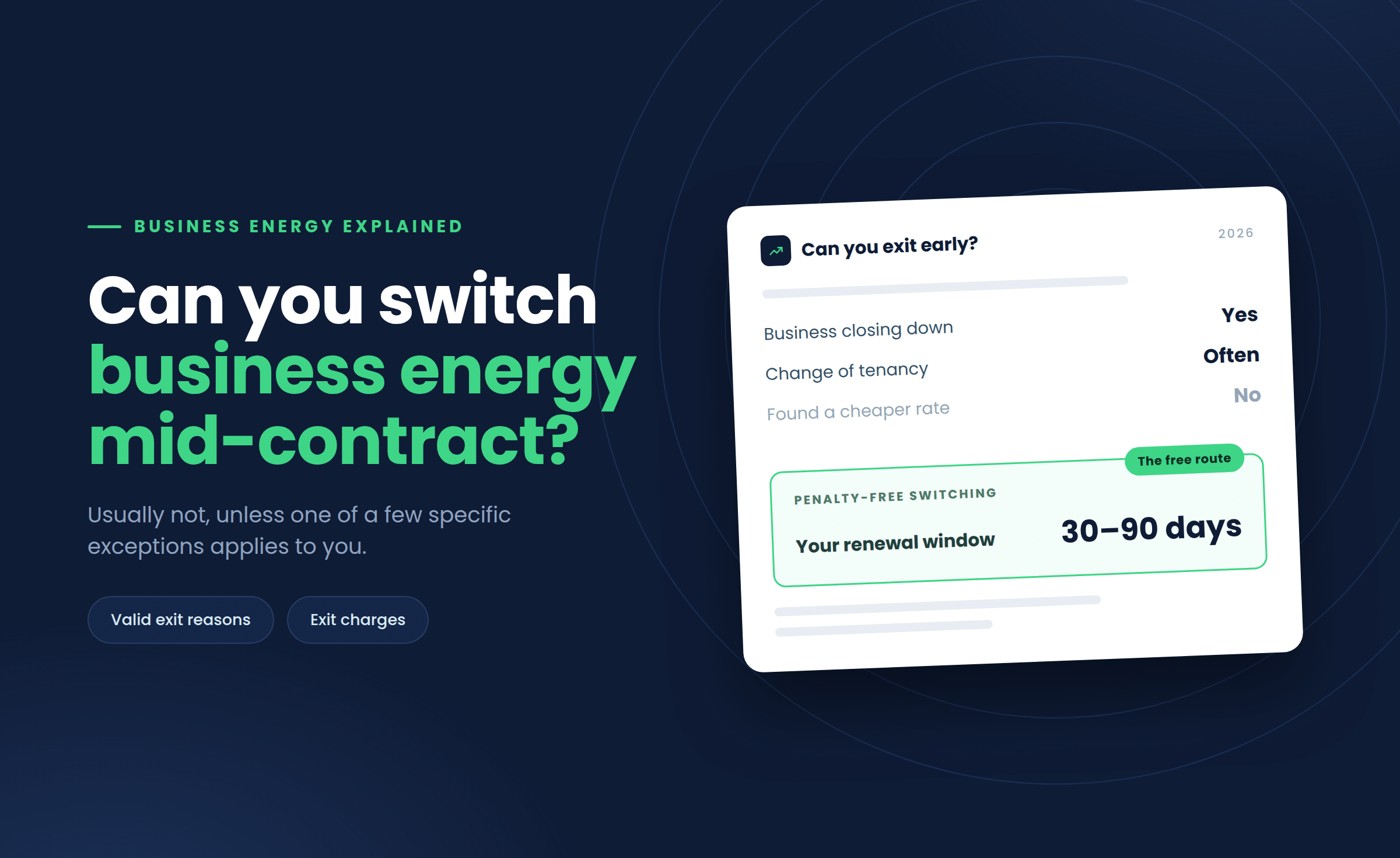
| Renewal window | Often 30 to 90 days before expiry, when you can switch without penalty |
How long do business gas contracts typically run?
Most business gas contracts run for one, two or three years, with three-year deals usually offering the lowest unit rate in exchange for a longer commitment. There is no single right answer; it depends on your appetite for locking in.
Choosing a term
- 1-year contracts: more flexibility, generally a slightly higher unit rate.
- 2-year contracts: a common middle ground for stable-usage businesses.
- 3-year contracts: typically the cheapest rate, but you are committed through any market swings.
If your business is growing fast, expanding sites, or expects usage to change, a shorter term often makes more sense than chasing the lowest headline rate.
How is the rate in your contract set?
Your rate reflects wholesale gas prices at the point you sign, your usage band, and non-commodity costs like the Climate Change Levy added on top regardless of supplier. Two businesses signing on the same day can still end up with different rates if their usage bands differ.
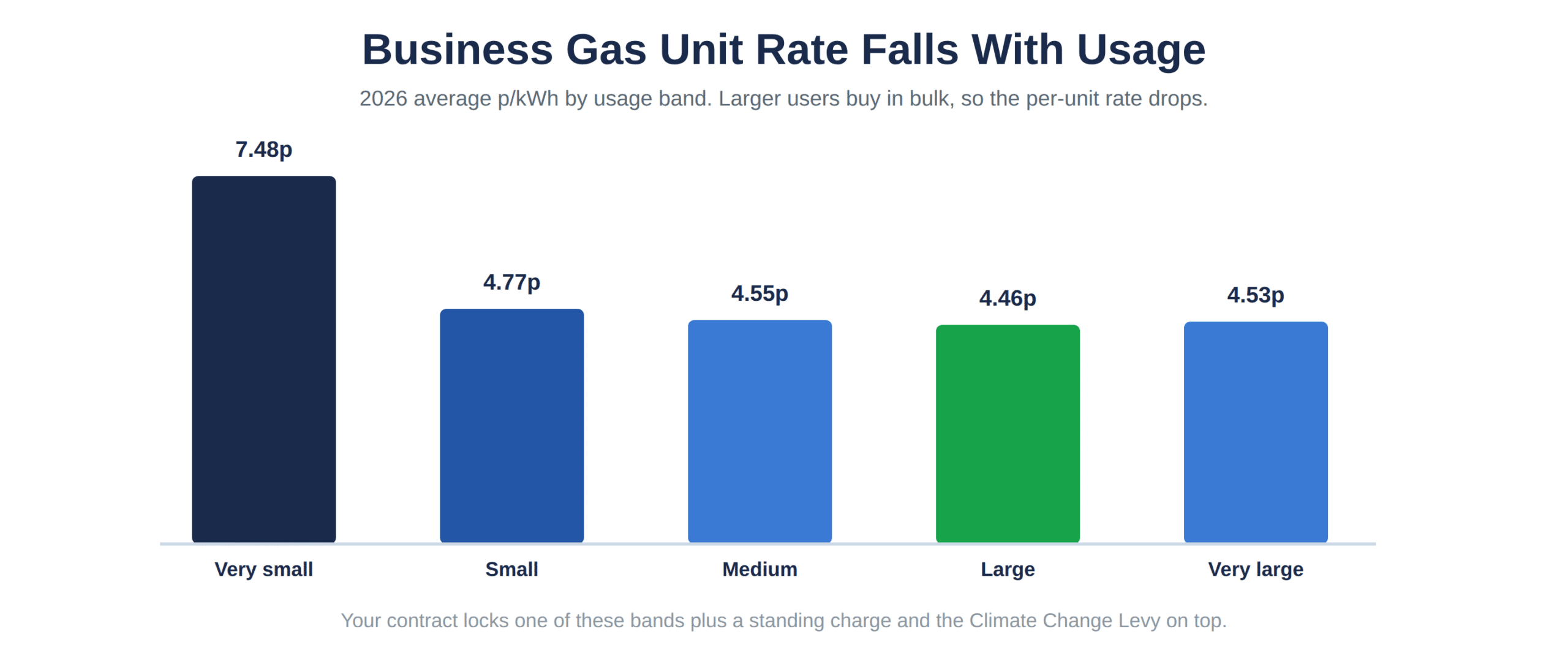
Climate Change Levy and VAT
The Climate Change Levy is added on top of the unit rate unless your business holds a Climate Change Agreement or qualifies for an exemption, as the government’s CCL guidance sets out.
VAT is charged separately, usually at 20%, though some businesses qualify for the reduced 5% rate. Our guide to VAT on business energy bills covers the qualifying criteria, and these bands come from DESNZ data.
What happens when a business gas contract ends?
If you do not arrange a renewal, most suppliers automatically roll you onto a deemed or out-of-contract rate. These rates are typically 40% to 80% higher than a negotiated deal, with no fixed term protecting you from further increases.
The deemed-rate trap
Deemed contracts exist for a reason: gas cannot simply stop flowing because the paperwork lapsed. But that convenience comes at a real cost if you leave it running, and our guide to deemed contracts explains how the rate is calculated and how quickly you can get off one.
Timing matters, so our guide to what happens when your contract ends and to business energy renewals both cover the window you need to act within.
Can you cancel a business gas contract early?
Only with the supplier’s agreement or by paying an early termination charge, since there is no cooling-off period for commercial gas agreements. Some contracts allow exit in specific circumstances, such as closing the business or a change of tenancy at the supply address.
Moving premises or change of tenancy
If you are moving premises rather than closing down, our guide to change of tenancy explains what you are liable for at the old address and how the new occupier’s contract is affected.