
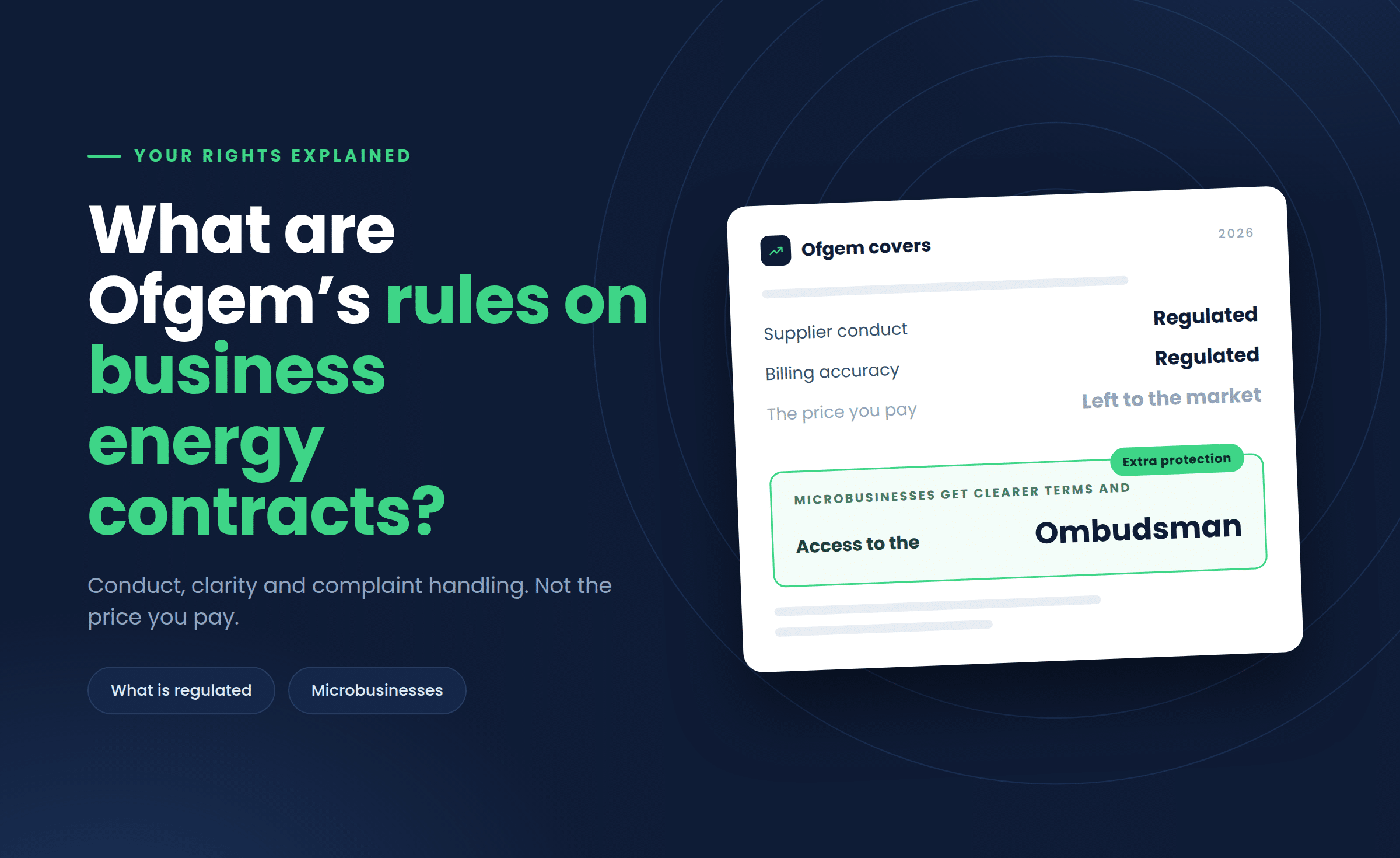
Ofgem regulates business energy through supplier licence conditions and the Retail Energy Code, covering how suppliers communicate contracts, handle complaints and treat microbusiness customers, but it does not set or cap the prices businesses pay.
Business energy regulation is quieter than the household equivalent, mostly because there is no headline price cap making the news. That does not mean the market is unregulated.
Ofgem sets licence conditions every supplier must meet to trade, from how contracts are presented to how complaints are handled. The Retail Energy Code sits underneath, governing how market participants interact.
Knowing where the rules apply, and where the market is left to competition, tells you what protection you can rely on and what you must negotiate yourself. It sits alongside the terms in our business energy contracts guide.
This guide covers Ofgem’s core role, the rules that protect microbusinesses, and what to do if a supplier breaks them.
What does Ofgem regulate in business energy?
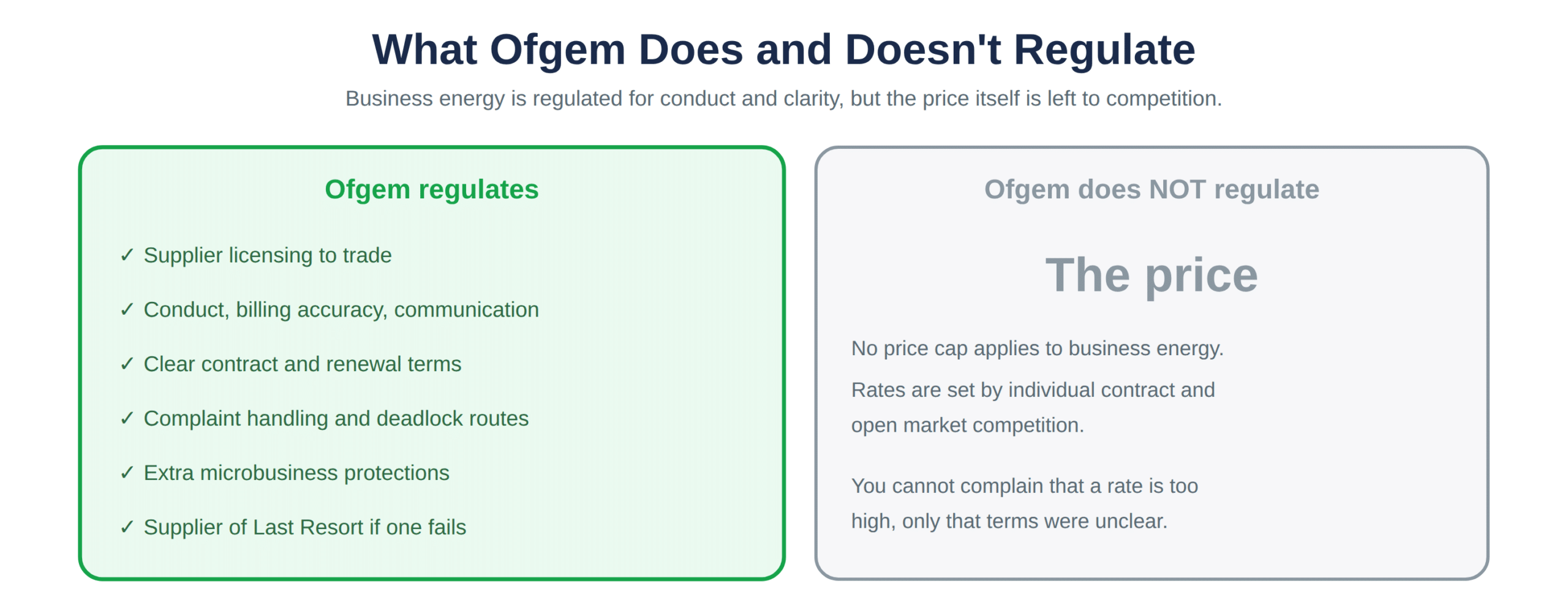
Ofgem sets and enforces supplier licence conditions covering conduct, complaint handling and billing accuracy, but it leaves pricing itself to open market competition for business customers.
Why business prices aren’t capped
Every company supplying gas or electricity needs an Ofgem licence, with standard conditions attached covering moves in and out of a property, correcting billing errors, and minimum communication standards.
- Supplier licensing: every supplier must hold and maintain an Ofgem licence.
- Conduct rules: standards for how suppliers communicate, bill and handle complaints.
- No price regulation: business rates are set by contract, not by Ofgem.
What protections exist for microbusinesses specifically?
Microbusinesses, broadly under 10 employees and lower usage thresholds, get extra protections under the Retail Energy Code, including clearer contract terms, commission disclosure from brokers, and Energy Ombudsman access.
Why smaller businesses get more cover
Ofgem recognised that a five-person shop does not have the negotiating power of a large industrial user, so certain protections were built in for smaller businesses. Our guide to micro business energy shows how to check whether you qualify.
Larger businesses are treated as capable of negotiating commercially, so they receive fewer automatic protections. The trade-off is that they also have more room to negotiate terms themselves.
If you are unsure which side of the line your business sits on, the employee count and usage thresholds are the deciding test. Checking that first tells you which protections you can actually rely on.
| Protection | Microbusiness | Larger business |
|---|---|---|
| Broker commission disclosure | Yes | Not automatic |
| Energy Ombudsman access | Yes | Not automatic |
| Clear contract terms | Yes | Yes |
| Negotiating position | Limited | Strong |
What are suppliers required to tell you about a contract?
Suppliers must give you clear information on your rate, contract length, renewal terms and how to end the contract, presented in a way you can reasonably understand before signing.
What a compliant contract makes clear
This does not guarantee a cheap rate, but it does mean the terms should not be buried or deliberately confusing. It is one of the more practical parts of Ofgem’s licence conditions.
It is worth reading the renewal and notice terms in particular before signing. Those two clauses cause more business energy disputes than the headline rate ever does.
- Rate detail: the unit rate and standing charge, including whether CCL is included.
- Contract length: and what happens at the end of it.
- Notice period: required to switch or end the contract.
- Exit fees: any charges for leaving before the term ends.
Our guide to deemed and rollover contracts explains what happens if you miss the notice window, one of the most common disputes these rules are designed to reduce.
What happens if a supplier breaks Ofgem’s rules?
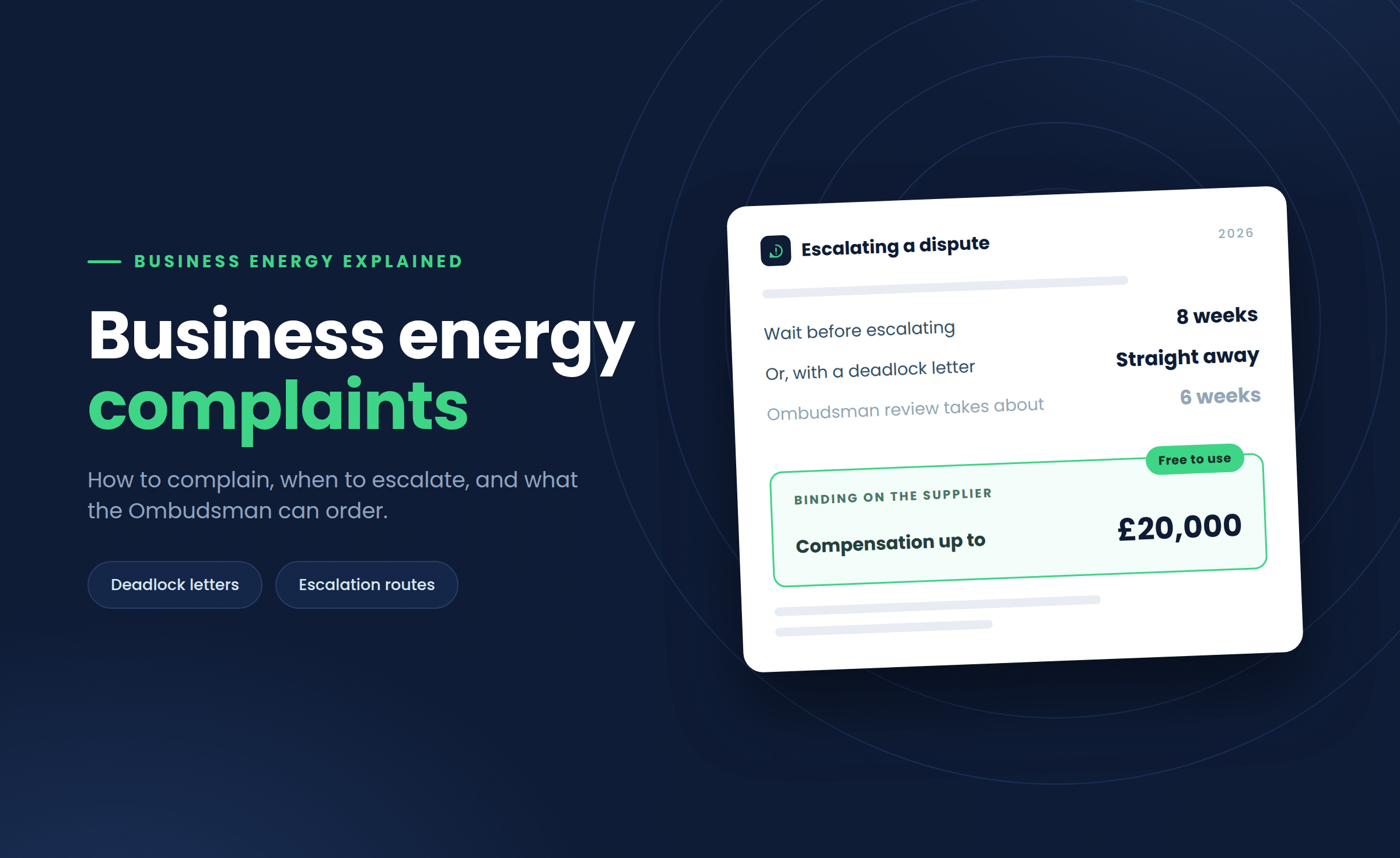
You raise it with the supplier first, and if it is not resolved within eight weeks, or you get a deadlock letter, you can escalate to the Energy Ombudsman.
Ofgem sets rules, the ombudsman resolves disputes
Ofgem itself does not typically investigate individual disputes. It sets the rules and takes enforcement action against systemic problems, while the Energy Ombudsman is the practical route for an unresolved complaint, as our business energy complaints guide sets out.
- Raise it first: with the supplier or broker directly.
- Wait for the response: their final answer, or eight weeks, whichever comes first.
- Escalate: to the Energy Ombudsman if still unresolved.
If a supplier fails financially rather than mishandling a complaint, that is a different process called Supplier of Last Resort, covered in our guide to failed energy companies.
How does the retail energy code fit in?
The Retail Energy Code governs how suppliers, network operators and other participants exchange data and handle switching, sitting underneath Ofgem’s licence conditions as the operational rulebook for the market.
The plumbing behind the rules
It is less visible than the headline licence conditions, but the Retail Energy Code is what makes switching, metering data and settlement work consistently. Bodies like Elexon and Xoserve operate within this framework.
You will not need to read it yourself, but it is worth knowing it exists as the plumbing behind the rules that do affect you. The Ofgem licence conditions remain the layer you can rely on directly.