
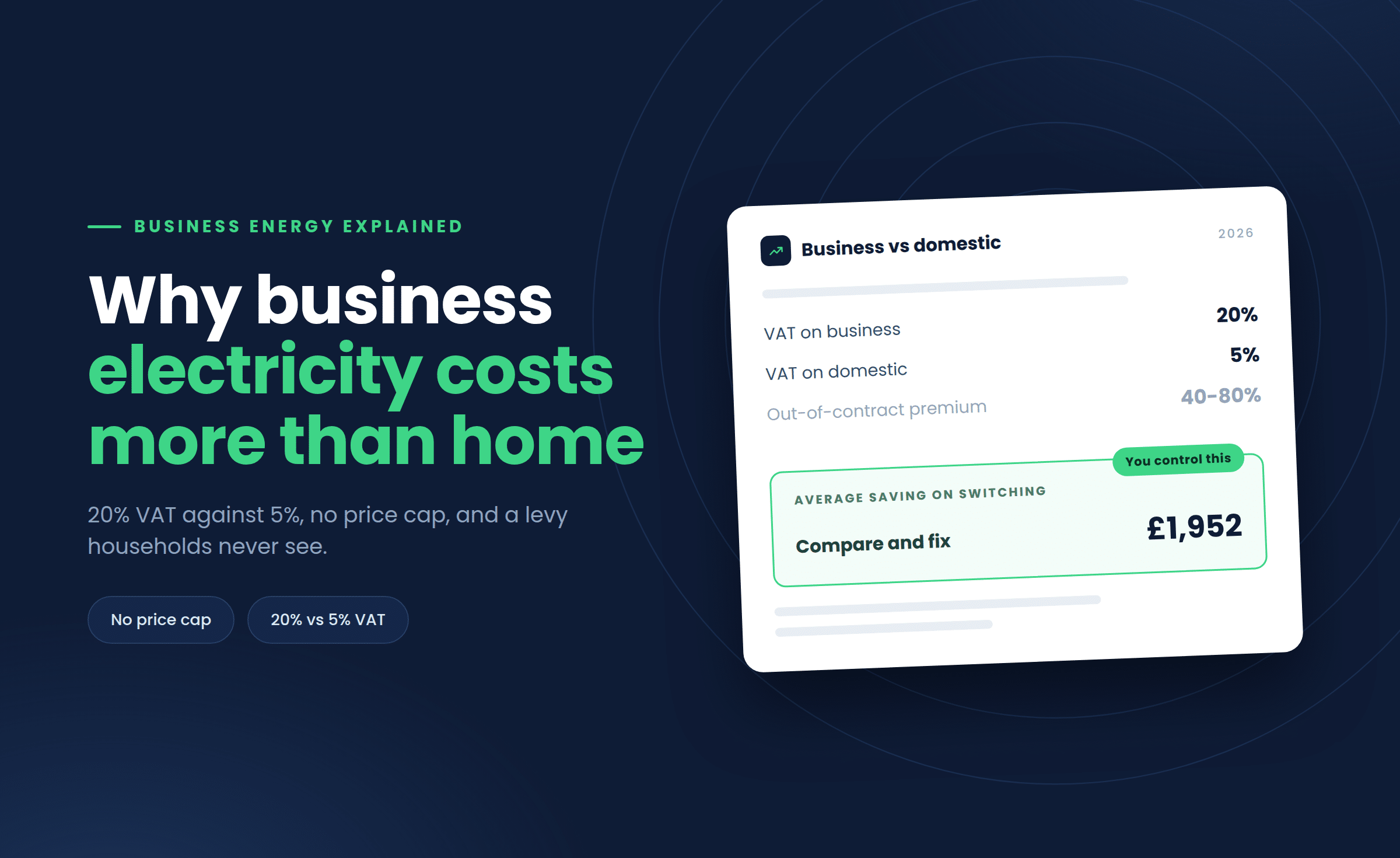
Business electricity is expensive mainly because of higher VAT than domestic supply, no price cap protection, network charges set by regional DNOs, the Climate Change Levy, and wholesale gas prices that remain well above pre-2021 levels.
If you run a business, you have probably noticed your business electricity costs more per unit than a friend’s household bill, even allowing for higher usage. That is not a billing accident: business energy runs under completely different rules.
There is no equivalent of the household price cap, VAT is higher, and contracts work differently. This guide walks through the real cost drivers, and where they sit against domestic supply, which our guide to business versus domestic energy explores in more detail.
How much does business electricity cost right now?
The UK average business electricity rate is 24.14p/kWh, still around 60% higher than five years ago, though it has broadly levelled off over the past year.
Average rate by business size
The table below breaks the current average down by size, from DESNZ price data. For the full picture, see our guides to current business electricity rates and the price per kWh.
| Business size | Annual usage | Rate (p/kWh) |
|---|---|---|
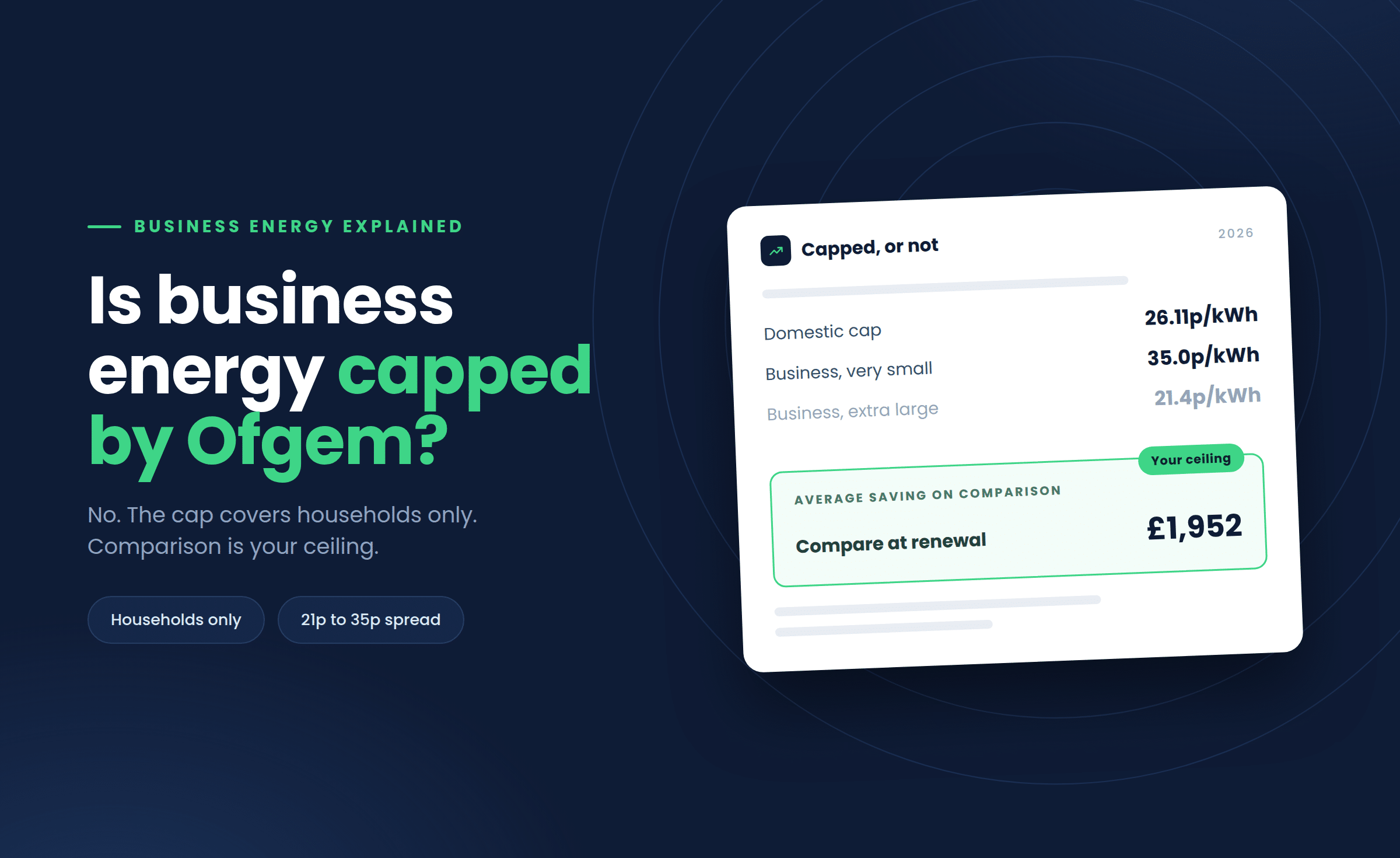
| Very small | 0 to 20 MWh | 35.02p |
| Small | 20 to 499 MWh | 28.76p |
| Medium | 2,000 to 19,999 MWh | 25.00p |
| Large | 20,000 to 69,999 MWh | 23.93p |
| Extra large | Over 150,000 MWh | 21.42p |
Unlike household energy, where one cap applies broadly, these rates are negotiated individually. Two firms using near-identical amounts of electricity can pay noticeably different unit rates.
The spread across sizes is wide, from about 35p for the smallest sites to near 21p for the largest. A small business simply cannot buy at the volume that earns the sharpest rates, which is part of why its bill feels so steep.
Why doesn’t business electricity have a price cap?
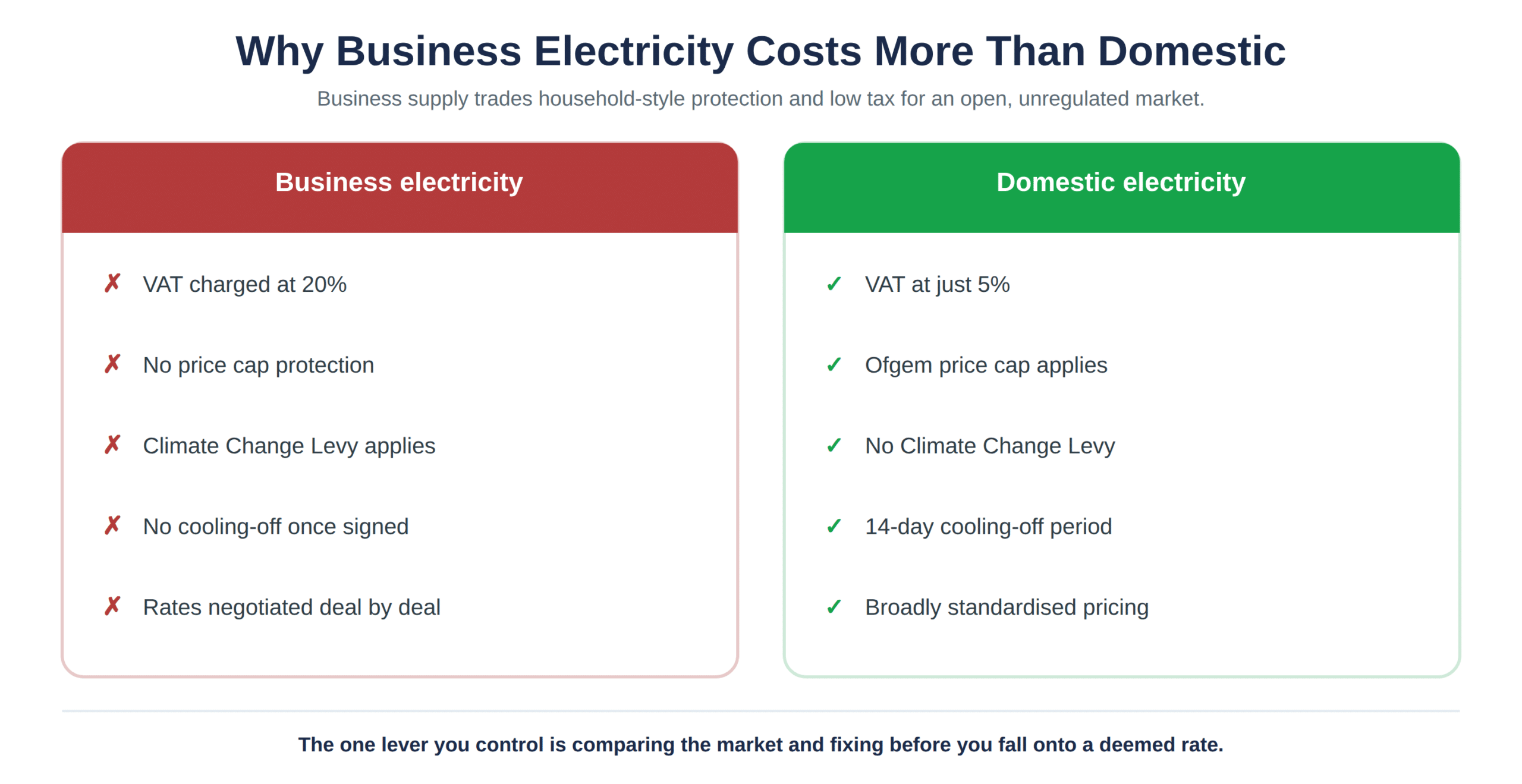
Ofgem’s energy price cap only applies to domestic customers on default tariffs, so business electricity is unregulated on price and suppliers can set rates freely within a competitive market.
This is the single biggest structural reason business electricity feels less predictable than household bills, as our guide on whether business prices are capped explains. There is no regulatory ceiling protecting you if you end up on a poor deal or a deemed rate.
What no cap means for you
It is also why an out-of-contract or deemed rate can run 40% to 80% higher than a negotiated deal. Without a cap, suppliers price default contracts steeply to nudge you onto a fixed term.
It is a genuinely different market: business energy contracts have no statutory cooling-off period once signed, and switching is entirely down to you actively comparing and choosing a deal.
What taxes and levies push the price up?
Business electricity carries standard-rate VAT at 20% for most companies, against the reduced 5% domestic rate, plus the Climate Change Levy, an environmental tax that does not apply to household bills at all.
The Climate Change Levy is charged per kWh on top of your unit rate, funding efforts to cut carbon from business energy use. Some energy-intensive sectors reduce it through a Climate Change Agreement with DESNZ.
- VAT: 20% standard rate, or 5% for qualifying low usage or charities.
- Climate Change Levy: a per-kWh charge on most business electricity and gas.
- Climate Change Agreements: can cut CCL liability for eligible sectors, often via the Energy Intensive User Group.
- UK ETS: affects large industrial and generation costs indirectly.
Getting your VAT treatment right
HMRC administers VAT on energy, and getting the rate wrong is more common than you would think, especially for mixed-use premises. It is worth checking your VAT on business energy treatment against HMRC’s fuel and power guidance if you have not in a while.
Why do network charges vary so much?
Distribution charges, known as DUoS, are set by your regional DNO, so two businesses on identical usage but different sides of the country can pay noticeably different network costs.
The UK is split into distribution regions covered by operators like UK Power Networks, SSEN and Northern Powergrid. Each sets its own charges, subject to Ofgem’s price controls.
On top of DUoS sit TNUoS transmission charges and BSUoS balancing costs, the latter managed by the National Energy System Operator. Both feed into the unit rate you are quoted, usually already baked in for smaller businesses.
Why time and location matter
- Peak-hour demand: heavy loads during peak network hours can raise effective costs.
- Location: rural or lower-density areas sometimes carry higher per-unit network charges.
- Half-hourly settlement: gives a more accurate, sometimes more favourable, picture for larger sites.
What can you do to bring the cost down?
You cannot change VAT or network charges, but you can shop the market properly, fix your rate before renewal, and check whether you qualify for any reduced-rate schemes.
Which cost drivers you can actually move
The table below sorts the main drivers by how much say you have over each. Most are fixed, but the two you can move are worth real money.
| Cost driver | What it is | Can you influence it? |
|---|---|---|
| Wholesale energy | The market price of power | Partly, by timing your fix |
| Network charges | Delivery costs set by region | No, fixed by your DNO |
| Climate Change Levy | A per-kWh green tax | Only via a CCA |
| VAT | 20%, or 5% if eligible | Only via eligibility |
| Supplier margin | The supplier’s own pricing | Yes, by comparing the market |
Where you actually have control
-
Compare before renewal
Check a panel of suppliers ahead of your renewal date, not after.
-
Check your VAT
Confirm whether you qualify for the reduced 5% rate.
-
Ask about a CCA
If you are in an energy-intensive sector.
-
Never lapse onto a deemed rate
It is the most expensive way to buy electricity.
Most of the expense is structural, but the controllable part is which supplier you are with and when you lock in. The businesses that pay least treat procurement as an ongoing task, not a once-every-few-years chore.