
Switching to a cheaper business energy plan comes down to five steps: gather a recent bill, compare live quotes across the market, choose the best fit for your usage, sign the new contract, and let the changeover run over 4 to 6 weeks.
Most owners already suspect they are overpaying. Between the jargon on a bill and the reluctance to spend an afternoon on the phone, that suspicion often just sits there for another year.
The process to reduce a business energy tariff is far less involved than it looks. It is rarely about one secret deal, and far more about the right fit for your usage, contract length and meter type, which our guide to a good unit rate helps you judge.
What is the fastest way to find a cheaper business energy plan?
A live comparison against a panel of suppliers, using your actual usage figures, is the fastest and most reliable way, since guessing from advertised headline rates almost always misleads.
What to have ready
Headline rates rarely reflect what you will pay, because your real rate depends on usage band, region, meter type and contract length. A comparison built on your own numbers cuts through that.
- A recent bill: from the last three months.
- Your usage: rough annual kWh for electricity and gas.
- The whole panel: compare across suppliers, or read how to switch supplier for the mechanics.
How do you compare business energy quotes properly?
Compare the full contract, not just the headline unit rate: standing charge, contract length, exit terms and whether the rate is fixed or variable all affect what you actually pay.
| What to compare | Why it matters |
|---|---|
| Unit rate (p/kWh) | The core cost per unit, varies by usage band |
| Standing charge (p/day) | A fixed daily cost, regardless of usage |
| Contract length | Longer terms can lock a rate but reduce flexibility |
| Fixed vs variable | Fixed protects against rises, variable can fall with the market |
| Exit terms | Set the cost if you need to leave early |
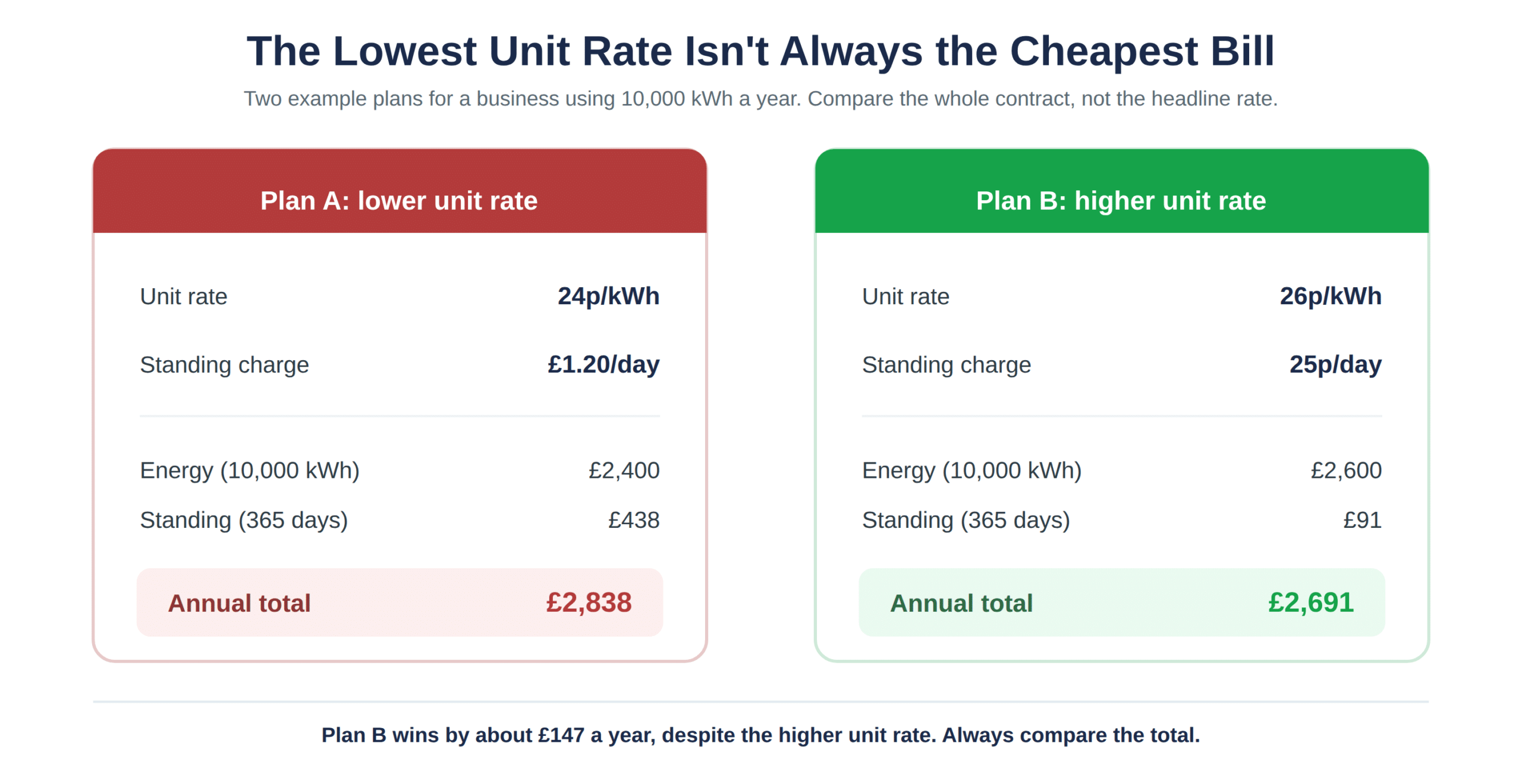
Fixed or variable, which reduces your tariff more reliably?
A fixed rate locks in certainty and suits most small and medium businesses. The best 2026 rates start from around 26p/kWh electricity and 8p/kWh business gas, though a variable rate can fall further if wholesale prices drop, which is a harder bet to call.
Should you use a broker or compare directly?
Both routes can reduce your tariff: a broker can save time on larger or complex sites, while comparing directly suits most small and medium businesses with a single, simple meter.
How business energy brokers get paid
Our guide to business energy brokers sets out how they are paid, what a letter of authority authorises, and when using one genuinely makes sense. Whichever route you take, the underlying supplier panel is broadly the same.
The one thing to watch with a broker is commission. It is usually built into the unit rate rather than charged separately, so always ask how a broker is paid before you sign.
What information do you need before switching?
Your MPAN or MPRN, a recent bill showing usage, your business name and address, and your current contract end date are the essentials, and having them ready cuts the process to minutes.
Your switching checklist
- MPAN or MPRN: found on any recent bill.
- Usage in kWh: your EAC or AQ, measured in kWh.
- Contract end date: and any notice period.
- Business details: name, trading address, and a letter of authority if using a broker.
What happens once you’ve chosen a new plan?
You sign the new contract, your new supplier registers the switch against your meter, and the changeover completes within 4 to 6 weeks, with supply never interrupted at any point.
No interruption to supply
A short objection window applies if you switch close to your existing term, during which your old supplier can query it. This rarely blocks a genuine renewal-window switch, and our guide on how long a switch takes covers the timeline in full.
Once live, your first bill under the new contract reflects the agreed rate from the changeover date. A final bill from your old supplier arrives separately, based on a closing meter read, and Ofgem’s business energy advice sets out your rights if anything is disputed.
There is nothing to install and no engineer visit. The switch is purely an administrative and billing change between your old and new supplier.
How much could switching save you?
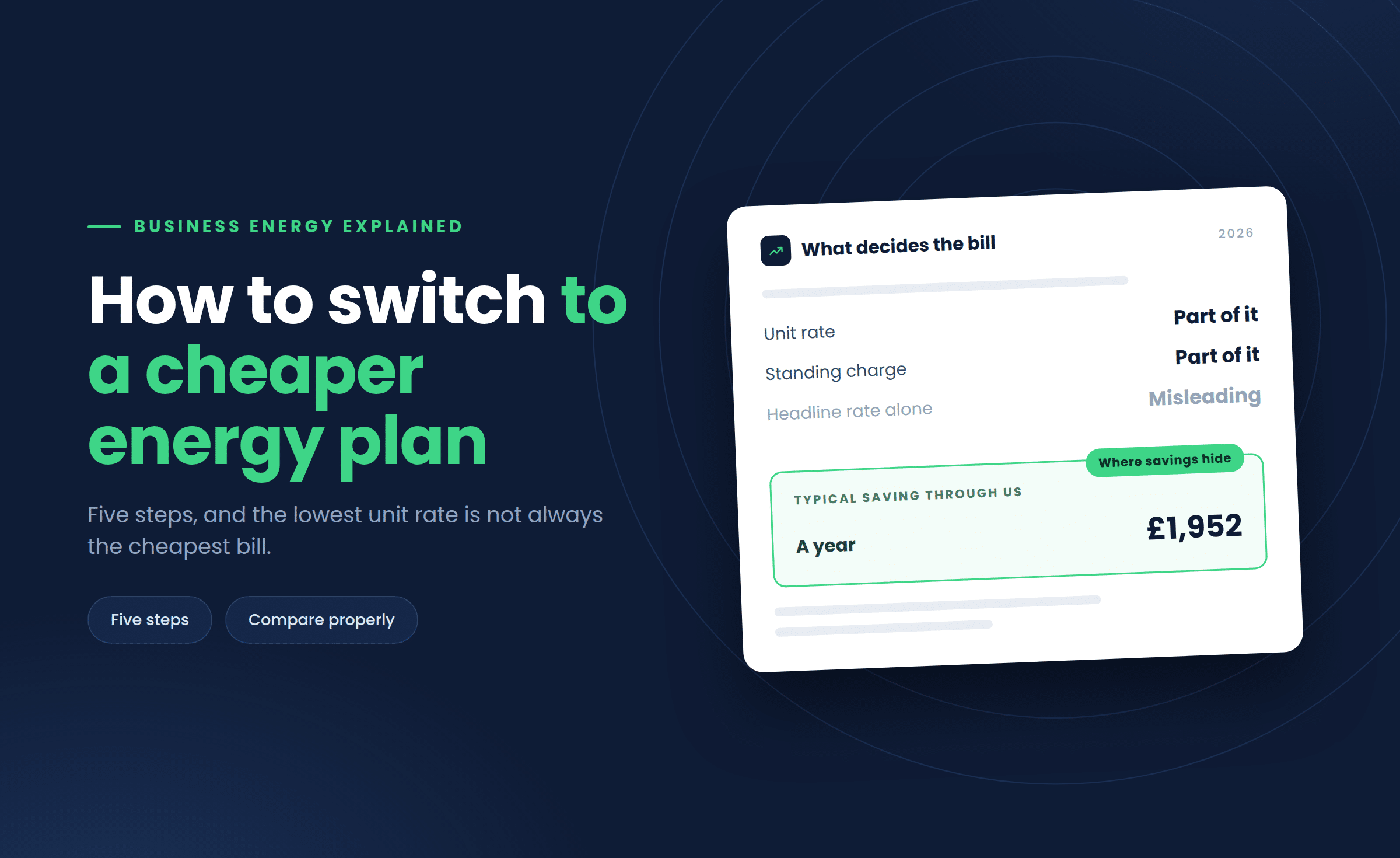
Businesses that switch through Utility Saving Expert save an average of £1,952 a year, with the exact figure depending on how far your current rate sits from the market and whether you were on an out-of-contract rate.
Indicative saving by size
| Business size | Typical annual spend | Saving potential |
|---|---|---|
| Small (~10,000 kWh elec, ~2,500 kWh gas) | £3,290 | Meaningful if currently out of contract |
| Medium (~25,000 kWh elec, ~10,000 kWh gas) | £7,129 | Larger absolute saving on volume |
These are indicative house averages, from DESNZ data, not a guaranteed quote. Timing it well, as our best time to switch guide shows, is what turns the average into your saving, and Ofgem’s switching rules protect you through the process.